Morgan Stanley (MS): How its customer relationships generate revenue and where risk concentrates
Morgan Stanley operates as a global investment bank and wealth manager that monetizes through three core channels: Institutional Securities (underwriting, M&A advisory, trading and financing), Wealth Management (advisory, custody, lending and asset management fees) and Investment Management (fund fees and distribution). Revenue flows from transaction fees, underwriting spreads, advisory retainers, asset management fees and balance-sheet financing—a model that couples fee volatility in capital markets with recurring fee income from AUM and wealth management. For investors evaluating MS’s customer footprint, the firm’s role alternates between principal, arranger and advisor across diversified counterparties and geographies; that mix shapes both upside during market cycles and exposure during funding stress. Visit the firm homepage for an executive snapshot: https://nullexposure.com/
Market-facing relationships in the provided results
- Alliance Laundry Systems (ALH): Morgan Stanley acted as the book-running manager for ALH’s IPO, handling marketing and pricing responsibilities for the offering (source: stocktitan report, March 2026 — https://www.stocktitan.net/news/ALH/alliance-laundry-systems-announces-public-filing-of-registration-k76x53ki8ewm.html).
- Suzano (SUZ): Suzano named Morgan Stanley among broker-intermediaries for its buyback funding plan, indicating MS’s role as a distribution and underwriting counterparty (source: TS2.Tech, March 2026 — https://ts2.tech/en/suzano-stock-holds-steady-premarket-after-13-5-jump-on-buyback-plan-and-2025-results/).
- Greentree Hospitality Group (GHG): Morgan Stanley served as an underwriter for GHG’s IPO, sharing underwriting risk and distribution duties with other banks (source: MarketBeat, March 2026 — https://www.marketbeat.com/instant-alerts/greentree-hospitality-group-ltd-sponsored-adr-nyseghg-short-interest-up-237-in-march-2026-03-30/).
- Atlantic Union Bank (AUB): Morgan Stanley & Co. LLC acted as financial advisor to Atlantic Union in its regional merger activity, providing strategic and valuation advice (source: WTOP, Oct 2024 filing referenced in dataset — https://wtop.com/virginia/2024/10/atlantic-union-acquires-maryland-based-sandy-spring-bank-in-big-regional-merger/).
- Aurora (AUR): Morgan Stanley was joint book-running manager on Aurora’s upsized public offering, participating in syndicate pricing and allocation (source: The Robot Report, press release — https://www.therobotreport.com/aurora-closes-upsized-public-offering-gross-proceeds-483m/).
- Ares Commercial Real Estate (ACRE): ACRE extended a financing arrangement with Morgan Stanley, moving maturity to 2029—MS is the lender/credit counterparty (source: Bitget/SEC filing summary, May 2026 — https://www.bitget.com/amp/news/detail/12560605319027).
- Asana (ASAN): For Asana’s NYSE direct listing, Morgan Stanley served as a financial advisor rather than an underwriter, advising on listing strategy for a non-firm-commitment process (source: Renaissance Capital coverage, IPO historical note — https://www.renaissancecapital.com/IPO-Center/News/70963/Collaboration-software-unicorn-Asana-selects-September-30-for-NYSE-direct-l).
- Acrivon Therapeutics (ACRV): Morgan Stanley was part of the underwriting syndicate for Acrivon’s IPO, providing distribution and underwriting capabilities (source: MarketBeat, Jan–May 2026 reporting — https://www.marketbeat.com/instant-alerts/acrivon-therapeutics-ltd-sponsored-adr-nyseghg-short-interest-up-237-in-march-2026-03-30/).
- Shoulder Innovations (SI): Morgan Stanley was one of the joint bookrunners on SI’s proposed offering, executing syndicate placement and pricing (source: Renaissance Capital/IPO Center, 2025–2026 filings — https://www.renaissancecapital.com/IPO-Center/News/112339/Shoulder-surgery-focused-medtech-Shoulder-Innovations-sets-terms-for-$100-m).
- Noble Corporation (NE): Morgan Stanley & Co. LLC acted as lead financial advisor and provided committed financing in Noble’s acquisition, combining advisory and committed-capital exposure (source: CityBiz report, March 2026 — https://www.citybiz.co/article/565321/noble-corporation-to-acquire-diamond-offshore-drilling/).
- Thermon (THR): Morgan Stanley served as financial advisor to Thermon on a strategic transaction, supplying M&A advisory services (source: CityBiz, March 2026 — https://www.citybiz.co/article/810144/ceco-environmental-and-thermon-group-to-merge/).
- Apartment Investment & Management (AIV): Morgan Stanley was engaged as financial advisor during a board-led strategic review that resulted in a plan of sale and liquidation, reflecting advisory engagement across portfolio monetizations (source: corporate proxy filings, FY2026 — https://www.stocktitan.net/sec-filings/AIV/defm14a-apartment-investment-management-co-merger-proxy-statement-66f5f08a1daf.html).
- TeraWulf (WULF): Morgan Stanley acted as lead bookrunning manager for Terawulf’s equity offering and MS Senior Funding served as administrative agent and lead arranger for its facility—MS covered both capital markets distribution and leveraged financing roles (source: Terawulf press releases and investor updates, May 2026 — https://investors.terawulf.com/news-events/press-releases/detail/136/terawulf-announces-pricing-of-upsized-common-stock-offering).
- Kyivstar (KYIV) / VEON: Morgan Stanley acted as a joint bookrunner and underwriter representative on Kyivstar’s secondary offering, handling international syndicate distribution (source: GlobeNewswire and related coverage, Feb 2026 — https://www.globenewswire.com/news-release/2026/02/03/3231297/0/en/Kyivstar-Group-Ltd-Announces-Closing-of-Secondary-Offering-of-Common-Shares.html).
- Bicara Therapeutics (BCAX): Morgan Stanley served repeatedly as a joint book-running manager for BCAX’s equity offerings, taking on marketing and underwriting responsibilities (source: GlobeNewswire and press filings, Feb–Mar 2026 — https://www.globenewswire.com/news-release/2026/02/25/3244229/0/en/bicara-therapeutics-announces-pricing-of-150-million-public-offering-of-common-stock-and-pre-funded-warrants.html).
- Blackstone Mortgage Trust (BXMT): MS participated as joint book-running manager on BXMT’s offerings, supporting capital markets distribution for mortgage REIT issuance (source: National Mortgage Professional, FY2021 filing cited — https://nationalmortgageprofessional.com/news/blackstone-mortgage-trust-announces-pricing-class-common-stock).
- Claros Mortgage Trust (CMTG): Morgan Stanley Bank amended repurchase and guaranty agreements with the trust, evidencing MS’s role as secured funding counterparty in repo/repurchase arrangements (source: TradingView summary, Jan 30, 2026 — https://www.tradingview.com/news/tradingview:5a47dd012c603:0-claros-mortgage-trust-signs-multiple-material-agreements/).
- KeyBank (KEY-P-J): Morgan Stanley & Co. LLC acted as lead structuring and financial advisor to KeyBank on a securitization and share repurchase/portfolio sale process (source: PR Newswire, 2021–2026 references — https://www.prnewswire.com/news-releases/key-sells-indirect-retail-auto-loan-portfolio-enters-into-accelerated-share-repurchase-program-301373639.html).
- Cullinan Management (CGEM): Morgan Stanley served as joint book-running manager for the offering, supporting IPO execution (source: stocktitan report, FY2021 — https://www.stocktitan.net/news/CGEM/cullinan-management-announces-closing-of-initial-public-offering-and-uh6ryuf6jo5e.html).
- Venture Global LNG (VG): Morgan Stanley acted as exclusive financial advisor on a major equity investment in Calcasieu Pass LNG, delivering transaction advisory and structuring (source: PR Newswire, 2019 transaction referenced — https://www.prnewswire.com/news-releases/venture-global-lng-and-stonepeak-infrastructure-partners-announce-1-3-billion-equity-investment-in-calcasieu-pass-lng-export-facility-862591746.html).
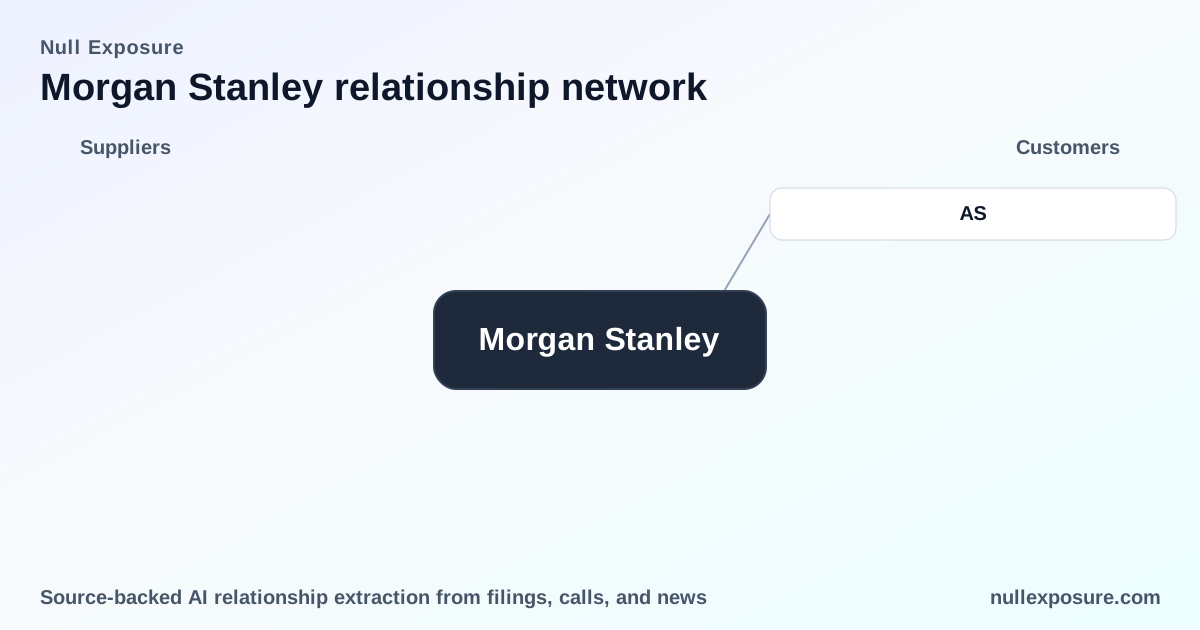
- Amer Sports (AS): Morgan Stanley acted as co-lead underwriter on a follow-on equity offering, providing distribution for a large follow-on placement (source: SimplyWall.St summary, FY2026 — https://simplywall.st/stocks/us/consumer-durables/nyse-as/amer-sports/news/does-amer-sports-as-debt-buyback-with-new-equity-mark-a-turn/amp).
- Portillo’s (PTLO): Morgan Stanley acted as the sole underwriter for a synthetic-secondary offering, a single-bank underwriting execution (source: GlobeNewswire, FY2023 filing — https://www.globenewswire.com/news-release/2023/03/08/2622633/0/en/portillo-s-inc-announces-pricing-of-offering-of-class-a-common-stock-in-synthetic-secondary-transaction.html).
- Netskope (NTSK): Morgan Stanley was lead book-running manager on Netskope’s IPO, reflecting MS’s role on large technology IPOs (source: MLQ.ai and broader coverage, FY2025–2026 — https://mlq.ai/news/netskope-ipo-shares-begin-trading-on-nasdaq-at-1900-per-share/).
- Personalis (PSNL): Morgan Stanley acted as underwriter on Personalis’s IPO, joining other banks in the syndicate (source: MarketBeat alert, Mar 2026 — https://www.marketbeat.com/instant-alerts/personalis-inc-nasdaqpsnl-receives-average-recommendation-of-moderate-buy-from-analysts-2026-03-11/).
- Legence (LGN): Morgan Stanley served as a bookrunner on Legence’s upsized secondary offering among a large syndicate, supporting institutional distribution (source: GlobeNewswire, Apr 2026 — https://www.globenewswire.com/news-release/2026/04/09/3271441/0/en/Legence-Announces-Closing-of-Upsized-Secondary-Underwritten-Public-Offering-of-Class-A-Common-Stock-and-Full-Exercise-of-Underwriters-Option-to-Purchase-Additional-Shares.html).
- EXL Service (EXLS): Exl entered a $125m accelerated share repurchase with Morgan Stanley, making MS the repurchase counterparty and execution agent (source: Bitget/GlobeNewswire/Press releases, Mar 2026 — https://www.bitget.com/amp/news/detail/12560605271723).
- Core Scientific (CORZ): Morgan Stanley provided sizeable credit facilities and term loans to Core Scientific, directly financing its data-center expansion (source: TradingView and multiple newswire summaries, Mar 2026 — https://www.tradingview.com/news/tradingview:c04432d9945ad:0-core-scientific-expands-bridge-term-loan-by-500-million-to-1-0-billion-draws-full-amount/).
Operating constraints and what they imply for investors
- Counterparty breadth and roles. Company-level signals show MS serves governments, large institutions, small business and high-net-worth individuals across advisory, underwriting, distribution and credit. That diversity reduces single-sector dependence but concentrates exposure in capital-markets cycles where underwriting and advisory fees fluctuate.
- Geographic footprint. MS reports dominant Americas revenue with significant EMEA and APAC operations; North America is the primary revenue engine, but global mandates (EMEA/APAC) amplify cross-border advisory flow and regulatory footprint.
- Contracting posture and maturity. Many customer relationships are short-term commercial engagements (underwriting, M&A mandates, ASR contracts, financing facilities) and not long-dated committed retail contracts, which gives MS flexibility but generates fee volatility tied to market activity.
- Service criticality and concentration. MS frequently acts as lead/sole bookrunner or exclusive financial advisor—roles that create highly critical single-counterparty exposure for specific transactions and concentrated balance-sheet credit lines (e.g., Senior Funding bridge facilities).
- Segment mix drives margin stability. Wealth Management and Investment Management provide recurring fee income and balance-sheet assets; Institutional Securities produces episodic, high-margin but cyclical revenue.
Middle-of-article resource
- For a structured view of Morgan Stanley’s client relationships and transaction roles, the firm’s public filings and transaction press releases are consolidated at our research hub: https://nullexposure.com/
Bottom line for investors
- Morgan Stanley monetizes through underwriting/advisory fees, recurring asset-management fees and financing spreads. The firm’s customer relationships tilt toward transaction-led engagements that reward market strength and increase volatility in downturns; investors should weight MS’s durable wealth-management revenue against the cyclicality of Institutional Securities.