Morgan Stanley (MS‑P‑L): Dealflow Signals and What They Mean for Preferred Investors
Morgan Stanley is a global investment bank and wealth manager that monetizes through advisory fees, underwriting spreads, trading income, and recurring wealth‑management fees; holders of the MS‑P‑L preferred tranche capture a priority income claim on the firm’s capital structure while remaining exposed to the cyclicality of corporate finance. Recent media coverage highlights Morgan Stanley’s continuing role as advisor on several large, headline M&A assignments, underlining the bank’s access to scale transactions that drive uneven but meaningful fee spikes.
For a concise feed of relationship and deal signals, see Null Exposure: https://nullexposure.com/
Dealmaking signals that matter: headline advisory work in FY2025–early 2026
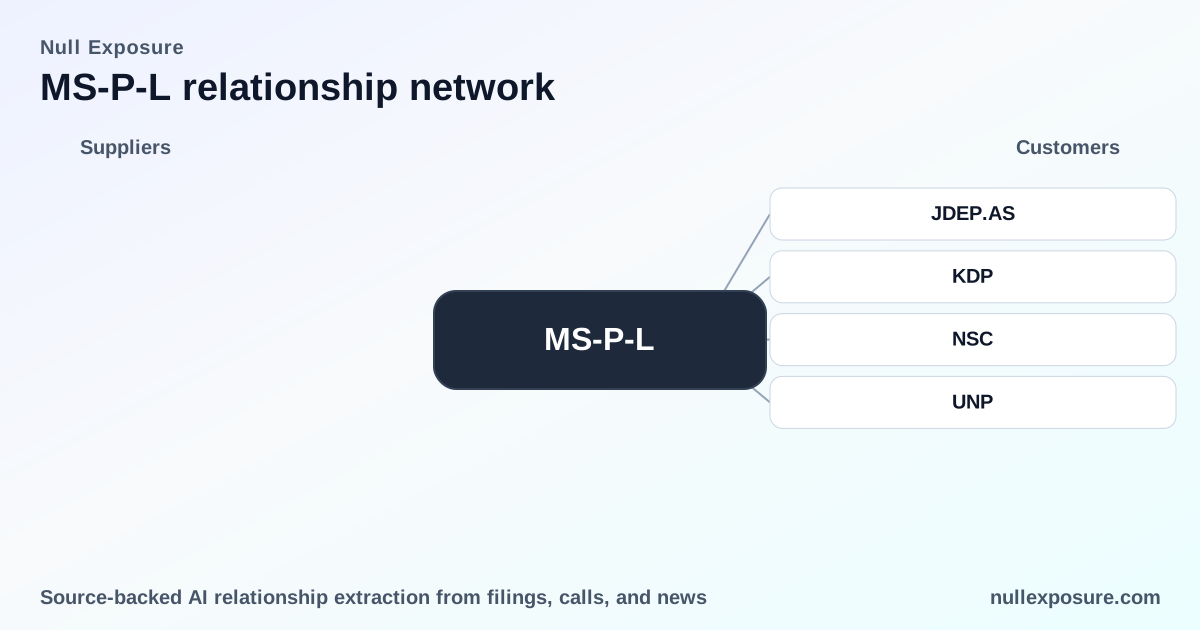
Morgan Stanley’s customer relationships in the monitored period are concentrated in large, strategic M&A transactions where the bank acted in advisory or facilitation roles. The monitoring results returned four named counterparties tied to two major transactions; each is summarized below with source context.
Keurig Dr Pepper (KDP) — co‑facilitator on the JDE Peet’s acquisition
Morgan Stanley co‑facilitated Keurig Dr Pepper’s $18 billion acquisition of JDE Peet’s, supporting KDP’s strategic consolidation in branded beverages. This involvement was reported in an AOL finance piece covering FY2025 deal activity and published March 10, 2026.
Source: AOL finance coverage on March 10, 2026, noting Morgan Stanley’s role on the KDP–JDE Peet’s transaction.
JDE Peet’s — target of KDP acquisition
JDE Peet’s was the $18 billion target in the transaction co‑facilitated by Morgan Stanley, placing the firm on the sell‑side advisory or facilitation register for a major cross‑border consumer deal. The same AOL report identifies this assignment as part of Morgan Stanley’s FY2025 advisory portfolio.
Source: AOL finance coverage on March 10, 2026, identifying JDE Peet’s as the acquisition target.
Union Pacific (UNP) — strategic buyer in a transformational rail deal
Morgan Stanley advised on Union Pacific’s agreement to acquire Norfolk Southern, a transformational tie‑up in U.S. railroads implied to be a very large, market‑moving transaction. An AOL summary of Wall Street profits cites Morgan Stanley’s advisory role in that $71 billion‑scale announcement.
Source: AOL finance coverage on March 10, 2026, reporting Morgan Stanley’s advisory participation on Union Pacific’s bid.
Norfolk Southern (NSC) — counterparty in the $71 billion rail consolidation
Norfolk Southern was the announced target in the proposed acquisition by Union Pacific; Morgan Stanley is listed among advisors on the deal in media coverage summarizing FY2025 corporate finance activity. The firm’s advisory footprint on such mega‑deals underscores exposure to concentrated, high‑value mandates.
Source: AOL finance coverage on March 10, 2026, reporting Morgan Stanley’s advisory involvement on the Norfolk Southern transaction.
These four names capture every counterparty returned in the monitored results for the MS‑P‑L customer scope in this ingestion window.
Why these relationships drive investor outcomes
The relationships above illuminate how Morgan Stanley’s advisory pipeline translates into episodic revenue for stakeholders in the capital stack:
- Contracting posture: Morgan Stanley sells time‑limited, mandate‑based advisory work where fees crystallize on completions and milestones, not steady subscription revenue. Large M&A assignments generate outsized fee events.
- Concentration: Advisory value is skewed to a small number of very large clients and transactions; the FY2025 signals show high concentration in a few transformational deals rather than broad, uniform fee generation.
- Criticality: For the counterparties involved, Morgan Stanley’s role is high‑impact—advisory advice materially affects deal structure and execution, increasing the strategic importance of those relationships to the bank’s near‑term fee profile.
- Maturity and repeatability: Large institutions like KDP, Union Pacific and their targets cultivate ongoing relationships with major global banks; repeated mandates are typical, but each assignment remains episodic in timing and payment.
No explicit operational or contractual constraints were identified in the monitoring feed for MS‑P‑L; that absence is itself a company‑level signal indicating the relationship records returned are event‑driven media mentions rather than regulatory or counterparty‑posted constraints.
Risk and return considerations for preferred holders
Preferred holders should weigh both the upside from fee‑rich mandates and the downside from deal volatility:
- Upside: Engagements on multi‑billion dollar transactions can produce meaningful advisory revenues that support distributable earnings and cushion capital cushions—beneficial to preferred coupons when retained earnings and capital adequacy remain healthy.
- Downside: Revenue is episodic and correlated with M&A cycles; a year with few large mandates suppresses income, and underwriting/trading losses can erode common equity buffers ahead of preferred claims.
- Reputational and litigation risk: High‑profile mandates carry scrutiny and potential litigation exposure; reputational costs can translate into client loss or regulatory attention, which affects franchise value over time.
- No direct counterparty credit exposure: The listed relationships are clients, not creditors; preferred investors are indirectly exposed through earnings volatility and capital impacts rather than direct credit claims on these counterparties.
Key takeaway: preferred security performance is tied to franchise economics and capital resiliency more than individual client solvency.
Tactical read for investors
- Continue to treat Morgan Stanley as a large‑cap investment bank with a pronounced dependence on large‑ticket advisory mandates; the FY2025 signals confirm the bank’s access to transformative deals that create episodic fee spikes.
- Monitor quarter‑to‑quarter advisory pipeline disclosures and capital adequacy measures for evidence that windfall fees are being retained to strengthen buffers rather than distributed in ways that could weaken preferred coverage.
- For more granular signal tracking and per‑relationship trendlines, explore the monitoring tools at Null Exposure: https://nullexposure.com/
Final assessment
Morgan Stanley’s presence on these marquee transactions signals continued franchise relevance in high‑stakes M&A, which supports the bank’s ability to generate intermittent but material advisory fees. For MS‑P‑L holders, that franchise strength is a positive, provided capital management conservatively balances distributions and buffer reinforcement over the earnings cycle.