MSA Safety: customer dynamics that shape revenue durability and liability exposure
MSA Safety manufactures and sells protective equipment and related services to industrial, military, and emergency-response customers worldwide, monetizing through product sales, distributor channels, maintenance/leasing contracts, and recurring service agreements. For investors, the core thesis is straightforward: MSA combines a broad global end-market footprint with reseller-driven distribution in the Americas and a modest but meaningful recurring services mix, producing steady margins while keeping individual customer concentration low. For deeper investor diligence, review our notes and source links below — and for ongoing relationship monitoring visit https://nullexposure.com/.
How MSA’s customer model actually operates — what matters to investors
MSA’s operating model is defined by a mix of transactional equipment sales and recurring revenue streams tied to service and leasing arrangements. Key company-level signals:
- Global reach, distributor-led sales: The company explicitly sells worldwide and relies heavily on distribution in its Americas segment, which supports scale but reduces single-buyer dependence.
- Low customer concentration: The firm reports that no customer accounted for more than 10% of sales or receivables in 2025, signaling diversified demand and limited counterparty concentration risk.
- Contract mix includes subscriptions and leases: MSA recognizes deferred revenue for arrangements that include leases, training, extended warranties, software subscriptions, maintenance and technical services — indicating a contractual posture that blends one-off product sales with recurring obligations.
- Service-provider role and managed contracts: The company acts as a lessor in managed fire service contracts and recognizes maintenance as a non-lease component, demonstrating an ongoing operational relationship with customers beyond initial equipment sales.
Together these signals indicate a mature, industrial product company with disciplined customer diversity and gradually increasing recurring revenue via service, leasing and subscription elements — conditions that investors value for predictability and margin resilience.
Notable customer and counterparty relationships you should know
Below are every relationship referenced in disclosed market and news items for FY2026, with concise takeaways and source citations.
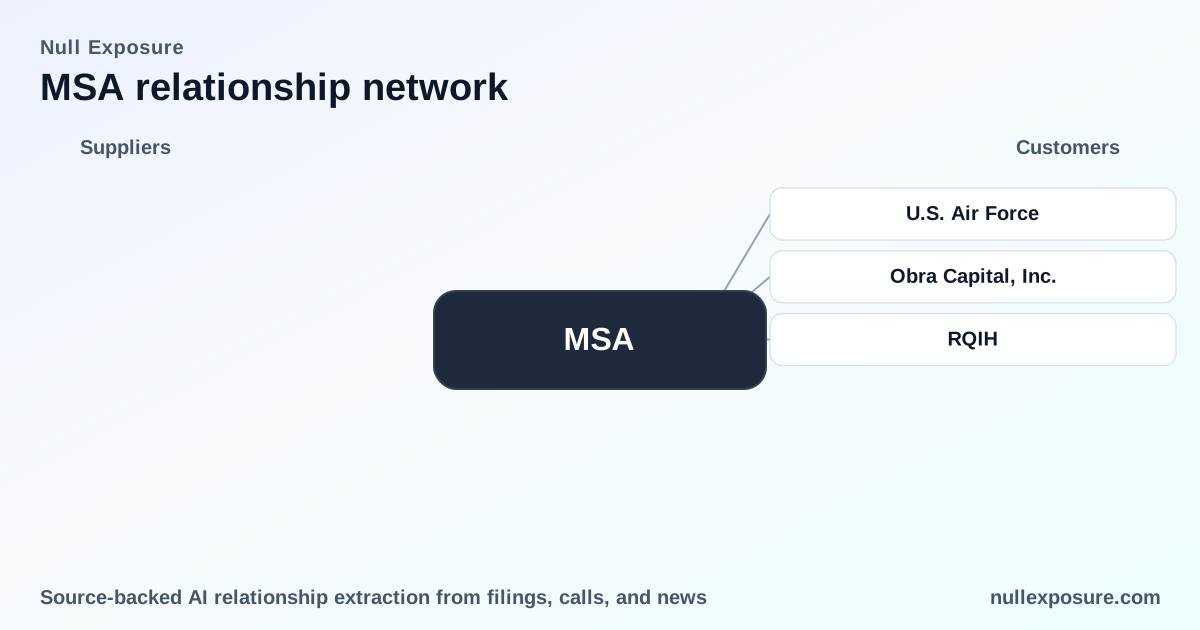
U.S. Air Force — government deliveries under pressure
MSA noted tougher year‑over‑year comparisons related to U.S. Air Force deliveries during FY2026, indicating the company is a supplier to U.S. military customers and that timing of government orders can create near-term revenue variability. (InsiderMonkey Q4 FY2025 earnings call transcript, reported March 10, 2026: https://www.insidermonkey.com/blog/msa-safety-incorporated-nysemsa-q4-2025-earnings-call-transcript-1695275/)
Obra Capital, Inc. (recently rebranded Vida Capital) — insurer/private capital partner in legacy liability JV
Obra Capital is an investor alongside R&Q in a joint venture set up to acquire a wholly owned MSA subsidiary that holds legacy liabilities, a move that transfers long‑tail liability exposure off MSA’s balance sheet into a dedicated vehicle. (Reinsurance News, March 10, 2026: https://www.reinsurancene.ws/rq-and-obra-capital-form-new-jv-to-acquire-msa-safetys-legacy-liabilities/)
RQIH / R&Q Insurance Holdings Ltd. — reinsurance partner in liability transfer
R&Q Insurance Holdings Ltd. (RQIH) partnered with Obra Capital to form the JV acquiring MSA’s legacy-liability subsidiary; this transaction is an explicit risk‑transfer and capital‑management action that reduces long-term contingent exposures for MSA. (Reinsurance News, March 10, 2026: https://www.reinsurancene.ws/rq-and-obra-capital-form-new-jv-to-acquire-msa-safetys-legacy-liabilities/)
(Note: RQIH and R&Q Insurance Holdings Ltd. refer to the same entity in the reporting and are listed separately in source captures; both entries above reference the same reinsurance JV.)
What the relationships imply for revenue quality and balance-sheet risk
The relationships above illustrate two linked business realities:
- Government contracting creates lumpiness: Sales to military and government customers like the U.S. Air Force produce material but episodic revenue flows; investors should expect quarter-to-quarter volatility when large deliveries complete versus prior-year comparatives.
- Liability management through third-party JVs: The R&Q/Obra JV is a strategic approach to de-risk legacy liabilities, turning potential long-tail claims into an arrangement backed by insurance/reinsurance capital rather than ongoing corporate provisioning.
These dynamics coexist with the earlier company-level signals: global distribution, immaterial customer concentration, and increasing recurring revenue through service and lease contracts — a mix that supports long-run margin stability even while occasional lumpiness and legacy issues persist.
Investment implications and a short checklist for analysts
MSA’s profile is that of a low-concentration industrial supplier with improving recurring revenue mechanics and active balance-sheet liability management. For investors and operators evaluating MSA customer relationships, consider the following:
- Revenue predictability: Recurring maintenance, leasing, and subscription revenue increases predictability but requires monitoring of contract terms and deferral practices.
- Customer concentration risk: Low — no single customer >10% of sales — supports credit resilience and reduces idiosyncratic demand risk.
- Counterparty and contractual posture: Distribution-heavy sales dilute direct customer negotiation leverage; managed service contracts and leases create warranty and service obligations that need to be tracked as deferred revenue and future margin drivers.
- Liability transfers: The R&Q/Obra JV is a constructive capital management move that limits downside from legacy claims, but investors should track the structure and recourse, and how much risk remains on MSA’s books.
Bold takeaway: MSA combines diversified demand and growing recurring-service economics with active liability transfer strategies — an attractive mix for investors focused on margin consistency and downside protection, provided they monitor government order timing and JV liability structures.
If you want continuous monitoring of these customer and counterparty shifts, see our coverage and alerts at https://nullexposure.com/.
Final perspective for portfolio managers
MSA’s customer relationships are broad, operationally embedded, and strategically hedged through insurer and private-capital arrangements for legacy issues. The company’s financials — healthy operating margins and returns on equity — reflect a business that captures both product and service value, while deliberate liability transfers protect the balance sheet. For buy‑and‑hold investors, the risk/reward centers on managing order-cycle volatility (especially government work) and confirming that recurring revenue growth offsets any residual legacy exposure.