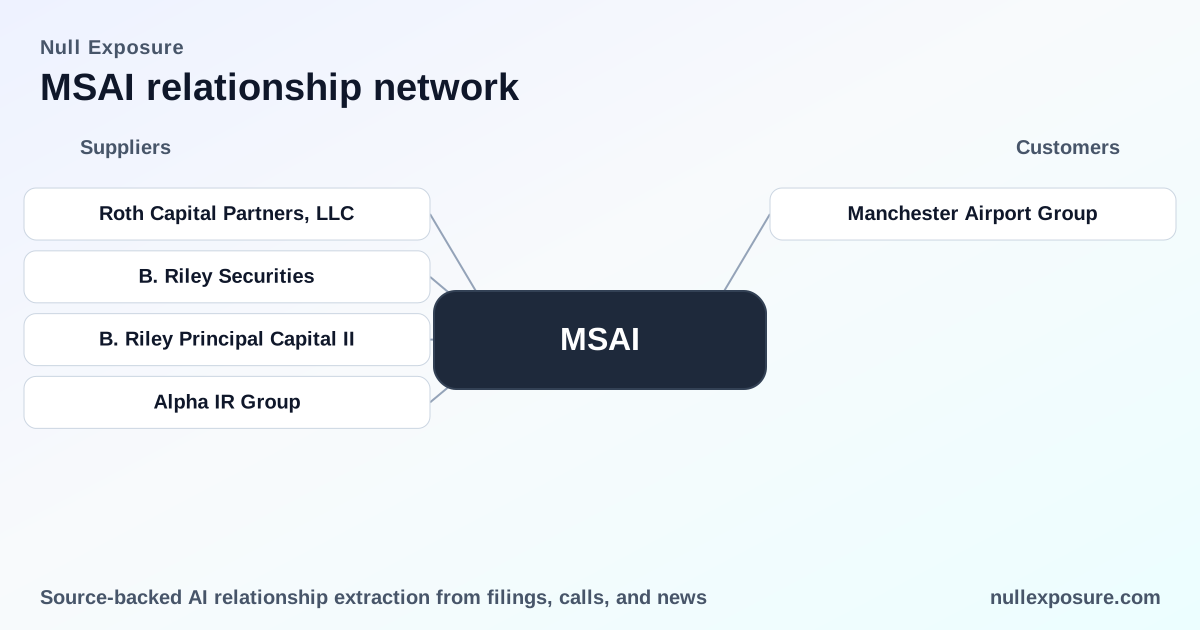
MultiSensor AI (MSAI) — customer relationships and what they mean for investors
Thesis: MultiSensor AI monetizes a hybrid hardware-plus-software model — selling advanced infrared cameras and edge software licenses while growing recurring revenue through its cloud subscription, MSAI Connect. Hardware sales generate upfront cash; the company converts enterprise customers to 12‑month subscription and term-based licenses to capture recurring revenue and services (training, calibration, repair), which together drive long‑term monetization and margin expansion. For investors evaluating customer risk and upside, the mix creates both near‑term revenue volatility and long‑term recurring value if conversion rates and retention improve. Learn more at https://nullexposure.com/.
How MSAI sells — the commercial mechanics behind the product line
MSAI runs a blended go‑to‑market: it sells hardware (infrared cameras and imagers) with revenue recognized on delivery, and two software products — MSAI Edge, sold as either a perpetual or 12‑month term license, and MSAI Connect, a cloud subscription typically contracted and billed annually with revenue recognized ratably. The company also bundles professional services (installation, training, calibration and repair) alongside product deployments. This structure creates a clear operating posture: upfront transactional cash from hardware and perpetual licenses, plus steadier, shorter‑duration recurring revenue from yearly subscriptions.
- Contract posture: subscription and term licenses are typically 12 months; perpetual sales are recognized upfront upon delivery.
- Revenue recognition implications: prepaid annual subscription cash boosts near‑term liquidity but leaves recognition spread across the contract period.
- Sales channel: direct enterprise sales plus channel partners for hardware distribution.
Concentration, geography and the maturity of relationships
MSAI is a North American concentrated operator focused on distribution & logistics, manufacturing and oil & gas. Customer concentration is material — the company reported that its top three customers represented approximately 47% of revenue for the year ended December 31, 2024, with a single distribution/logistics customer accounting for 25% of 2024 revenue. That concentration creates both negotiating leverage with key customers and exposure to churn or lost contracts.
- Geography: operations and revenue are primarily in North America.
- Customer type: enterprise customers (including government and academic institutions) are a strategic focus.
- Relationship maturity: the company uses pilots and spot purchases as a pathway to enterprise adoption; pilot deals can scale into larger, recurring subscriptions.
These are company‑level signals: high customer concentration, a focus on North America, and a mixed maturity profile where pilot engagements are a common precursor to enterprise contracts.
What public reporting shows about contract types and spend
Constraints and filings indicate that MSAI’s software is sold in both short‑term subscription and perpetual license formats, with MSAI Connect usually contracted for 12 months and MSAI Edge available as either a term license (12 months) or perpetual license; subscription receipts are generally collected in advance. The company’s public disclosures also include a commercial example: a July 2022 paid pilot for roughly $350,000 covering 87 devices and one‑year MSAI Connect subscriptions across 18 UK facilities — evidence that pilot programs can be meaningful in value and scale without implying the same counterparty for other wins.
Key operating takeaways: short contract lengths increase churn exposure but accelerate customer conversion to recurring economics; material customer concentration amplifies customer retention as a valuation driver.
Customer relationships reported in the market
Manchester Airport Group — reliability monitoring for baggage handling
Manchester Airport Group selected MultiSensor AI’s platform to improve reliability and enable proactive maintenance across baggage handling and inspection operations in mission‑critical airport environments, a commercial deployment that highlights MSAI’s traction in distribution/logistics infrastructure. According to a Newsfile press release (March 10, 2026) the company announced the deployment, and a TradingView summary of the company’s FY2026 results (May 3, 2026) reiterated MAG’s selection of MSAI’s platform for baggage‑handling performance and reliability. (Newsfile, March 10, 2026; TradingView / company release, May 3, 2026: https://www.newsfilecorp.com/release/278442/MultiSensor-AI-to-Deploy-Reliability-Monitoring-Solutions-with-Manchester-Airport-Group, https://www.tradingview.com/news/tmx_newsfile:5d5701c75094b:0-multisensor-ai-announces-fourth-quarter-and-full-year-2025-results/)
Note: multiple company press releases and event materials across late FY2025 and FY2026 reference the same MAG relationship, indicating continued market messaging around this customer win (Newsfile releases, March 2026).
How these customer facts affect valuation and execution risks
- Revenue durability vs. volatility: the mix of upfront hardware and perpetual license revenue with one‑year subscriptions produces faster cash inflows but lower revenue visibility than longer SaaS contracts. True gross recurring revenue depends on subscription renewal rates and the company’s ability to convert pilot and one‑off buyers into multi‑year customers.
- Concentration risk: with nearly half of revenue tied to the top three customers in 2024, investor returns hinge on retention and expansion within these accounts; loss of a single large customer could materially impact near‑term results.
- Contract length and upsell mechanics: 12‑month subscriptions create annual re‑sell moments where the company can upsell edge and cloud packages; success here determines the sustainability of recurring margins.
- Sales motion and criticality: deployments in mission‑critical infrastructure like airports demonstrate product criticality and a path to higher switching costs if MSAI proves reliability and ROI, but those wins often begin as pilots or targeted deployments before scaling.
Investment checklist for relationship-driven risk
- Confirm renewal and retention rates on the Connect subscriptions and the conversion rate from pilot to enterprise deployment.
- Track disclosure on percentage of revenue from top customers beyond 2024 to measure trend in concentration.
- Monitor the cadence of large pilots (such as the $350k UK example) turning into multi‑site rollouts.
For a concise briefing on MSAI’s commercial posture and customer signals, visit https://nullexposure.com/ — the portal hosts curated summaries that expand on these relationship dynamics.
Conclusion: MSAI’s commercial model blends high‑value hardware transactions with a shorter‑dated subscription layer that is scaling through enterprise pilots and marquee deployments such as Manchester Airport Group. The upside rests on converting pilots and high‑value customers into repeatable subscription revenue, while the risk is concentrated around a small group of large accounts whose retention will determine short‑term financial stability and long‑term valuation uplift.