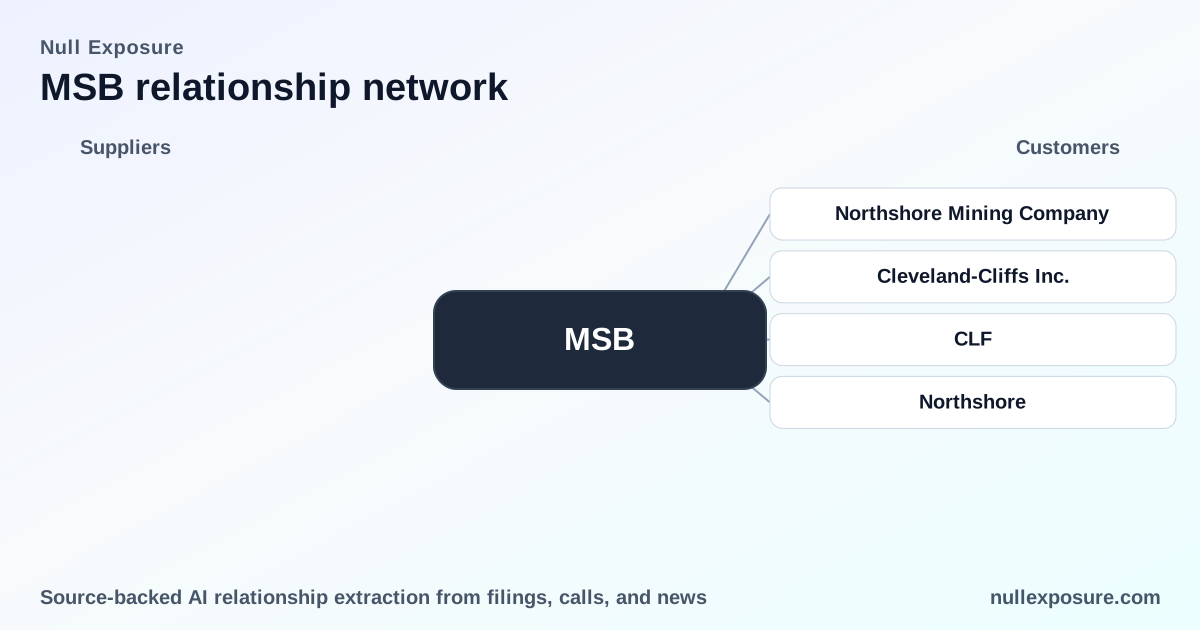
Mesabi Trust (MSB) — customer relationships that drive a royalty payout franchise
Mesabi Trust is a single-purpose royalty trust that monetizes iron ore extraction through contractual royalty receipts—primarily tied to production and pellet prices from Northshore Mining Company and its parent Cleveland‑Cliffs. The trust’s cash flow is almost entirely royalty cash collection, which the trustees distribute to unitholders as periodic dividends; royalty mechanics, counterparty behavior, and commodity prices therefore directly determine distributions and valuation. For a concise map of counterparties and primary documents, see https://nullexposure.com/.
How Mesabi earns and why counterparties matter
Mesabi’s operating model is straightforward: it holds royalty interests on Mesabi Range lands and receives payments based principally on pellet selling prices and a small per‑ton extraction royalty. That structure produces high concentration — one product (iron ore pellets) and a small set of counterparties account for virtually all cash flow — and creates direct sensitivity to contractual interpretation and operational decisions by the operator, Northshore, and its parent, Cleveland‑Cliffs. The trustees’ annual field inspections in Minnesota underline the trust’s North American operational footprint and ongoing monitoring of the operator’s performance.
For additional context on counterparty dynamics and to review the underlying source materials, visit https://nullexposure.com/.
What the documents and press coverage show: relationship-by-relationship notes
Northshore Mining Company — FY2025 10‑K (arbitration outcome)
Mesabi’s FY2025 10‑K states that arbitration initiated by the Trust in October 2022 concluded in June 2024, with the Trust seeking damages for alleged underpayment of royalties for 2020, 2021 and the first four months of 2022 related to pricing methodology. This filing is the Trust’s primary disclosure of the dispute with Northshore. (Mesabi Trust FY2025 10‑K filing)
Cleveland‑Cliffs Inc. — FY2025 10‑K (arbitration named)
The same FY2025 10‑K names Cleveland‑Cliffs alongside Northshore as the subject of the arbitration over alleged underpaid royalties for the 2020–2022 periods, reflecting that Cliffs’ corporate role creates direct legal and cashflow exposure for the trust. (Mesabi Trust FY2025 10‑K filing)
Cleveland‑Cliffs (news) — Duluth News Tribune reporting on royalties (FY2022 / Jan 2022)
A Duluth News Tribune article noted Mesabi received $20.9 million in royalties from Cliffs in January 2022, up from $12.3 million a year earlier, reflecting the direct linkage between fourth‑quarter pellet prices and trust collections reported for the FY2022 period. (Duluth News Tribune report; reporting on January 2022 royalties)
Northshore Mining Company (news) — dividend notice press release (FY2026)
A trading/news release summarizing Mesabi’s dividend declaration explains that Northshore pays royalties primarily based on the selling price of pellets shipped from Northshore’s Silver Bay pellet plant plus a smaller per‑ton royalty on ore extracted, confirming the trust’s price‑and‑volume royalty mechanics. (Press release summary in March 2026)
CLF — duplicate Duluth News Tribune mention (FY2022)
The Duluth News Tribune coverage referencing Cleveland‑Cliffs and the January 2022 $20.9 million payment is echoed in market reports; it reinforces that Cliffs is the proximate payer of the trust’s material receipts. (Duluth News Tribune; FY2022 reporting)
Cleveland‑Cliffs Inc. — MarketScreener press release (FY2025 receipts)
A MarketScreener press release on Mesabi Trust’s July 2025 distribution states the trustees recorded total royalty receipts of $5,300,287 from Cleveland‑Cliffs on July 30, 2025, providing a concrete, date‑specific cash receipt in FY2025. (MarketScreener press release, July 30, 2025)
CLF — MarketScreener duplicate listing (FY2025)
A duplicate MarketScreener entry reiterates the $5.3 million receipt from Cliffs on July 30, 2025, corroborating the trustees’ disclosed distribution determination for that payment date. (MarketScreener; July 2025)
Cleveland‑Cliffs (Railfan quote) — operator criticism (FY2022)
A Railfan report quotes an industry source characterizing the royalty structure as “ridiculous,” attributing operational decisions (including potential shutdowns) at Northshore to the existing royalty terms, which signals counterparty operational tension that can influence production and royalties. (Railfan news piece; commentary tied to FY2022 conditions)
CLF — Railfan duplicate (FY2022)
The Railfan piece is captured again under the CLF name, repeating the operator’s complaint about the royalty structure and underlining persistent public tensions between the trust and operator. (Railfan; FY2022 commentary)
MarketScreener — Northshore payment mechanics (FY2025)
MarketScreener’s Mesabi press release reiterates that Northshore’s payments are calculated primarily from pellet selling prices at the Silver Bay plant plus a smaller per‑ton extraction royalty, aligning with the trust’s long‑stated royalty formula and clarifying where pricing inputs are sourced. (MarketScreener press release; FY2025)
TradingKey — Northshore payment mechanics (FY2026)
A TradingKey summary in 2026 repeats that Northshore’s royalty payments derive principally from pellet plant selling prices at Silver Bay, confirming continuity in the payment formula through FY2026 reporting. (TradingKey summary; 2026)
TradingView — arbitration and idling of operations (FY2025)
TradingView summarized Mesabi’s disclosures that the trust initiated arbitration against Northshore and Cliffs over idling of Northshore operations and alleged royalty underpayments, signaling legal and operational conflict that directly affects cash flow timing and recoverability. (TradingView summary of Mesabi SEC filings; FY2025)
Cliffs (TradingView duplicate) — arbitration reference (FY2025)
That same TradingView note appears under Cliffs, restating the arbitration and operational idling issues and emphasizing Cliffs’ role as the umbrella counterparty in public reporting. (TradingView; FY2025)
Northshore (TradingView) — production and shipment volumes (FY2025)
TradingView reports that for the three months ended October 31, 2025, production and shipments from Mesabi Trust lands at Northshore totaled 915,605 tons, down from 1,066,665 tons in the prior‑year period, which is direct evidence of volume pressure that reduces royalty receipts. (TradingView summary; three months ended Oct 31, 2025)
Operating constraints and company‑level signals
- Geographic concentration: North America (Minnesota). The trustees’ annual inspection trips and descriptions of Silver Bay and Babbitt sites establish that Mesabi’s operations and monitoring are regionally focused in the U.S. Midwest. This is a company‑level geographic signal rather than a relationship‑level attribution.
- Single‑segment business: iron ore mining. Mesabi discloses that substantially all revenue and assets relate to one business segment—iron ore mining—creating single-product exposure and limited operational diversification.
- Contracting posture: royalty instrument with discrete pricing formula. The trust’s receipts depend on contractual application of pellet selling prices (preceding quarters’ highest arm’s‑length prices per dispute language), making contract interpretation and operator behavior central to cashflow risk.
- Concentration and criticality: few counterparties control collection. Northshore (and Cleveland‑Cliffs as parent) are the primary payers; counterparty credit and operational choices are critical to distributions.
Investment implications — what investors and operators should watch
- Royalty economics are binary and direct. Changes in pellet prices or Northshore production volumes lead to immediate, proportional shifts in distributions.
- Legal and operational risk is non‑trivial. The arbitration concluded in mid‑2024 and public complaints by operator management demonstrate that contract disputes and idling decisions materially affect cash receipts.
- Concentration amplifies both upside and downside. With essentially a single operator and product, dividend stability is contingent on the operator’s capital planning and Cliffs’ corporate decisions.
- Near‑term cash markers exist. Documented receipts such as the $20.9 million (Jan 2022) and $5.3 million (July 2025) payments provide concrete checkpoints for modeling distributions and stress scenarios.
- Field visibility matters. Trustee inspections and reported plant locations in Minnesota support active monitoring, which is positive governance for a royalty trust but does not negate contract enforcement risk.
For investors assessing Mesabi Trust, these relationship facts translate into a valuation profile where commodity cycles, operator capital allocation, and contract enforcement determine the cash yield and downside protection. To assess counterparties and material filings in one place, consider the relationship analytics at https://nullexposure.com/.
Bottom line
Mesabi Trust is a concentrated, contract‑driven royalty vehicle whose distributions are a direct function of Northshore’s pellet pricing and production and Cleveland‑Cliffs’ corporate posture. Legal disputes, demonstrated receipts, and production variability are the primary levers investors should model when forecasting dividends and downside scenarios.