Midland States Bancorp (MSBI): Equipment-sale watershed and what customer links tell investors
Midland States Bancorp operates as a regional financial holding company through Midland States Bank, monetizing across interest margin, transaction and interchange fees, and fee-based services such as equipment finance, merchant services and mortgage servicing. The company generates core revenue from commercial and consumer lending and deposits, with an outsized historical contribution from equipment finance that was substantially divested in late 2025 — a transaction that resets balance-sheet composition and client mix. For a concise company view and underlying relationship intelligence, see NullExposure’s profile: https://nullexposure.com/.
Why the North Mill transaction matters to returns and risk
Midland executed a strategic sale of substantially all of its equipment finance portfolio to North Mill Equipment Finance, converting roughly $545 million of loans into approximately $502 million of sale proceeds. That transaction materially reduces Midland’s equipment finance exposure, trims loan assets, and shifts future revenue mix away from interest earned on that portfolio to deposit and commercial banking flows. According to the company announcement (GlobeNewswire, Dec 1, 2025) and follow coverage around the completion (Yahoo Finance / Investing.com reporting in May 2026), Midland transferred the bulk of the Midland Equipment Finance book to North Mill, reshaping the loan profile and near-term earnings composition.
Named customer and counterparty relationships you need to know
This section lists every distinct relationship cited in the source material and gives the investor-focused takeaway with source context.
-
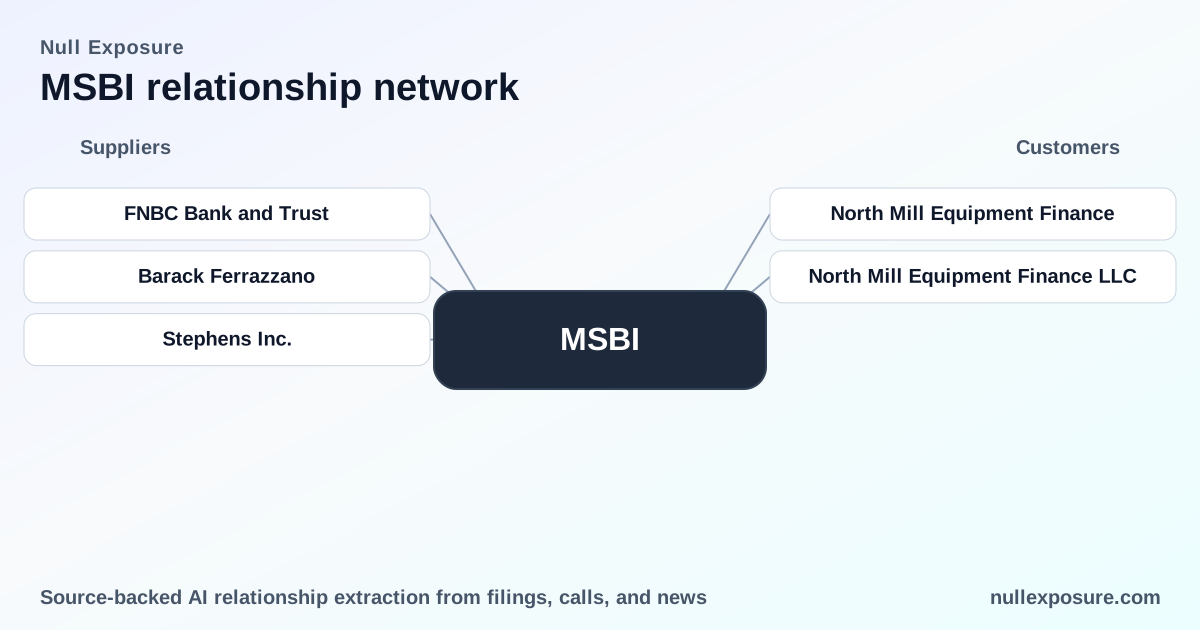
North Mill Equipment Finance / North Mill Equipment Finance LLC
Midland sold substantially all of its equipment finance portfolio to an affiliate of North Mill Equipment Finance for about $502 million, reducing loans on Midland’s books by roughly $545 million; the deal was disclosed in a company press release and reported through financial news outlets in late 2025 and confirmed in public reports in 2026 (GlobeNewswire, Dec 1, 2025; Yahoo Finance, May 2026).
Source: Midland States Bancorp press release via GlobeNewswire (Dec 1, 2025) and subsequent reporting (Yahoo Finance / Investing.com, May 2026). -
GreenSky
GreenSky is referenced in Midland’s commentary as part of non-core loan programs that were originated through third parties or capital markets, specifically cited alongside other sold portfolios and equipment financing loans; this language is included in corporate disclosures addressing the classification of non-core lending activities (Yahoo Finance SG, May 2026).
Source: Midland public disclosures quoted in Yahoo Finance Singapore (May 2026).
How the contractual and counterparty profile guides the operating model
The company-level signals extracted from Midland’s disclosures define how revenues, counterparty concentration and contract economics translate into investable characteristics:
- Contracting posture: a mix of usage-based and short-term flows. Card and interchange income is recognized daily as transactions clear, which creates high-frequency, usage-based revenue tied to consumer behavior and card networks. Separately, certain lending lines such as agricultural production loans are described as short-term instruments that cycle seasonally and compress duration risk.
- Customer concentration and target market: regional and middle-market focused. Midland targets small and midsized businesses, municipalities and individual consumers within Illinois and the St. Louis metropolitan area, producing geographic concentration in North America (primarily the U.S.) and sector concentration among middle-market commercial borrowers and small businesses.
- Service mix and role orientation: seller and service provider. The company acts as both lender/seller (equipment finance historically) and ongoing service provider (merchant services, deposit accounts, loan servicing), a hybrid that produces revenue diversity but creates dependence on deposit pricing and fee income.
- Criticality and maturity: entrenched retail and commercial relationships with legacy equipment finance now exited. The equipment finance business had been a material line; its sale signals reduction in a previously important, mature revenue stream and shifts emphasis back toward core banking and fee services.
- Materiality of related-party transactions: limited. Disclosures indicate there have been few material related-party transactions above established thresholds, a signal of low governance or insider transaction risk at material levels.
These characteristics translate into predictable cash flow drivers (deposit spreads, interchange flows) and cyclical exposures (commercial loan cycles, agriculture seasonality). For a deeper breakdown of Midland’s post-sale exposure and concentration effects, consult our platform: https://nullexposure.com/.
What the North Mill sale means for earnings composition and capital
The portfolio sale converts a performing loan block into near-term liquidity and/or capital that management can redeploy. Investors should note two immediate effects:
- Near-term capital and liquidity improved, while recurring net interest income from that loan book ceased. That reduces interest-earning assets and transfers future upside on those credits to North Mill.
- Earnings volatility profile shifts toward deposit and fee income sensitivity. With equipment finance out of the core loan mix, Midland’s P&L will lean more on net interest margin on remaining commercial and consumer loans, mortgage/repository revenues, and interchange/merchant fees recognized on a usage basis.
Analysts will reweight forward models to reflect a smaller loan book and higher reliance on transactional fee streams and deposit margins; Midland’s trailing revenue of about $274.5 million and market capitalization around $538 million provide a baseline for post-transaction valuation comparisons.
Investor checklist: what to watch next
- Monitor reported net interest income and margin stabilization as the sold portfolio drops out of interest earnings.
- Track deposit growth and cost of funds: Midland’s ability to reinvest sale proceeds into higher-margin lending or to return capital to shareholders will determine medium-term ROE.
- Watch interchange and merchant services performance, given their usage-based recognition and potential to offset lost equipment finance income.
- Observe geographic concentration risks in Illinois and the St. Louis area for loan performance sensitivity during regional downturns.
Bottom line: the North Mill transaction is a structural inflection that reduces Midland’s equipment finance footprint and recasts future earnings toward core banking and fee-driven services. Investors should treat the sale as a capital and strategic reset, not merely a one-off portfolio clean-up.
Final thoughts and where to read more
For investors and operators evaluating MSBI customer relationships, the takeaway is straightforward: the company has traded a recurring, interest-bearing equipment finance book for immediate proceeds and lower future loan exposure, increasing the relative importance of deposit margins and usage-based fee income. Track quarterly disclosures for realized gains, redeployment strategy, and changes in loan composition.
For ongoing relationship mapping and curated intelligence on counterparties and deal activity, visit NullExposure’s company hub at https://nullexposure.com/.