Midland States Bancorp (MSBIP): Customer Relationships That Reshaped the Balance Sheet
Investment thesis — Midland States Bancorp operates as a regional community bank that monetizes through interest margin on lending, fee-based wealth and trust services, merchant and interchange income, and loan sales/servicing. Recent strategic divestitures and third‑party financing arrangements have shifted Midland’s customer exposure away from direct equipment finance originations toward more fee-driven and core banking relationships, improving capital and liquidity optics for investors while concentrating revenue dependence on transactional fees and deposit-led services. For deeper coverage of counterparties and document-level sources, visit https://nullexposure.com/.
How Midland makes money and why customers drive valuation
Midland’s operating model combines traditional community banking with a set of specialized lending programs. Interest income from commercial, CRE and consumer loans remains the foundation of revenue, supplemented by monthly wealth management fees (charged on assets under administration), interchange and merchant services income (usage-based and recognized daily), and occasional loan sales or portfolio transfers that create one-time cash inflows. The company organizes these monetization streams to capture both recurring fees and transactional, usage‑based revenue — a mix that supports stable margins but also links earnings to local economic cycles and payment volumes.
From an investor perspective, three business-model constraints matter:
- Contracting posture: a blended mix of usage‑based (card interchange recognized daily), short‑term commercial credit (loans ≤ 5 years) and subscription-like wealth management fees recognized monthly, which makes cash flow partly predictable but partly volume-sensitive.
- Counterparty concentration and criticality: Midland targets small and middle‑market businesses, individuals and municipal clients primarily in Illinois and the St. Louis area, creating geographic concentration and high criticality for regional economic health.
- Maturity and spend scale: The bank retains both core service relationships and large one-off financing exposures (e.g., financing to third‑party buyers), with industrial-scale transactions already exceeding the $100m band in aggregate financings — a signal that Midland’s customer relationships can be both routine and material for the balance sheet.
What changed: the equipment finance divestiture and its partners
Midland announced and completed a sizeable exit from equipment finance origination, selling the bulk of that portfolio to a specialist buyer. That transaction resets the bank’s client and loan book composition and has immediate capital and liquidity implications for investors.
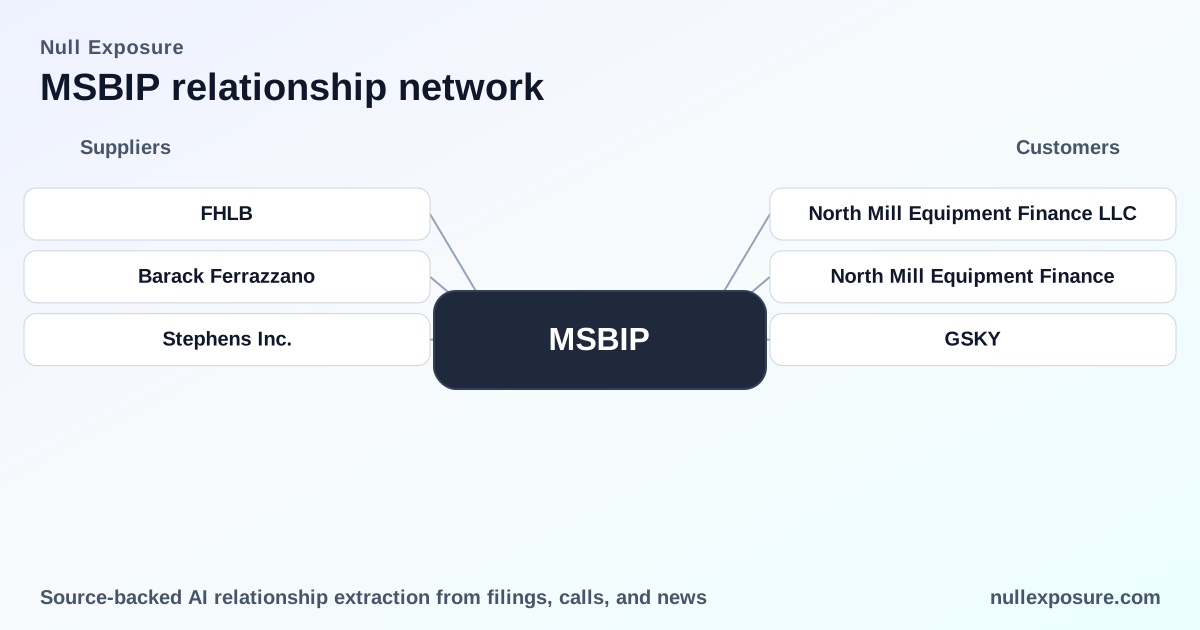
North Mill Equipment Finance / North Mill Equipment Finance LLC — buyer of the equipment portfolio
Midland sold substantially all of its equipment finance portfolio to an affiliate of North Mill Equipment Finance LLC. According to Midland’s press release, the sale transferred the bulk of the portfolio and its associated servicing relationships to North Mill; separate market reports indicate the portfolio carried a book value of roughly $545 million and the transaction consideration was approximately $502 million. (See Midland’s announcement on GlobeNewswire, Dec 1, 2025: https://www.globenewswire.com/news-release/2025/12/01/3197090/0/en/midland-states-bancorp-announces-sale-of-substantially-all-of-its-equipment-finance-portfolio-to-north-mill-equipment-finance.html and related press mentions on Investing.com, May 3, 2026: https://www.investing.com/news/insider-trading-news/midland-states-bancorp-svp-mooney-sells-63k-in-shares-93CH-4471156).
- Key takeaway: Midland executed a material portfolio sale that removes concentrated equipment-finance credit exposure while monetizing held loans for cash, transferring ongoing counterparty servicing relationships to North Mill.
(Additional coverage and commentary on the same transaction can be found in Sahm Capital’s release referencing North Mill Equipment Finance LLC: https://www.sahmcapital.com/news/content/midland-states-bancorp-announces-sale-of-substantially-all-of-its-equipment-finance-portfolio-to-north-mill-equipment-finance-2025-12-01.)
Non‑core loan programs and the GreenSky connection
Midland’s reported non‑core loan programs include portfolios originated through third parties or capital markets channels, notably loans tied to GreenSky transactions. That program has implications for how Midland generates fee income and manages credit risk transferred through participations.
GreenSky / GSKY — third‑party originations used in non‑core programs
Midland classifies certain loans as non‑core, including loans originated to finance the sale of the GreenSky portfolio, and has provided financing to buyers of participations related to those originations. Midland’s 2025 fourth-quarter results explicitly reference GreenSky in the description of non‑core loan programs, indicating the bank both originated and financed a portion of these assets through third‑party arrangements. (See Midland’s FY2026 results release on GlobeNewswire, Jan 22, 2026: https://www.globenewswire.com/news-release/2026/01/22/3224325/0/en/midland-states-bancorp-inc-announces-2025-fourth-quarter-results.html.)
- Key takeaway: GreenSky-related loans are categorized as non‑core and were originated or financed through third parties, demonstrating Midland’s use of distribution channels and participations to scale originations without keeping all credit on‑balance sheet.
What the constraints tell investors about Midland’s operating posture
The constraint signals embedded in Midland’s public descriptions define a bank that mixes transactional and contractual income with regional lending risk:
- Contracting posture: usage‑based revenue from interchange and merchant services produces daily or monthly cash receipts, while wealth management fees resemble subscription revenue recognized monthly. Commercial lending activity includes short-term credit lines and equipment loans with maturities frequently under five years, increasing turnover in asset composition.
- Concentration and geography: Midland’s client footprint is concentrated in Illinois and the St. Louis metro, which amplifies local macro sensitivity but provides relationship depth with municipal and middle‑market customers.
- Criticality and maturity: The bank retains a diversified role — lender, servicer and occasional buyer — with the ability to sell large loan portfolios to specialist buyers, indicating a mature and strategic approach to capital management but also exposure to episodic portfolio sales that drive one-time gains or liquidity events.
- Spend scale: Evidence of multi‑hundred‑million dollar financings to third‑party buyers places Midland’s non‑core program at a scale that materially affects balance-sheet metrics and investor valuation considerations.
Bottom line for investors and operators
Midland transitioned away from direct equipment finance exposure through a sale to North Mill and continues to operate a hybrid model that balances recurring fee income (wealth, interchange) with active loan portfolio management (non‑core programs and participations tied to GreenSky). That repositioning improves capital flexibility but concentrates Midland's earnings sensitivity around transaction volumes, regional credit cycles, and successful execution of fee businesses.
If you evaluate counterparties or want document-level sourcing and relationship mapping for due diligence, visit https://nullexposure.com/ for structured access and updates.
Key documents referenced above:
- Midland press release, Dec 1, 2025: sale of equipment finance portfolio to North Mill: https://www.globenewswire.com/news-release/2025/12/01/3197090/0/en/midland-states-bancorp-announces-sale-of-substantially-all-of-its-equipment-finance-portfolio-to-north-mill-equipment-finance.html
- Market and news coverage of the transaction (Investing.com and MarketScreener, May 2026/Dec 2025): https://www.investing.com/news/insider-trading-news/midland-states-bancorp-svp-mooney-sells-63k-in-shares-93CH-4471156 and https://www.marketscreener.com/news/midland-states-bancorp-inc-to-announce-fourth-quarter-2025-financial-results-on-thursday-january-ce7e59d9df88f426
- Midland fourth-quarter results discussing non‑core programs and GreenSky, Jan 22, 2026: https://www.globenewswire.com/news-release/2026/01/22/3224325/0/en/midland-states-bancorp-inc-announces-2025-fourth-quarter-results.html
Bold claims and relationship summaries above reflect the company’s public disclosures and market reporting; use these sources when adjusting valuation assumptions for credit exposure, fee sustainability, and regional concentration risk.