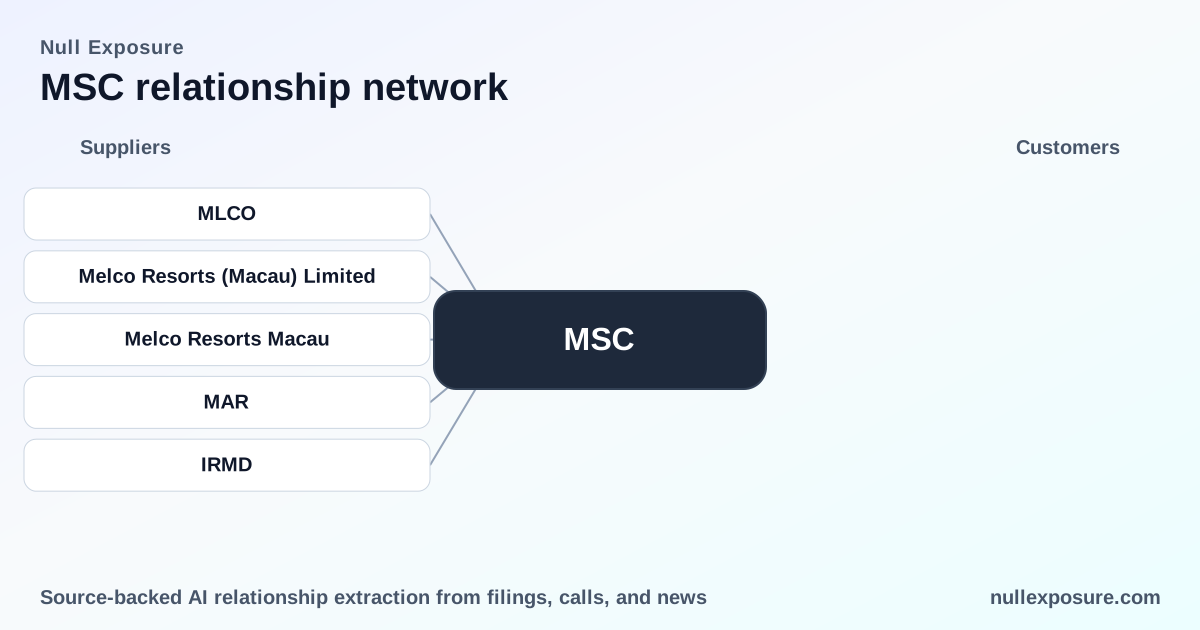
Studio City International (MSC): What the customer-relationship record actually shows for investors
Studio City International operates a large gaming, retail and entertainment resort on Cotai, Macau and monetizes through casino gaming, hotel rooms, retail concessions and live entertainment — effectively a destination resort model where gaming and premium non-gaming spend drive margins. According to public filings through the quarter ended 2026-03-31, trailing revenue stands at roughly $694.6M with EBITDA of $280.5M, and a market capitalization near $500.7M, giving investors a compact, cash-generative resort operator with meaningful exposure to Macau tourism flows. For a concise view of coverage and data, visit the platform homepage: https://nullexposure.com/
Why customer-relationship signals matter for a resort operator
Investors use customer-relationship records to understand commercial concentration, third-party dependencies, and off-balance-sheet exposures that can affect cash flow and operational continuity. For a hospitality and gaming operator like Studio City, relevant relationships typically include strategic partners for entertainment, retail licensees, hotel management/franchise partners, and supply-chain vendors that can create short-term operational risk.
Studio City’s public financial profile — positive operating margin, negative EPS driven by non-operating items, and moderate institutional ownership — points to a business that is operationally mature but sensitive to tourism demand and regulatory dynamics in Macau. From a relationship perspective, two company-level signals stand out:
- No explicit contractual constraints surfaced in the customer-relationship feed for the company, which is a company-level signal that the review did not detect disclosed restrictive customer contracts or named contractual counterparty constraints.
- Ownership and concentration signals in filings show high insider ownership (about 24%) and modest institutional ownership (~23%), which is consistent with a business where fewer counterparties and key insiders influence strategic decisions.
Those signals are company-level: they reflect what the relationship search returned (or did not return) and should be treated as operational context rather than hard evidence of specific vendor risk.
One relationship surfaced — and why you should read it closely
The customer search returned a single relationship item. It is important to read that item for what it actually is: the hit references maritime slot-sharing arrangements between the container carrier ZIM and an entity named MSC (the shipping line), not Studio City’s resort operations. That name overlap is consequential for anyone scanning automated relationship feeds.
ZIM — slot-sharing arrangements with MSC (shipping line), FY2026
The search captured a March 2026 article in The Loadstar describing slot and tonnage arrangements on transpacific liner services: ZIM-operated vessels run certain services marketed alongside MSC-branded services, with MSC reserving roughly 30% of slot capacity on those ZIM vessels, and MSC providing tonnage on other services. According to The Loadstar (March 2026), this is a slot-sharing/tonnage-provider arrangement between container carriers rather than a hospitality supply or customer agreement. Source: The Loadstar article on March 10, 2026 (https://theloadstar.com/zim-takeover-raises-questions-for-transpac-shippers-and-msc/).
- Why this matters to you as an investor in Studio City: this relationship is a name-collision in the search results — the MSC referenced in the shipping story is the global carrier Mediterranean Shipping Company, not Studio City International Holdings Ltd. The surfaced item therefore does not reflect a customer contract or operational dependency for Studio City’s Macau resort. Treat automated hits with company-name collisions as false positives until validated by domain context.
Practical implications for investment diligence
- Validation is essential. A relationship feed can surface relevant third-party exposures — or it can return false positives driven by shared tickers and acronyms. Investors must validate each named counterparty against business lines and filings before changing valuation assumptions.
- No disclosed customer contracts in the feed is itself an informative finding. In this case, the absence of hospitality-related customer disclosures suggests either a low level of material third-party customer dependency visible in public relationship records or limitations in the data capture for Studio City. Either way, treat customer dependence risk as neutral until corroborated by contracts, revenue segmentation, or management commentary.
- Operational concentration remains industry-driven. Studio City’s fortunes are tied to Macau visitation and gaming spend; supply-chain or logistics partners (like shipping carriers) are peripheral unless the company discloses material dependencies for concession stock, construction, or event logistics. No such material third-party customer risk surfaced in this pass.
Key takeaways for investors
- The only relationship returned by the customer scan involved ZIM and an MSC that is the shipping line, not Studio City’s resort operations. This is a classical name-collision result and should not be interpreted as a commercial relationship for Studio City. Source: The Loadstar, March 2026.
- Studio City’s financials reflect a mid-cap, operating resort with positive EBITDA but negative EPS, showing operational cash flow strength with financial or non-operating drag; guard against over-interpreting automated relationship results without cross-checking with filings (latest quarter to 2026-03-31).
- No explicit contractual constraints were detected in this relationship sweep, a company-level signal that reduces the immediate likelihood of a disclosed, material counterparty dependency in the customer dimension — but it does not substitute for classic diligence on concession agreements and major vendor contracts.
If you want a systematic reconciliation of relationship hits against corporate filings and press releases for this ticker, review the platform’s consolidated view at https://nullexposure.com/ — it will help you filter out name collisions and surface hospitality-relevant partnerships.
Bottom line
Automated customer-relationship searches are a useful starting point for due diligence, but they require human validation. For Studio City International (MSC), the single hit returned concerns shipping-slot arrangements between ZIM and the shipping-line MSC — not Studio City’s business — making this an exemplar of why investors must combine relationship signals with business context and filings before updating valuation or risk assessments. Focus diligence on Macau demand trends, concession terms, and any named entertainment or hotel-management partners for material impact on cash flow.