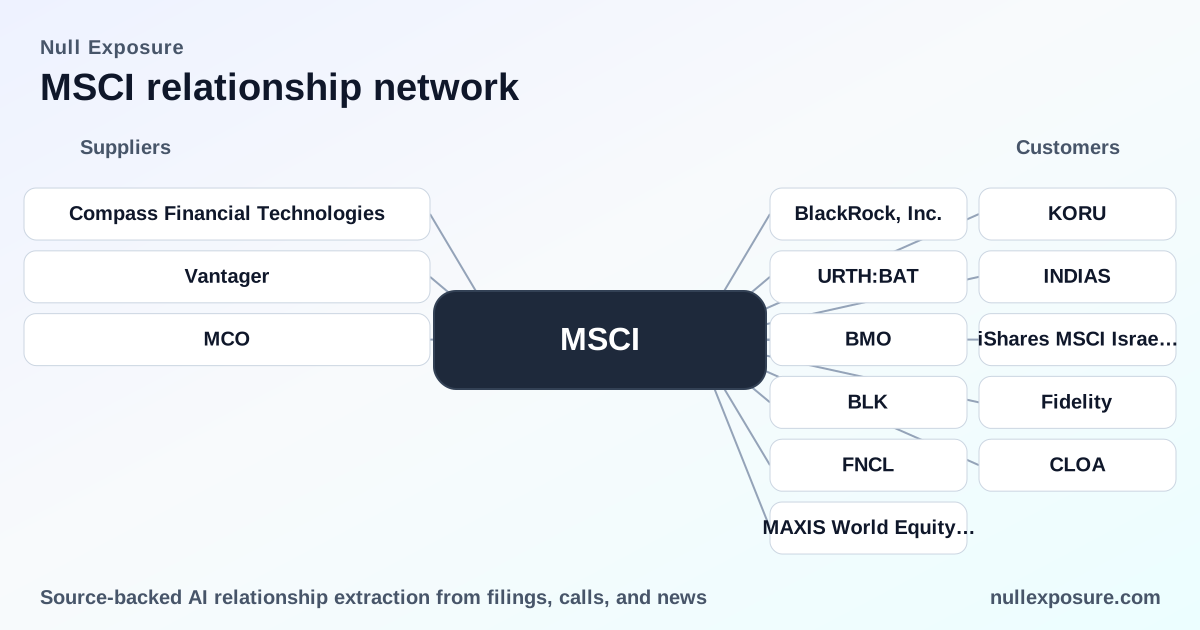
MSCI customer relationships: who pays, who rebalances, and what it means for investors
MSCI operates as a global index and analytics franchisor that licenses recurring subscriptions and asset‑based fees to portfolio managers, ETF issuers and corporate clients; the company monetizes by selling annual licenses for indexes and analytics while collecting usage-linked fees tied to assets under management for index‑linked products. For investors, the key dynamic is a mix of high-margin recurring revenue and variable, AUM‑sensitive income that links MSCI’s growth to both index adoption and passive fund flows.
Discover more MSCI customer intelligence at https://nullexposure.com/
The business model in one paragraph: predictable coupons plus flow exposure
MSCI’s revenue base blends annual, advance‑paid subscriptions for analytics and data with usage‑based, asset‑linked licensing for index products. The Index segment generated 57.0% of revenue in FY2025, with a majority of that income coming from recurring subscription fees, while asset‑based fees provide upside or downside tied to ETF and fund assets. This structure produces stable base earnings with cyclical exposure to market flows, and the FY2025 10‑K highlights a concentrated revenue dependency on a few large issuers — a strategic strength for monetization and a concentration risk for investors.
Customer map: every relationship from the recent capture, explained
-
BlackRock / BLK / CLOA — BlackRock is MSCI’s largest client, accounting for 10.8% of consolidated operating revenues in FY2025, and MSCI reports that 96.5% of BlackRock‑related operating revenue is fees tied to BlackRock’s index‑based products and ETFs; this is disclosed in MSCI’s FY2025 Form 10‑K (filed Feb 2026). Multiple news items also note MSCI extended its ETF licensing agreement with BlackRock through 2035 (TradingView, Mar 2026).
-
URTH:BAT / iShares MSCI World ETF — MSCI’s semi‑annual index reviews produce constituent changes that force ETFs such as iShares’ MSCI World to rebalance holdings; ad‑hoc‑news reported a material reshuffle to the MSCI World Standard Index in March 2026 that required iShares to adjust portfolio weights (ad‑hoc‑news, Mar 10, 2026).
-
iShares MSCI Emerging Markets ETF (EEM) — EEM tracks MSCI’s Emerging Markets Index and is a primary example of MSCI’s asset‑linked revenue model: iShares funds that reference MSCI indexes drive AUM‑sensitive fees for MSCI (247WallSt, Apr 2026; fund fact sheets, 2026).
-
BMO / BMO MSCI Emerging Markets ETF — BMO’s MSCI‑linked emerging markets fund is cited as tracking MSCI’s Emerging Markets Index and thus represents another route for MSCI’s index licensing revenues tied to third‑party ETF flows (Morningstar global, Mar 2026).
-
iShares (generic reference to BlackRock’s ETF platform) — Coverage across news sources regularly references iShares funds as primary users of MSCI indexes; these funds collectively drive a meaningful portion of MSCI’s asset‑based fees (Morningstar and ad‑hoc reporting, 2026).
-
Fidelity MSCI Financials Index ETF / FNCL — Fidelity’s FNCL explicitly tracks an investable MSCI sector index for US financial firms, illustrating MSCI’s role as index licensor to active and passive issuers (TradingView ETF profile, Mar 2026).
-
Fidelity (general) — Multiple Fidelity ETFs use MSCI sector and regional indexes; Fidelity’s product set demonstrates the breadth of institutional licensees that pay either subscription or AUM‑based fees to MSCI (TradingView, Mar 2026).
-
ING — ING’s improved ESG ratings from MSCI (upgraded to AAA for example) are cited in press coverage, showing MSCI’s role as a ratings and sustainability provider to corporates and a source of third‑party validation that can affect inclusion in ESG indexes (Globe and Mail, ManilaTimes, 2025–2026).
-
MAXIS World Equity (MSCI ACWI) ETF (2559) — The Japanese listed ETF 2559 follows the MSCI ACWI Index, demonstrating MSCI’s global footprint in index licensing across regions and exchanges (TradingView analysis, Mar 2026).
-
Direxion Daily MSCI South Korea Bull 3X Shares (KORU) — Leveraged products that reference MSCI indexes (KORU) translate index methodology changes directly into trading behavior and performance swings in short timeframes (Nate News, Feb 2026).
-
T. Rowe Price (TROW) — T. Rowe Price uses MSCI benchmarks (for example referencing MSCI ACWI as of end‑2025 in firm research), illustrating MSCI’s status as a common performance benchmark for active managers (T. Rowe Price research, 2026).
-
SCHW‑P‑J (Schwab) — Schwab has used MSCI‑based ESG indices (e.g., the MSCI KLD 400 Social Index) for personalized indexing and ESG product offerings, showing MSCI’s footprint in retail and custom indexing initiatives (Investopedia coverage, 2022 cited in 2026 news aggregation).
-
INDIAS / iShares MSCI India ETF — The iShares MSCI India ETF executes quarterly rebalances driven by MSCI index reviews, underlining the mechanical flows and trading volume generated by MSCI methodology changes (ad‑hoc‑news, Mar 2026).
-
iShares MSCI Israel ETF — MSCI’s semi‑annual reviews also prompt rebalances for niche country ETFs like the iShares Israel ETF, again tying index governance to near‑term capital shifts (ad‑hoc‑news, Mar 2026).
-
Cenovus Energy Inc. — Industry coverage references MSCI’s ESG scoring (Cenovus cited with a BBB MSCI ESG score), showing MSCI’s role in corporate ESG assessments that feed investor decisions and index inclusion (MarketScreener, May 2026).
-
JIDE (J.P. Morgan international equity ETF) — J.P. Morgan’s JIDE mirrors the MSCI EAFE universe for market cap coverage while adding active security selection, highlighting MSCI’s use as a reference universe for both passive and active products (ETF Trends, Mar 2026).
This list captures the names and citations pulled from filings and news coverage through early 2026; each relationship is either a direct licensee, an ETF referencing an MSCI index, or a corporate rated by MSCI.
Explore deeper client‑level exposure analysis at https://nullexposure.com/
What investors must watch: concentration, revenue mix and index governance
-
Concentration risk is real. BlackRock alone represented 10.8% of MSCI’s operating revenues in FY2025, so MSCI’s earnings are materially sensitive to decisions and product flows at a single large client (MSCI Form 10‑K, FY2025).
-
Revenue structure blends stability and cyclicality. The company emphasizes annual, recurring subscriptions billed in advance for much of its Analytics and Index income, while asset‑based fees introduce volatility tied to ETF AUM and market performance (MSCI 10‑K disclosures, FY2025).
-
Index methodology changes drive concrete flows. Public coverage of MSCI index rebalances (March 2026 press) demonstrates that methodology shifts are not academic — they trigger fund rebalances, trading volumes and short‑term revenue movements for MSCI through AUM‑linked fees.
-
Global, mature customer base. MSCI reports serving roughly 6,800 clients in more than 100 countries, which supports scale and diversification but does not eliminate issuer concentration among large ETF platforms.
Operational signals and contract posture
MSCI’s public disclosures frame its operating posture as license‑and‑service: annual subscriptions are the baseline, asset‑based (usage) fees provide variable upside, and the company acts as both index licensor and analytics service provider across multiple segments (Index, Analytics, Sustainability & Climate, Real Assets, Private Capital Solutions). The firm’s distribution model leverages proprietary applications and third‑party channels to deliver services globally, supporting a sticky, high‑margin core with exposure to market cycles (MSCI Form 10‑K, FY2025).
Bottom line for operators and investors
MSCI is a high‑quality franchisor whose revenue engine combines predictable subscriptions with AUM‑linked upside. The investment thesis rests on durable licensing economics and wide institutional adoption, but investors must weigh client concentration (notably BlackRock) and the operational reality that index methodology changes convert into real trading and revenue swings. For customer‑level diligence and extended relationship mapping, see our detailed pages at https://nullexposure.com/ — they provide actionable signal flow for underwriting MSCI exposure and counterpart dynamics.