Morgan Stanley Direct Lending Fund (MSDL): Institutional Hooks and Operational Signals for Credit Investors
Morgan Stanley Direct Lending Fund (MSDL) underwrites directly originated private loans to U.S. middle‑market companies and monetizes through recurring interest income, origination and monitoring fees, and periodic capital appreciation of loan marks and equity co‑investments. The vehicle is externally managed and distributes income to shareholders, making it a yield‑oriented play on private credit exposure with notable sensitivity to credit spreads, portfolio seasoning, and manager sourcing capabilities. For more context on how these institutional relationships inform portfolio dynamics, visit https://nullexposure.com/.
How MSDL actually operates — the practical mechanics investors should price in
MSDL targets senior secured term loans and subordinated debt to middle‑market borrowers, typically structured with multi‑year tenors (commonly five to eight years) and floating‑rate coupons tied to benchmarks such as SOFR. That contracting posture produces a business that is income‑driven and duration‑sensitive: floating rates reduce interest‑rate risk but preserve credit and liquidity risk, and the long stated terms concentrate economic exposure over extended periods.
MSDL’s underwriting footprint is explicitly U.S.‑centric and middle‑market focused; the fund reported investments across hundreds of portfolio companies, with notable sector weightings to software and services, which creates secular growth exposure but also sector concentration risk. The fund’s externally managed structure means performance and net returns are materially influenced by manager incentives and fee schedules; governance and alignment with Morgan Stanley’s platform are therefore critical to monitor. In short: long-lived loans, focused counterparty profile, and external management define the operating model investors must underwrite.
Institutional relationships observed in the public record
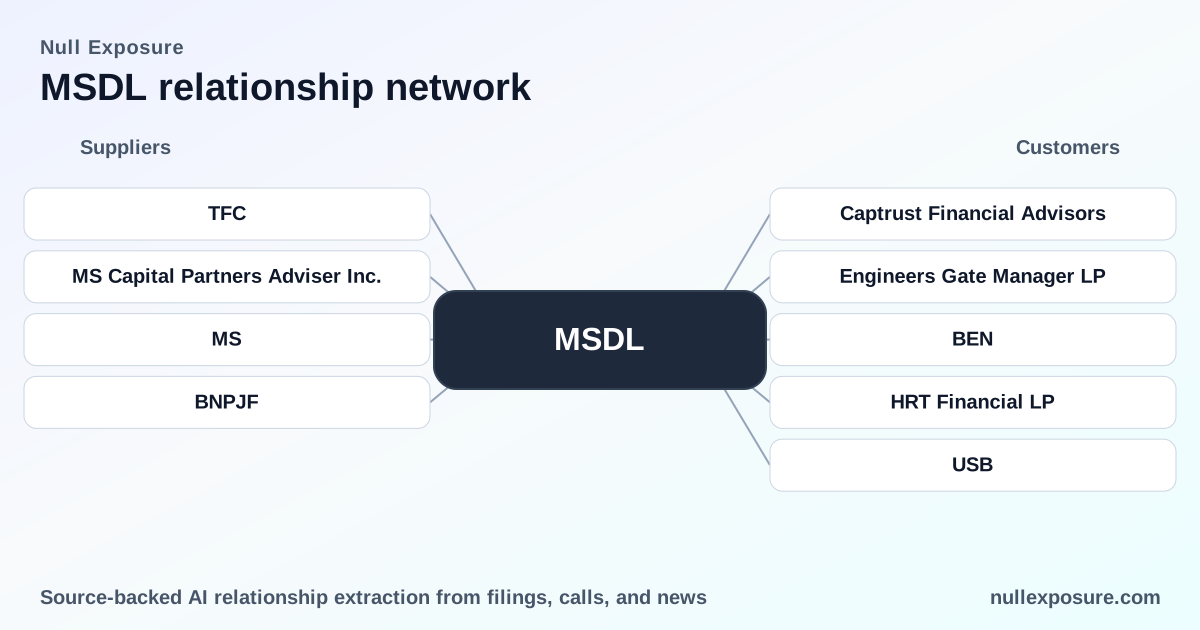
Below are each of the relationships surfaced in public alerts and filings. Each entry is drawn from the same MarketBeat investor alert stream covering March 2026 activity; the link provided with each item points to the underlying report.
BEN (Franklin Resources Inc.)
Franklin Resources increased its stake to 374,761 shares valued at approximately $6.03 million after adding 24,637 shares during the quarter, signaling active accumulation by a large asset manager. According to a MarketBeat instant alert in March 2026, Franklin’s position expansion positions it as a meaningful institutional holder for the period. https://www.marketbeat.com/instant-alerts/morgan-stanley-direct-lending-fund-nysemsdl-given-new-1400-price-target-at-wells-fargo-company-2026-03-02/
Captrust Financial Advisors
Captrust acquired 49,345 shares valued near $924,000, buying an incremental 880 shares in the quarter, consistent with advisory rebalancing into yield instruments for client accounts. MarketBeat’s March 2026 alert records the trade as a modest institutional pickup within the reporting period. https://www.marketbeat.com/instant-alerts/morgan-stanley-direct-lending-fund-nysemsdl-given-new-1400-price-target-at-wells-fargo-company-2026-03-02/
Engineers Gate Manager LP
Engineers Gate initiated a new stake in MSDL in the referenced quarter with a position of about $257,000, representing a small but fresh allocation from a hedge/asset manager. The MarketBeat report from March 2026 shows this as a new entrant to the shareholder base during the quarter. https://www.marketbeat.com/instant-alerts/morgan-stanley-direct-lending-fund-nysemsdl-given-new-1400-price-target-at-wells-fargo-company-2026-03-02/
Franklin Resources Inc. (duplicate entry)
The same Franklin Resources position is listed again in the public alerts: 374,761 shares valued at $6.03 million after acquiring 24,637 shares, reinforcing that Franklin was a net buyer in the quarter. MarketBeat’s alert captures the duplicate disclosure in its March 2026 filing summary. https://www.marketbeat.com/instant-alerts/morgan-stanley-direct-lending-fund-nysemsdl-given-new-1400-price-target-at-wells-fargo-company-2026-03-02/
HRT Financial LP
HRT Financial reported an increment to 176,399 shares valued at about $3.30 million, having added 97,279 shares during the period—a sizable tactical increase that signals conviction from this holder. The MarketBeat instant alert from March 2026 lists this as a substantial accumulation in the quarter. https://www.marketbeat.com/instant-alerts/morgan-stanley-direct-lending-fund-nysemsdl-given-new-1400-price-target-at-wells-fargo-company-2026-03-02/
USB (US Bancorp DE)
US Bancorp DE increased its position to 3,707 shares worth roughly $60,000 after acquiring 1,417 shares in the quarter, reflecting a small custodial or bank‑sponsored account allocation. The MarketBeat March 2026 filing note reports the incremental purchase and current holding size. https://www.marketbeat.com/instant-alerts/morgan-stanley-direct-lending-fund-nysemsdl-given-new-1400-price-target-at-wells-fargo-company-2026-03-02/
US Bancorp DE (duplicate entry)
The US Bancorp DE item appears again in the alerts with the same numbers — 3,707 shares, ~$60,000, confirming the reporting entry in the public alert stream for March 2026. https://www.marketbeat.com/instant-alerts/morgan-stanley-direct-lending-fund-nysemsdl-given-new-1400-price-target-at-wells-fargo-company-2026-03-02/
For a consolidated view of institutional activity and ongoing monitoring, consider reviewing the fund details at https://nullexposure.com/.
What these relationships tell investors about concentration and counterparty risk
Collectively, the reported movements are incremental and dispersed across a range of managers, rather than indicating a single dominant new buyer or seller. MSDL itself reports institutional ownership near 32% and insider ownership around 0.52%, which points to diversified external participation but not overwhelming institutional concentration. The reported buys from long‑only managers, boutiques, and bank custodians demonstrate broad distribution across buyer types, which supports liquidity in the fund’s shares but does not reduce underlying loan concentration risk tied to middle‑market borrowers.
Investment implications and a short risk checklist
- Income orientation: Dividend yield reported at approximately 12.7%, supported by recurring loan interest and fees; investors should underwrite coupon quality and mark volatility.
- Valuation signals: Price‑to‑book around 0.77 and trailing P/E roughly 11.25 indicate market pricing that reflects yield premium and idiosyncratic credit risk.
- Concentration risk: Sector exposures (notably software and services) increase sensitivity to sector‑specific cycles despite a broad 208‑company portfolio.
- External management: Performance depends on Morgan Stanley’s sourcing and monitoring, and fee alignment is material to net returns.
- Contracting posture and maturity: Loan terms are typically five to eight years and floating‑rate; this structure reduces duration risk but preserves credit and liquidity exposures over the medium term (company filings).
Bottom line: MSDL is a yield‑first vehicle that trades on private credit underwriting and manager execution; institutional buys reported in March 2026 are supportive but do not change the fund’s core exposure profile.
For continued updates and curated relationship intelligence on closed‑end credit funds, visit https://nullexposure.com/.
Concluding thought: investors should value MSDL as a platform play on middle‑market private credit — attractive for income if underwriting of borrower credit quality and manager execution is satisfactory, but requiring vigilance on sector concentration, external management fees, and mark volatility.