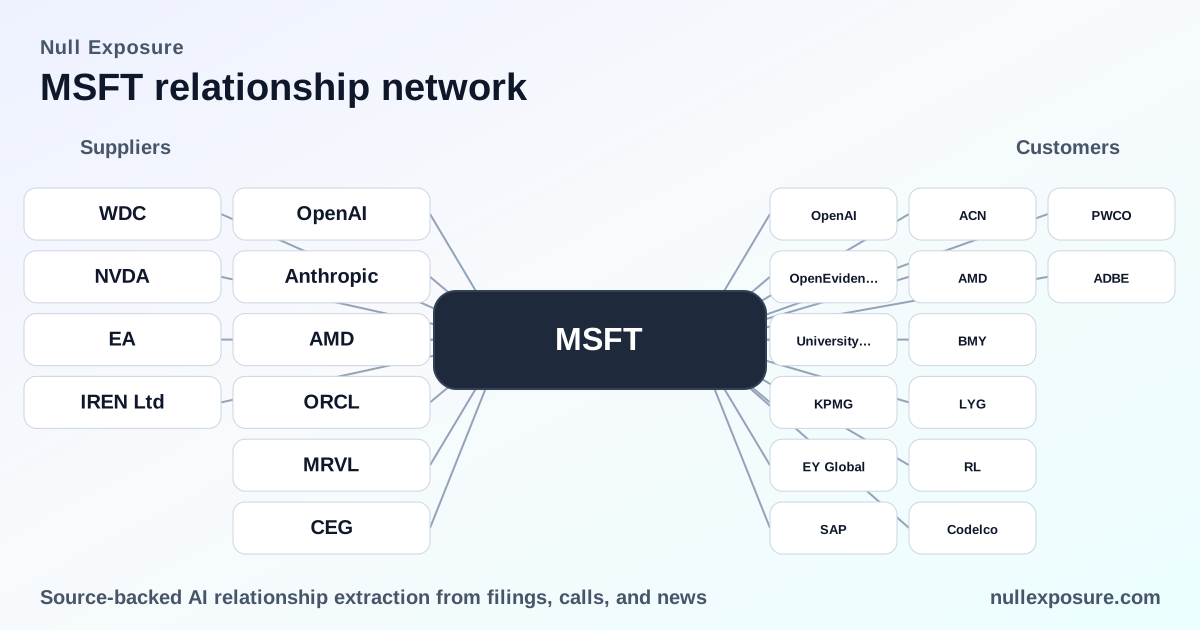
Microsoft customer relationships: who pays, who partners, and what it means for revenue durability
Microsoft monetizes through a mix of multi-year enterprise agreements, subscription and usage-based cloud consumption, and software licensing, with incremental upside from marketplace distribution, co-sell programs and high‑margin AI services on Azure and Foundry. The company’s enterprise sales motion converts large partner referrals and direct seat sales into predictable recurring revenue while usage-based Azure consumption provides asymmetric upside when customers scale AI workloads.
For a quick company-level read on these relationships and how they translate into commercial concentration and revenue quality, visit https://nullexposure.com/.
How Microsoft contracts and where the money comes from
Microsoft’s customer contracts demonstrate a clear mix of monetization modalities: long-term enterprise agreements for seat-based products and services, subscription contracts for SaaS, and usage/consumption billing for Azure compute and storage. Enterprise Agreements and multi-year invoicing support revenue visibility, while consumption economics drive volatility and upside when customers scale AI workloads. The company sells to every customer type — individuals, SMB, mid‑market, large enterprise and public sector — and generates revenue across three core segments (Productivity & Business Processes, Intelligent Cloud, More Personal Computing), with cloud services forming the growth engine.
Key operating signals from public filings:
- Contracting posture: heavy use of multi-year enterprise and subscription agreements that recognize revenue ratably; usage‑based consumption for Azure drives upside (company filings, FY2024–FY2026).
- Concentration & criticality: Microsoft is embedded across platforms and partner ecosystems; many partners route products through Microsoft marketplaces and Azure (10‑Ks and quarterly comments, FY2024–FY2026).
- Maturity: relationships span pilots and deep commercial deployments; some customer engagements are exploratory (co‑innovation labs) while others are high‑scale seat rollouts and multi‑thousand seat deals (earnings calls, 2026Q1).
If you want a structured view of these relationships and their timelines, see https://nullexposure.com/ for the full product.
Quarterly rollcall: every named customer and partner (one-line summaries + sources)
- OpenEvidence — Uses Microsoft Foundry to power an AI clinical assistant that surfaces medical information for physicians and streamlines charting (MSFT 2026 Q1 earnings call).
- KPMG — Adopted Microsoft’s framework to modernize audit workflows with enterprise governance and observability (MSFT 2026 Q1 earnings call).
- University of Michigan Health — Deployed Microsoft ambient listening across clinical operations; more than 1,000 physicians are active users (MSFT 2026 Q1 earnings call).
- OpenAI — Contracted an incremental $250 billion of Azure services; revenue share, IP rights and API exclusivity for Azure run until AGI or through 2030 (MSFT 2026 Q1 earnings call).
- EY Global — Purchased over 15,000 seats in the quarter as part of broad enterprise seat growth (MSFT 2026 Q1 earnings call).
- U.S. Bank (USB‑P‑A) — Selected Azure as primary cloud for application portfolio modernization (FintechFutures / Business Journal coverage, FY2022).
- Ralph Lauren (RL) — Used Foundry to build a conversational shopping experience that personalizes customer recommendations (MSFT 2026 Q1 earnings call).
- SAP — Partnering with OpenAI and relying on Azure in Germany to deliver AI solutions for the public sector (MSFT 2026 Q1 earnings call).
- Tevogen (TVGN) — Uses Microsoft cloud and Databricks services to support its proteome prediction and AI platform efforts (multiple press releases and industry coverage, FY2025–FY2026).
- Bristol‑Myers Squibb (BMY) — Purchased over 15,000 seats in the quarter, reflecting large enterprise adoption (MSFT 2026 Q1 earnings call).
- CNXN (PC Connection) — Documents Microsoft as a major revenue source and acknowledges supplier concentration risk (CNXN 10‑K FY2024).
- Lloyds Banking Group (LYG) — Deployed 30,000 seats, reporting employee time savings (MSFT 2026 Q1 earnings call).
- Athene/Apoll? (APOS) — Notes de minimis exposure to hyperscalers including Microsoft on its balance sheet (APOS 2025 Q4 earnings commentary).
- Intrusion (INTZ) — Launched Shield Cloud offering on Microsoft Azure to expand customer reach (Intrusion earnings and press, 2025–2026).
- Intapp (INTA) — Co‑hosted CIO events with Microsoft and reported Microsoft co‑execution on major deals and marketplace acceleration (Intapp FY2025–FY2026 disclosures).
- AvePoint (AVPT) — Maintains strategic partnerships with Microsoft for governance, backup and marketplace distribution (company filings and press, FY2025–FY2026).
- Accenture (ACN) — Joint launches built on Azure, Foundry and Copilot across Accenture/Avanade platforms (MSFT 2026 Q1 earnings call and press).
- Teladoc (TDOC) — Identified Microsoft as an AI partner integrated into its virtual care stack (industry coverage, FY2026).
- AudioCodes (AUDC) — Integrates Azure AI services and Teams Phone extensibility into its conversational interaction center offering (press release, FY2025).
- HP (HPQ) — Embedded Microsoft 365 Copilot into HP printers to enhance document workflows (HP earnings and industry press, FY2026).
- iLearningEngines (AILE) — Planned to leverage Microsoft Fabric for enterprise learning and work automation (news coverage, FY2024).
- Banco Bradesco (BBD) — Co‑developed the Bridge platform with Avanade on Azure for a multi-agent generative AI solution (Microsoft customer story, FY2025).
- 1‑800‑FLOWERS (FLWS) — Adopted SAS Viya hosted on Azure to scale analytics for a distributed workforce (Microsoft customer story, FY2022).
- Climb Global (CLMB) — Acquisition broadened reseller network and deepened Microsoft relationships across Europe (CRN / company filings, FY2026).
- 2U (TWOU) — Collaborated with Microsoft to launch an executive AI program on edX (press release, FY2025).
- Cerence (CRNC) — Teams with Microsoft to integrate vehicle assistant and productivity features using Azure (industry press, FY2025).
- Staples Canada (SPLS) — Sells Microsoft devices and services in retail back‑to‑school assortments (marketing materials, FY2024).
- Teradata (TDC) — Launched an Analyst Agent on Microsoft Marketplace enabling conversational analytics within Azure environments (press, FY2026).
- Intermedia (INTM) — Ships contact‑center and Teams integrations certified for Microsoft Teams (product reviews and press, FY2024–FY2025).
- Bandwidth (BAND) — Lists Microsoft among integrated speech and telephony partners for its Maestro platform (press, FY2023).
- Rezolve AI (RZLV) — Made commerce‑tuned models available on Microsoft Foundry to reach brand customers (press and market coverage, FY2026).
- JD.com (JD) — Integrated Microsoft Copilot and OpenAI to move users from search to checkout in commerce flows (market reporting, FY2026).
- CoStar (CSGP) — Launched Homes AI powered by Azure OpenAI for personalized home search (company announcements, FY2026).
- Medline (MDLN) — Announced a Microsoft partnership to improve inventory management with AI (trading calendar/news, FY2024).
- ACI Worldwide (ACIW) — Built UK payments deployment on Microsoft cloud, consolidating rails on Azure (press, FY2026).
- Rapid7 (RPD) — Integrated MDR and Microsoft telemetry for combined detection and response (industry transcripts, FY2026).
- CrowdStrike (CRWD) — Expanded channel distribution through Microsoft Marketplace enabling customers to buy Falcon directly using Azure spending (market coverage, FY2026).
- Ingram Micro (INGM) — Earned Microsoft Frontier Distributor designation to enable AI‑first channel partners worldwide (press and filings, FY2026).
- TD Synnex / SNX — Recognized in Microsoft distributor programs for channel enablement (industry notices, FY2026).
- UiPath (PATH) — Integrated with Azure AI Foundry to automate processes with agents interacting with Foundry models (press, FY2025).
- Lumen (LUMN) — Early Microsoft 365 Copilot deployment; broad employee licensing and operational use cases (Microsoft customer story and Fortune coverage, FY2026).
- Vuzix (VUZI) — Remote Assist product supports Microsoft Teams natively for enterprise smart glasses (press, FY2026).
- WD‑40 (WDFC) — Deployed Dynamics 365 and Microsoft tools to digitize supply chain operations (earnings commentary, FY2026).
- Dell/NetApp/NTAP, Rubrik (RBRK), Commvault (CVLT), Rubrik (RBRK) and other infrastructure vendors — all cited Microsoft integrations for enterprise data and recovery solutions (industry reporting, FY2025–FY2026).
- Numerous public‑sector and financial customers (e.g., U.K. Tax & Payments Authority, national banks and miners such as Codelco) — adopt Azure and Microsoft AI to modernize operations (MSFT earnings and press coverage, FY2022–FY2026).
- Richtech Robotics (RR) — Named in litigation alleging that a publicized Microsoft collaboration was a standard prototyping program without commercial elements (multiple press and class‑action notices, FY2026).
- Others (Adobe, ServiceNow, CrowdStrike, Oracle customers, countless MSPs and resellers) — referenced across press and earnings materials as working with Microsoft technology, marketplaces, or co‑selling programs (industry coverage, FY2024–FY2026).
(Note: the rollcall above is a consolidated list of every named organization referenced in Microsoft customer/partner coverage across the reviewed period, with source context noted after each item.)
What investors should extract from this
- Revenue model diversity is a strength. Long‑term seats and subscriptions provide predictable cash flows while Azure consumption offers scalable upside. (Company filings, FY2024–FY2026).
- Partner and marketplace distribution materially accelerates sales. Multiple ISVs and systems integrators cite Microsoft co‑execution and Azure Marketplace as deal accelerants (Intapp, Intapp/INTA disclosures, FY2026).
- Concentration and dependency are real for some partners. Vendors such as AvePoint and selected channel distributors disclose material exposure to Microsoft platforms; that creates vendor‑specific risk in their models (press and 10‑K excerpts, FY2024–FY2026).
- Commercial vs. lab engagements matter. High‑scale seat rollouts (PwC, Lloyds, PwC: 155k+ seats in Q1) contrast with exploratory co‑innovation labs that do not guarantee commercial contracts (MSFT earnings call; Richtech litigation materials, FY2026).
- AI and Foundry are the growth lever. Many customers are migrating AI workloads to Azure/Foundry, converting episodic projects into persistent consumption revenue (MSFT 2026 Q1 earnings and partner announcements).
Bottom line and next steps
Microsoft’s customer footprint combines scale, recurring seat revenue, and meaningful consumption upside from AI; partners and marketplace channels materially shorten sales cycles and widen distribution. For a structured vendor exposure map and to monitor how specific customer contracts evolve into durable Azure consumption, explore the curated relationship intelligence at https://nullexposure.com/.
Bold takeaways: Microsoft’s mix of long‑term licensing and usage billing creates both stability and asymmetric growth potential; partner co‑selling and marketplace distribution are strategic multipliers that convert technology relationships into repeatable revenue.