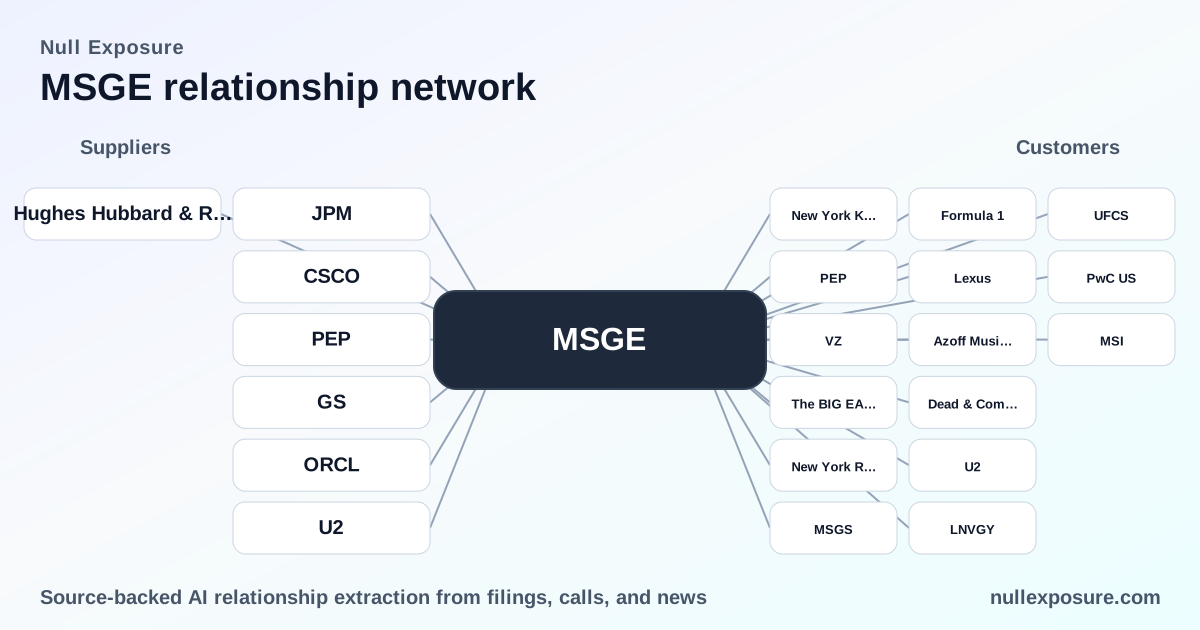
MSGE Customer Map: How Madison Square Garden Entertainment Monetizes Venue Economics
Madison Square Garden Entertainment (MSGE) operates a venue-anchored entertainment business that monetizes through ticketing and promotion, suite and arena licensing, sponsorship and advertising, concessions and merchandise, and recurring show productions. The company leverages long-term arena licenses and multi-year corporate partnerships to stabilize cash flows while product revenue (concerts, tours, attractions like Sphere) drives variable upside. For a concise institutional briefing and relationship monitoring, visit https://nullexposure.com/.
Why customers matter to MSGE investors
MSGE's model is a hybrid of predictable, contract-driven cash (licensing, suites, arena fees) and volatile event-driven revenue (concerts, family shows, sports seasons and sponsorships). Long-term license arrangements and suite agreements anchor revenue, while sponsorships and headline acts deliver margin expansion and utilization. Institutional investors should treat MSGE as a venue operator with promotional upside rather than a pure content house.
Operating constraints and business-model signals investors must track
- Contracting posture: Long-term, locked-in revenue streams. MSGE’s disclosures describe 35-year arena license terms for the Knicks and Rangers and multi-year suite and sponsorship contracts; these contracts create durable, predictable cash tied to venue access and shared economics. The Knicks/Rangers arena license is explicitly documented in company filings.
- Licensing and seller role: The company acts as principal for suite licenses and merchandise sales, recognizing revenues on a gross basis and controlling access and inventory; this increases revenue visibility but also concentrates operational responsibilities.
- Geographic concentration: All revenues and assets are U.S.-based, primarily concentrated in the New York City metro area; MSGE’s economics are therefore sensitive to NYC demand cycles and tourism flows.
- Customer concentration: No single customer represented 10% of revenue in FY2023–FY2025, signaling revenue diversification across events and sponsors even as a few long-term partners are strategically important.
- Service provision: MSGE provides centralized services (IT, HR, marketing) to related entities under service agreements, reflecting shared infrastructure and internal cost allocation that investors should monitor for related-party dynamics.
- Segment focus: The company reports as a single operating segment (MSG Entertainment), reinforcing that venue operations and promotions are the primary profit center.
Collectively, these signals imply high contractual maturity and operational centrality of venue relationships, offset by event-by-event revenue volatility.
Customer relationships — direct excerpts and sources
Below are every customer relationship documented in the provided results, each with a concise investor-facing summary and source note.
Pepsi
MSGE renewed a multi-year sponsorship deal with Pepsi, signaling continued consumer-packaged-goods support for venue-level advertising and promotions. Management cited the renewal on the FY2025 Q4 earnings call. (msge-2025q4-earnings-call, 2025Q4)
The BIG EAST Conference
The BIG EAST extended its agreement to hold the conference tournament at Madison Square Garden through 2028, securing a multi-year event anchor for the arena. (Villanova news release, FY2018)
New York Knicks (Billboard / FY2022)
MSGE holds long-term arena license agreements covering Knicks home games, embedding NBA schedule-driven traffic and suite economics in revenue. (Billboard report on FY2022 spin-off)
New York Rangers (Billboard / FY2022)
Long-term arena license coverage includes the Rangers, providing NHL season revenue and associated suite/concession upside. (Billboard report on FY2022 spin-off)
Verizon
MSGE confirmed a multi-year renewal with Verizon, reinforcing telecom sponsorship and naming/signage revenue lines. (msge-2025q4-earnings-call, 2025Q4)
VZ (earnings call duplicate)
Management reiterated Verizon as a renewed multi-year partner during the FY2025 Q4 call. (msge-2025q4-earnings-call, 2025Q4)
MSGS (PR Newswire FY2024)
Arena license accounting disclosures reference MSG Sports (MSGS) and shared economics under the Arena License Agreements, indicating material intercompany commercial arrangements. (PR Newswire, FY2024)
New York Rangers (TicketNews FY2025)
MSGE’s FY2025 revenue commentary explicitly includes the Rangers’ season as a core revenue driver along with concerts and family shows. (TicketNews, FY2025)
MSGS (PR Newswire FY2025)
MSGE reported increased revenues subject to sharing with MSG Sports under Arena License Agreements, citing higher suite license fee revenues in FY2025. (PR Newswire, FY2025)
Lexus
Lexus renewed a multi-year marketing partnership with the MSG family, maintaining automotive luxury presence in sponsorship inventory. (Times of India report on FY2021 renewal)
Azoff Music Management
Azoff bought out MSG’s 50% interest in a joint venture for $125 million, a transaction that cleared legacy JV exposure tied to artist management. (Variety, FY2018)
New York Knicks (TicketNews FY2025)
TicketNews cited the Knicks season as part of MSGE’s FY2025 revenue mix, reaffirming the team’s role in seasonal utilization. (TicketNews, FY2025)
New York Knicks (MSGE FY2025 Q1)
MSGE noted the Knicks began their 2025–26 regular season at The Garden, underlining continuity of arena scheduling. (MSGE fiscal 2026 Q1 release, referencing FY2025 season timing)
New York Rangers (MSGE FY2025 Q1)
MSGE reported the Rangers commenced the 2025–26 season at The Garden, confirming ongoing arena license performance. (MSGE fiscal 2026 Q1 release)
Madison Square Garden Sports Corp. (PR Newswire FY2024)
Company filings adjusted accounting treatment for operating lease revenue related to Arena License Agreements with MSG Sports, emphasizing the financial link between MSGE and MSGS. (PR Newswire, FY2024)
MSGS (PR Newswire FY2024 duplicate)
The FY2024 release reiterates the Arena License Agreement effects on reported operating lease revenue between MSGE and MSG Sports. (PR Newswire, FY2024)
Madison Square Garden Sports Corp. (PR Newswire FY2025)
PR Newswire FY2025 noted that revenue sharing with MSG Sports increased due to higher suite license fees, demonstrating the revenue mechanics of the arena license. (PR Newswire, FY2025)
Formula 1
MSG entered a deal related to the Las Vegas Formula 1 race, expanding partnership activity tied to major live-event sponsorships. (Front Office Sports report, FY2022)
the National Hockey League’s Rangers (TradingKey FY2026)
Public coverage highlights that MSGE hosts the NHL’s Rangers as a principal tenant, reinforcing core arena tenancy. (TradingKey market summary, FY2026)
LNVGY (Lenovo) — earnings call
Management confirmed Lenovo (and subsidiary Motorola) as new partners welcomed during fiscal 2025, signaling corporate sponsorship additions. (msge-2025q4-earnings-call, 2025Q4)
New York Knicks (FrontOfficeSports FY2022)
Long-term arena license deals with the Knicks are documented as foundational commercial relationships. (Front Office Sports, FY2022)
New York Rangers (FrontOfficeSports FY2022)
Front Office Sports also documents long-term license deals tying the Rangers to The Garden. (Front Office Sports, FY2022)
Dead & Company
MSG Sphere’s programming success includes headline acts like Dead & Company, contributing to venue-level box office performance. (Hollywood Reporter, FY2024)
U2
U2 is cited among successful acts at MSG Sphere, underscoring the draw of marquee performers for ticketing revenue. (Hollywood Reporter, FY2024)
the National Basketball Association’s Knicks (TradingKey FY2026)
TradingKey reiterates that MSGE hosts the NBA’s Knicks, a repeated confirmation of tenancy and suite economics. (TradingKey, FY2026)
Lenovo (earnings call duplicate)
Lenovo’s partnership (including Motorola) was affirmed on the FY2025 Q4 earnings call. (msge-2025q4-earnings-call, 2025Q4)
UFCS / UFC
Coverage credits Sphere with generating recurring revenue from film and a marketing business, with events like upcoming UFC fight nights enhancing live-event revenue. (Hollywood Reporter, FY2024)
PwC US
MSG family companies announced PwC US as a multi-year marketing partner and the Official Business Consulting Partner of the Arena, Knicks and Rangers, strengthening B2B sponsorship inventory. (Markets/FinancialContent press release, FY2025)
Radio City Rockettes
The Radio City Rockettes’ Christmas Spectacular sold 1.1 million tickets across 200 shows, delivering record-setting seasonal revenue for MSGE. (TicketNews, FY2025)
Motorola
Motorola—identified as a Lenovo subsidiary—was named among new partners in fiscal 2025, broadening the company’s technology sponsorship base. (msge-2025q4-earnings-call, 2025Q4)
Investment implications and closing view
Key investment thesis: MSGE combines durable contractual cash (arena licenses, suite fees, sponsorships) with high-margin event upside (concerts, Sphere programming, seasonal attractions). The primary risks are NYC demand sensitivity and event scheduling variability; the primary strengths are long-dated arena licenses and diversified sponsorships that stabilize baseline cash flow.
For institutional monitoring and to track changes in partner renewals or accounting treatment affecting shared-revenue lines, explore the MSGE relationship dashboard at https://nullexposure.com/.
For a tailored briefing or to receive updates on MSGE counterparty events and contract renewals, visit https://nullexposure.com/.