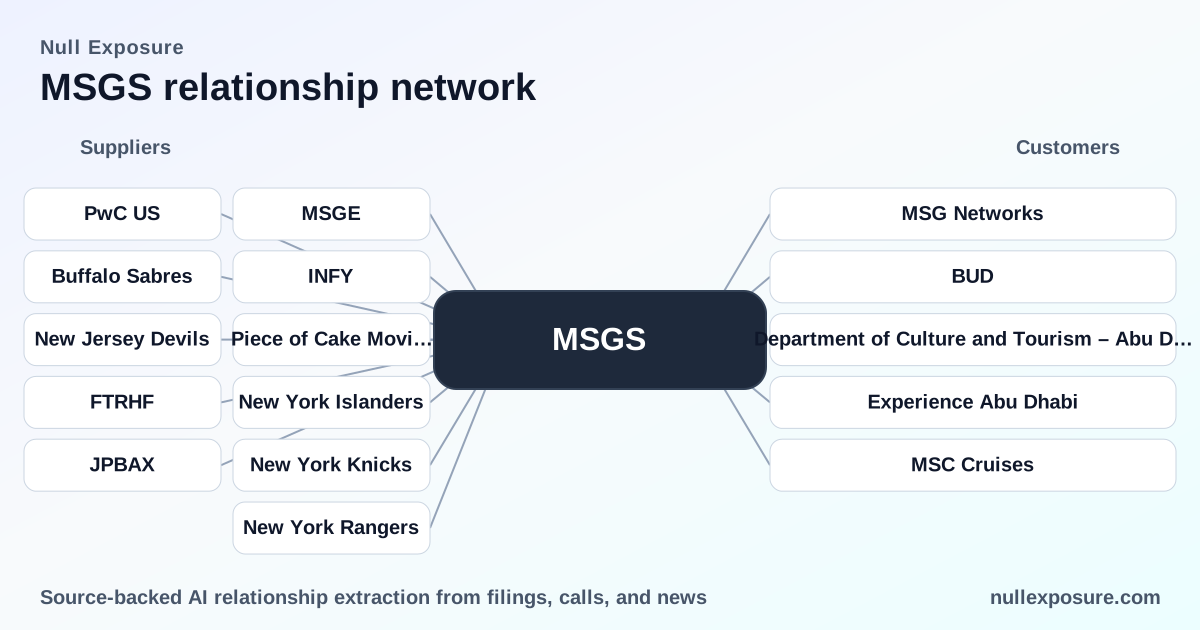
MSG Sports: Customer relationships that underwrite local rights, corporate partnerships and recurring premium revenue
Madison Square Garden Sports Corp (MSGS) monetizes premium live sports assets by combining long-term media licensing, corporate sponsorships, and multi-year suite and hospitality agreements tied to the New York Knicks and New York Rangers. The company’s cash flow profile is driven by a concentrated set of high-value counterparty relationships—notably local media rights with MSG Networks and an expanding roster of global sponsors—that together create predictable recurring revenue but leave timing and renewal of a handful of contracts as principal risk drivers. For a quick view of the platform and relationships, visit https://nullexposure.com/.
How the relationships translate into cash flow and strategic leverage
MSG Sports operates as an integrated rights holder and promoter: it controls team inventory (tickets, suites, sponsorship signage), negotiates licensing for local telecasts, and packages access for global brands. Media rights historically created a significant recurring revenue stream; sponsorships and corporate suite licensing provide diversification and premium-margin services. Contracting posture is skewed toward licensing and long-duration commercial commitments—many counterparty agreements include multi-year terms and annual escalators—so revenue recognition and renewal terms are central to forward visibility.
- Concentration: Substantially all revenue and assets sit in the U.S., primarily the New York City market, increasing exposure to local demand and regional media economics.
- Criticality: Media rights and suite licenses are material to cash flows—the 10‑K records multi-year local media rights with substantial annual fees.
- Maturity: Several relationships are multi-year and active today, but a small number of large agreements dominate revenue, so near-term amendments or renewals materially affect results.
Who the customers and partners are — plain-language takeaways
MSG Networks
MSG Networks holds local telecast rights for Knicks and Rangers games under media rights agreements amended in June 2025 and running through the 2028–29 seasons; the 10‑K states these arrangements generate material local media rights revenues for MSG Sports. According to MSGS’s FY2025 Form 10‑K, local media rights revenues for the Knicks and Rangers totaled $157.4 million in fiscal 2025 and the amended agreements will be recorded at reduced rates going forward. (Source: FY2025 10‑K, amendments summarized June 2025.)
Anheuser‑Busch (BUD)
Anheuser‑Busch expanded a multi‑year sponsorship across the MSG Family of Companies as an Official Sponsor, giving the brewer portfolio‑level exposure across sports and entertainment assets. This press release frames Anheuser‑Busch as a strategic global sponsor within MSG Sports’ broader commercial program. (Source: Business Wire / FinancialContent press release, January 7, 2026.)
Lenovo
Lenovo signed a multi‑year partnership to be an Official Partner across Madison Square Garden attractions and professional franchises and will receive brand inclusion across MSG Networks, extending the company’s international technology branding into MSG Sports’ media and venue inventory. (Source: Lenovo press release, May 3, 2026.)
Motorola Mobility
Motorola — operating as a Lenovo subsidiary in this announcement — will act as an Official Partner of Madison Square Garden and the Knicks and Rangers, placing hardware and mobile branding into MSG Sports’ event and team programs. (Source: Lenovo press release, May 3, 2026.)
Department of Culture and Tourism – Abu Dhabi
The Department of Culture and Tourism – Abu Dhabi partnered with MSG Sports to place Experience Abu Dhabi branding on Knicks jerseys for the season, representing a tourism‑driven marketing relationship tied to premium team inventory. (Source: SportsTravelMagazine coverage, referenced March 2026.)
Experience Abu Dhabi
Experience Abu Dhabi, as the tourism brand executing the above campaign, secured jersey placement and marketing rights with the Knicks in a season‑long partnership that illustrates MSG Sports’ ability to monetize team inventory for destination marketing. (Source: SportsTravelMagazine coverage, referenced March 2026.)
MSC Cruises
MSC Cruises became the New York Knicks’ official cruise line partner and the team’s first global rights marketing partner, reflecting an effort to broaden corporate sponsorships beyond traditional U.S. consumer brands into travel and leisure partners. (Source: TravelMarketReport, partnership announced in FY2023 coverage.)
Contract terms and company‑level constraints that matter to investors
The company disclosures and press coverage reveal several structural constraints that shape MSGS’s revenue profile:
- Licensing and media‑rights orientation (high confidence): The 10‑K explicitly records media rights agreements and June 2025 amendments, confirming core revenues are licensed rights fees. This is an explicit, named relationship with MSG Networks and is material to fiscal results.
- Long‑term contracting posture (high confidence): Multiple excerpts describe multi‑year agreements and suite licenses with annual escalators, supporting revenue durability but concentrating renewal risk into multi‑year decision points.
- Materiality of media rights (high confidence): The company notes a significant recurring revenue stream from long‑dated media agreements originally negotiated in 2015 and still material in FY2025.
- Geographic concentration (high confidence): Management discloses that substantially all revenues and assets are attributed to the U.S. and primarily the New York City metro area, increasing sensitivity to local market dynamics.
- Large enterprise counterparties (moderate confidence): Corporate partners include global brands—Anheuser‑Busch, Lenovo/Motorola, MSC Cruises and others—indicating institutional sponsorship revenue and diversified commercial audiences.
- Spend scale (very high confidence): Local media rights revenues are in the hundreds of millions (FY2025: $157.4M), establishing that a small number of counterparties represent large annual cash flows and therefore concentrated vendor/customer exposure.
Where the filings name a counterparty (MSG Networks), the constraint is applied specifically; other constraints are presented as company‑level signals that affect all customer relationships.
Investment implications — what to watch and why it matters
The commercial model delivers predictable, high‑value recurring revenue via media rights and long‑term corporate suites and sponsorships, but the balance sheet and valuation dynamics reflect concentrated risk: media rights amendments reduced revenue rates in FY2025, and the remaining term on local telecast agreements runs only through the 2028–29 season, focusing investor attention on renewal economics. Financials show Revenue TTM of $1.071B and Gross Profit TTM of $351.1M while EPS remains negative (-$0.68 TTM), signaling operating leverage but also margin pressure in some periods.
Key monitoring items for analysts:
- Renewal terms and pricing of the MSG Networks telecast agreements as they approach 2028–29.
- Sponsorship pipeline and international partners (Lenovo, Anheuser‑Busch, MSC) that can offset media rights variability.
- Suite and hospitality contract renewals and escalation clauses that preserve margin.
For continued tracking of MSG Sports’ customer landscape and to map contract expiries against revenue sensitivity, visit https://nullexposure.com/.
Bottom line
MSG Sports converts premium team inventory into large, predictable revenue lines through a small set of strategically important counterparties—media licensing with MSG Networks and global sponsorships with household brands—but investor returns hinge on renegotiation outcomes and the company’s ability to sustain sponsorship growth as media‑rights economics evolve. The next three years of contract renewals and sponsorship renewals are the defining horizon for revenue trajectory and valuation re‑rating.