MSC Income Fund (MSIF): Income-first, private-loan focused, and actively managing exits
MSC Income Fund, Inc. (MSIF) operates as a closed-end investment company that monetizes by originating and holding income-producing private loans and select fixed-income securities while harvesting returns through interest income, periodic principal paydowns, and occasional equity upside and realized gains. The fund is shifting toward a concentrated Private Loan strategy focused on U.S. middle-market borrowers and is steadily monetizing its legacy lower-middle-market (LMM) portfolio to redeploy capital into longer-duration, secured debt. For a quick company profile and deeper signals, visit https://nullexposure.com/.
Key relationships that move the income stream
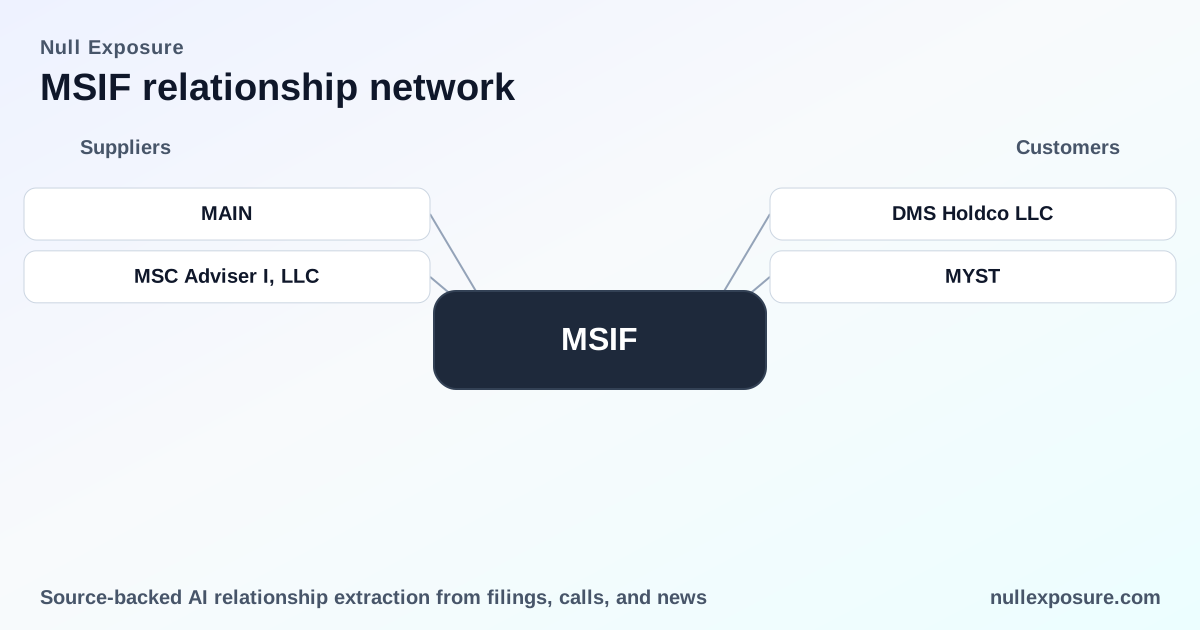
MSIF’s recent public signals show two active deployment and monetization threads: fresh private loan/equity deployments alongside Main Street Capital into DMS Holdco LLC, and a realized exit from a legacy LMM holding, Mystic Logistics. These transactions illustrate the dual mechanics of MSIF’s model: deploy secured, mid-market debt for yield, and crystallize gains by exiting LMM equity stakes when valuation or strategy shifts warrant.
DMS Holdco LLC — strategic first‑lien loan plus equity co-investment
MSIF committed capital alongside Main Street Capital to provide $20.8 million in first‑lien, senior secured debt and $4.8 million in direct equity to DMS Holdco LLC to support DMS’s acquisition of Johnson & Quin. This structure combines secured yield with limited equity upside tied to a specific acquisition-driven growth event. According to an Intellectia news report covering MSIF’s FY2026 activity, the combined commitment totaled $25.6 million (Intellectia, March 10, 2026). Key takeaway: the deal exemplifies MSIF’s preference for secured, mid-market debt augmented with small equity stakes to capture upside.
Mystic Logistics (MYST) — complete exit and realized gain
MSIF reported a full exit of its investment in Mystic Logistics during Q4 2025, realizing a $6.0 million gain, demonstrating active portfolio pruning of LMM holdings and the capacity to monetize secondary returns when appropriate. This was disclosed in MSIF’s Q4 2025 earnings call and accompanying commentary (MSIF Q4 2025 earnings call transcript, March 7, 2026). Key takeaway: realized exits like Mystic both fund redeployment into the Private Loan strategy and validate MSIF’s ability to capture embedded value in legacy investments.
(Each of the above relationships is drawn from MSIF public disclosures and contemporaneous news coverage in March 2026 documenting FY2026 activity.)
How MSIF’s operating model shapes these relationships
MSIF’s deal footprints and portfolio actions are not random — they are structured and strategic. The firm’s public filings and disclosures reveal company-level operating constraints and tilt:
- Contracting posture: long-term, secured loans. MSIF’s Private Loan investments are typically secured by a first-priority lien and have original terms of three to seven years, which creates predictable coupon-like cash flow but longer liquidity horizons (company filings).
- Counterparty profile: mid‑market borrowers. The Private Loan strategy targets privately held companies with annual revenues of roughly $25–$500 million and EBITDA of $7.5–$50 million, with individual investments generally ranging $1 million to $30 million—consistent with the DMS commitment scale (company filings).
- Geographic concentration: U.S.-centric. Portfolio headquarters are generally U.S.-based, anchoring MSIF’s credit exposure to North American economic cycles (company filings).
- Role dynamics: occasional seller and principal investor. MSIF has acted as a seller of its own common shares to Main Street in historical years, and it is principally an investment firm that originates and holds Private Loans rather than a pure service provider (company filings).
- Portfolio lifecycle: winding down non-core LMM investments. The firm has intentionally stopped making new LMM platform investments and expects its LMM and other legacy portfolios to decline over time as positions are repaid or sold, which frames exits like Mystic Logistics as part of an orderly run‑off strategy (company disclosures).
These constraints imply a business model that is income-focused, credit-centric, and moving toward greater homogeneity in counterparty and collateral profiles, with the trade-off that liquidity and concentration risk increase as new investments skew to multi-year secured loans.
Concentration, valuation, and distribution context
MSIF trades as a closed-end vehicle with a Market Capitalization of approximately $619 million, a reported dividend per share of $1.40 and an implied dividend yield of ~10.5%, and a Price/Book near 0.83, reflecting market discounts often seen in closed-end funds that hold less liquid assets (company overview). These metrics signal both attractive current income and potential valuation risk if underlying credit performance weakens.
Institutional ownership is moderate (about 23.5%) with insiders holding under 0.5%, which underscores that price discovery is driven by the market’s view on NAV, discount/premium dynamics, and expected credit outcomes.
What investors and operators should watch next
- Credit performance across the mid‑market private loan book will determine whether high current yields translate into sustainable distributions or become a depleting yield from NAV contraction.
- The pace of redeployment: MSIF’s continued liquidation of LMM positions funds Private Loan originations; a continued shift will increase concentration in secured, multi‑year loans.
- Realized gains versus underwriting: exits such as Mystic Logistics provide liquidity and upside validation; the frequency and size of such exits will influence total return and distribution sustainability.
- Secondary partnership dynamics: co-investments alongside Main Street Capital demonstrate MSIF’s willingness to split risk and share originations, which affects capital allocation and potential governance leverage.
For ongoing monitoring and a deeper signal suite on MSIF’s counterparties and realized activity, see https://nullexposure.com/.
Bottom line for investors
MSIF’s model is deliberately income-first, anchored in secured private loans to U.S. middle-market companies, and supported by selective equity exposure and opportunistic exits. Transactions like the DMS commitment and the Mystic Logistics sale illustrate the dual mechanics of deployment and monetization that drive returns. Investors should weigh attractive current yield and realized-gain potential against concentration, liquidity, and mid-market credit risk inherent to a long-term, secured lending strategy.