MSN: Who Buys Emerson Radio and Why it Matters to Investors
Emerson Radio Corporation (MSN) is a small, branded consumer electronics and housewares merchant that monetizes through product sales from warehoused inventory and trademark licensing to third parties. Its revenue base is concentrated in a handful of mass merchandisers and online marketplaces, with a mix of short-term order-driven product sales and recurring licensing receipts that generate deferred revenue. Investors should treat MSN as a highly concentrated, low-margin retail supplier with meaningful counterparty and working-capital exposure. For a deeper lens on customer relationships, visit https://nullexposure.com/.
One-line executive snapshot
- Revenue concentration is acute: in fiscal 2025 two customers — Amazon and Walmart — together accounted for approximately 70% of net revenues; trade receivables are similarly concentrated and have shifted year-over-year.
- Operating posture is transactional and short-term, supported by licensing income but largely dependent on continued purchase orders and timely payments from a small group of large retailers.
Customer-by-customer breakdown: who drives MSN’s cash flow
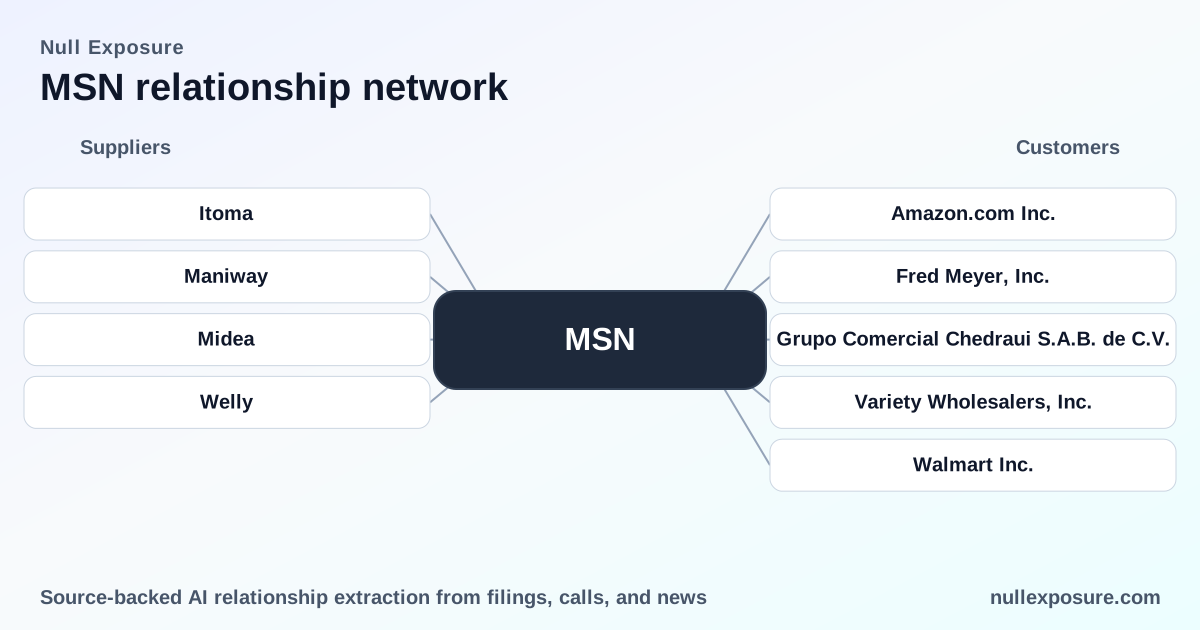
Amazon.com Inc.
Amazon accounted for approximately 39% of Emerson’s net revenues in fiscal 2025, making it the company’s largest single customer for that year. Source: company 10-K for the fiscal year ended March 31, 2025.
Walmart Inc.
Walmart accounted for approximately 31% of net revenues in fiscal 2025, and historically has been the largest single retailer for the company in prior periods. Source: company 10-K for the fiscal year ended March 31, 2025.
Fred Meyer, Inc.
In fiscal 2024, Fred Meyer made up approximately 10% of net revenues, illustrating that regional wholesalers and banner-specific relationships also contributed material sales in prior years. Source: company 10-K for the fiscal year ended March 31, 2024.
Grupo Comercial Chedraui S.A.B. de C.V. (Chedraui)
As of March 31, 2024, Chedraui represented roughly 30% of the company’s trade accounts receivable (net of reserves), signaling significant receivables exposure to the Mexico-based mass merchandiser even though revenue share disclosures focus on U.S. retailers. Source: company 10-K (disclosure as of March 31, 2024).
Variety Wholesalers, Inc.
As of March 31, 2025, Amazon and Variety Wholesalers comprised approximately 59% and 19% of trade accounts receivable, respectively, highlighting a receivable concentration that differs from revenue percentages and points to collection and credit exposure dynamics. Source: company 10-K (disclosure as of March 31, 2025).
What the supply-and-customer signals tell investors about MSN’s operating model
Emerson’s public disclosures establish several company-level characteristics that shape risk and upside:
- Contracting posture — short-term, order-driven: The company states it “does not have long-term contracts with any of its customers, but rather receives orders on an ongoing basis,” which creates volatility tied to order cadence and buyer assortment decisions. This is a company-level contracting signal from the 10-K.
- Licensing is a defined but distinct revenue stream: Emerson grants licenses to use its trademarks and records deferred revenue related to these licenses; licensing includes guaranteed minimum royalties or a greater-of arrangement. Licensing provides recurring cash but is not a substitute for concentrated retail sales. Evidence is drawn from the company’s licensing disclosure in its annual report.
- Geographic focus — North America: The company markets products “exclusively in the United States, Canada and Mexico,” concentrating geographic revenue and credit exposure in North America. This limits diversification benefits and ties performance to the North American retail cycle.
- Materiality and concentration risk are explicit: Management confirms that the loss or significant reduction of sales to one of its key customers would have a material adverse effect on financial results, and trade receivables are highly concentrated among two or three customers.
- Dual role — seller and licensor: Emerson operates as a single segment covering product sales and licensing revenue, selling Emerson-branded product through mass merchandisers and online marketplaces while also licensing its trademark. This hybrid model reduces product-development burden but keeps brand exposure tied to partners’ merchandising strategies.
- Core product maturity: The company’s core business is low- to moderately-priced consumer electronics and houseware products, categories that compete on price and placement rather than proprietary technology, implying margin pressure and limited pricing power.
Operational and financial implications for investors
- Cash-flow volatility is the primary risk. With large percentages of revenue coming from two retailers and receivables concentrated among a small number of buyers, a slowdown in order flow or payment delay could quickly stress liquidity.
- Margin compression is structural. The mix of low-priced consumer goods and heavy retail discounting constrains gross profit; reported gross profit and operating margin metrics are weak, consistent with the company’s latest trailing figures.
- Licensing is a stabilizer, not a savior. Licensing receipts create deferred revenue and some predictability, but the company continues to rely on ongoing product sales to mass channels for the majority of cash generation.
- Short-term contracting reduces lock-in but increases exposure to retail assortment decisions. Without long-term purchase commitments, Emerson’s inventory turns and working capital are sensitive to retailer ordering patterns and promotional cycles.
Investment takeaways and final verdict
- Primary risk: customer concentration and receivable concentration. Two retailers accounted for roughly 70% of revenue in FY2025; receivables are similarly concentrated and have moved between periods, creating acute counterparty exposure.
- Secondary risk: low-margin, competitive product set. The product portfolio competes on price and placement, limiting margin expansion potential.
- Stabilizers: licensing income and North American footprint. Trademark licensing provides recurring revenue and the company focuses on the contiguous North American market, simplifying logistics and distribution.
For investors focused on counterparty exposure and cash-flow resilience, Emerson is a case of concentrated retail dependency coupled with limited pricing power — a high-risk, potentially high-turnover play that requires close monitoring of buyer order patterns and receivables aging. For more granular relationship analytics and historical disclosure comparisons, see https://nullexposure.com/.