Maison Solutions (MSS): Customer relationships that shape a microcap specialty grocer
Maison Solutions operates as a regional, specialty grocery retailer focused on Asian food and merchandise, with core revenues generated from in-store supermarket sales and a growing, productized software and services line. The company monetizes through traditional retail margins (annual revenue TTM $118.7M) while supplementing cash flow with software license sales ($2.6M in other income for FY2025) and consulting fees (~$0.45M), creating a hybrid retail-plus-software business model that compresses the typical grocery operating profile but concentrates counterparty and geographic exposure. For investors evaluating customer relationships, the interplay between retail competition, licensed software distribution, and transaction economics is the primary driver of upside and downside. For background and relationship analytics visit https://nullexposure.com/.
Business snapshot: Maison is a small-cap, high-insider-ownership operator headquartered in Monterey Park, California (Market Cap ~$4.65M; EBITDA negative $8.52M; Shares outstanding ~2.88M). The company runs stores in Southern California and the Phoenix/Tucson Arizona metros and recorded over 3.8 million annual transactions in FY2025, underscoring operational scale at the store level but financial fragility at the corporate level (negative operating margin and net loss).
What the relationship list tells investors
- Maison frames major supermarket chains and online grocers as competitive counterparts, not as customers — competition dynamics shape pricing, foot traffic, and digital strategy.
- Maison also functions as a licensor and service provider: it sold software licenses and delivered consulting services to other supermarkets, creating a modest but meaningful non-retail revenue stream that changes its contracting posture from pure merchant to multi-role vendor.
- The company recently divested a joint-venture interest to a local operator, a transaction that removes a capital commitment and alters local market footprint.
Key relationships (complete list and source notes)
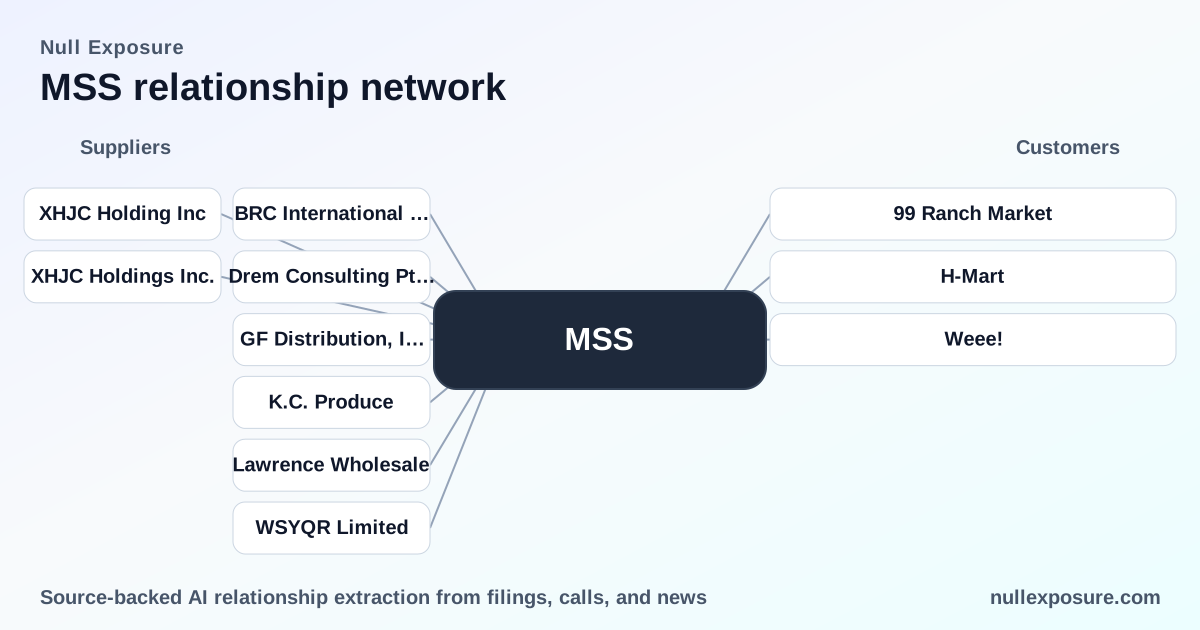
- 99 Ranch Market — Maison lists 99 Ranch Market as a principal competitor in conventional supermarket retail. According to Maison’s FY2025 Form 10-K, 99 Ranch Market is identified alongside H‑Mart as a primary rival for conventional supermarkets, reflecting direct competition for the same Asian‑food customer base and store-level traffic in the California market (FY2025 10‑K filing).
- H‑Mart — H‑Mart is explicitly named in the FY2025 10‑K as a principal competitor for conventional supermarkets, positioning Maison against a national specialty grocer with broader scale and sourcing advantages that pressure margin and local market share (FY2025 10‑K filing).
- Weee! — Maison identifies Weee! as a principal competitor on the online grocery front in its FY2025 10‑K, indicating that digital fulfillment and delivery channels are contested and that Maison’s customer-facing apps and integrations compete with established e-commerce players (FY2025 10‑K filing).
- JC Business Guys, Inc. — On January 31, 2026, Maison executed a Buy‑Sell Agreement to divest its 49% interest in HKGF Market of Arcadia, LLC to JC Business Guys, Inc. for a nominal purchase price of $1.00 following board approval on January 27, 2026; the transaction closed the same day and was reported via a company press release amplified by The Globe and Mail (press release reported Jan 31, 2026).
Operating-model constraints and what they imply for customer exposure
- Licensing and software segment: productized IP with perpetual, non-exclusive grants. Maison reported $2.6M of income in FY2025 from sale of licenses for two software systems (smart shelf display & store design; supply chain management) to four licensees with perpetual, non-exclusive, non-transferable rights. This establishes Maison as a licensor with productized software revenue that reduces pure retail cyclicality and creates recurring, albeit currently limited, margin streams (FY2025 10‑K).
- Service-provider activity complements licensing. The company recorded roughly $0.45M in consulting income for operational improvement services delivered to other supermarkets in FY2025, establishing Maison in a service-provider role that leverages operating know-how but exposes it to labor and delivery risk tied to consulting contracts (FY2025 10‑K).
- Seller and related-party sales signal concentration risk. Maison disclosed related-party supermarket product sales totaling ~$393k, signaling intercompany commercial flows that investors should monitor for revenue quality and potential circularity (FY2025 10‑K).
- Buyer-side digital channels and cashier-less experiences. Maison enables orders via third-party mobile apps (Freshdeals24) and a WeChat applet for home delivery or in-store pickup, aligning it as a buyer of digital channel services and exposing the company to third-party platform risks and integration costs (FY2025 10‑K).
- Geographic concentration in the North American West: operational scale and vulnerability. The company operates stores in Los Angeles area and in Phoenix/Tucson, with the FY2025 filing noting over 3.8M transactions; this concentration amplifies local competitive dynamics and regulatory/operational shocks (FY2025 10‑K).
- Counterparty mix skewed to individuals/customers and a small number of licensees. Filings characterize Maison’s customer base as modern U.S. consumers in Asian-American communities, and licensing deals were made to four licensees — the combination produces a retail revenue base of many individuals and a small set of institutional licensees (FY2025 10‑K).
Investor implications: risk, optionality, and focus areas
- Risk — margin pressure from competitors: Direct competition from established chains such as 99 Ranch Market and H‑Mart, coupled with online competition from Weee!, compresses gross margins and necessitates differentiation at the store and digital level. Maison’s operating loss and negative EBITDA highlight execution risk at current scale (FY2025 10‑K; financials).
- Optionality — software and consulting are de‑risking revenue channels if scaled. The $2.6M license sale and $0.45M consulting income demonstrate an ability to monetize proprietary systems and know‑how; scaling licensing beyond a handful of deals would materially diversify cash flow and increase gross margin contribution.
- Concentration and counterparty risk: Heavy insider ownership (≈58% insiders) and minimal institutional holdings constrain external governance pressure and liquidity; localized store footprint concentrates operational risk in select metro areas.
- Event risk reduced by JV divestiture: The nominal sale of the Arcadia JV stake to JC Business Guys for $1 removes an ownership obligation and potentially simplifies capital allocation, but also reduces local store exposure and any upside from that JV’s growth (press release reported Jan 31, 2026).
What investors should track next
- Growth in licensees and repeatable software revenue versus one‑time license sales; additional licensing deals would convert a boutique software effort into a scalable, higher-margin segment (FY2025 10‑K).
- Same-store sales and transaction economics relative to 99 Ranch Market and H‑Mart in overlapping trade areas, and shifts in online order share versus Weee! (FY2025 10‑K).
- Any post‑divestiture arrangements or transitional services linked to the Arcadia JV sale to JC Business Guys that could affect local supply, pricing, or store operations (press release reported Jan 31, 2026).
Conclusion: Maison’s customer and partner map blends traditional grocery competition with nascent software licensor economics. For investors, the critical question is whether the company can scale its software and consulting roles enough to offset retail margin pressure from larger specialized grocers and online platforms. For structured relationship analysis and ongoing monitoring, explore more at https://nullexposure.com/.