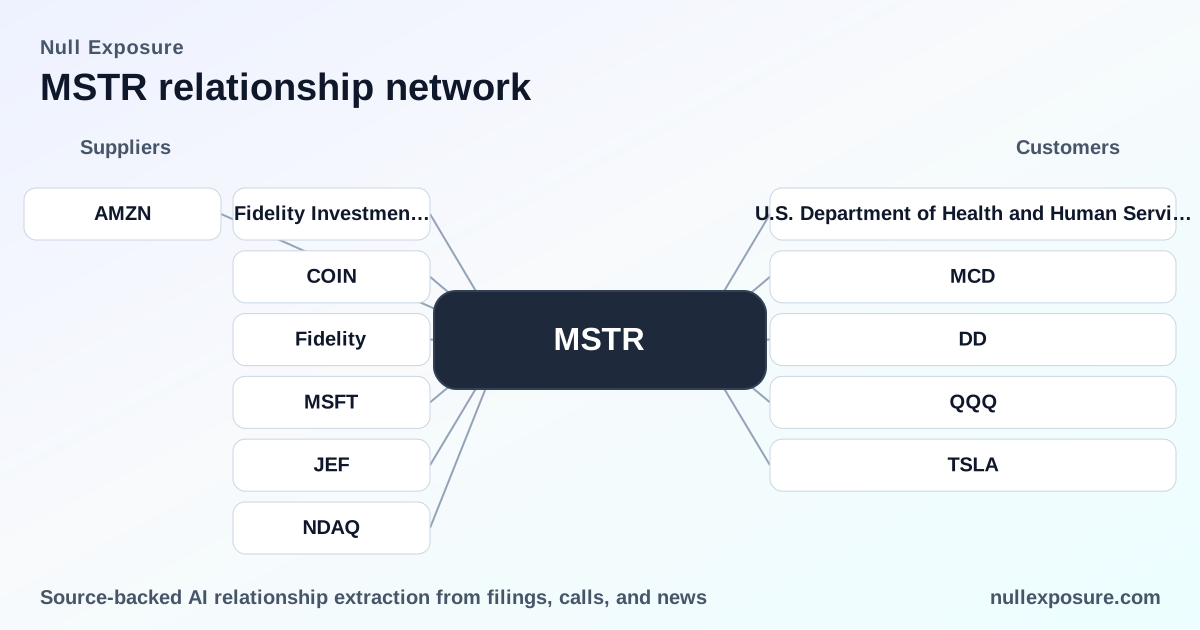
MicroStrategy (MSTR): What its customer relationships reveal to investors
MicroStrategy sells enterprise analytics software and related services, monetizing through a mix of term and perpetual licenses, multi-year cloud subscriptions, and professional services (implementation, support, consulting). The product is sold into large enterprises, mid-market accounts and public-sector agencies worldwide; recurring revenue from cloud subscriptions and support complements upfront license receipts and services fees. For investors, the customer footprint is broad, global and commercially mature, with no single customer accounting for 10% of revenue while government engagements and marquee early customers support the company’s go-to-market credibility.
Explore deeper coverage at https://nullexposure.com/.
How MicroStrategy actually takes money from customers
MicroStrategy operates with a dual pricing model that is fundamentally subscription-led for cloud deployments and license-driven for on-premise scenarios. According to the company’s 2024 Form 10‑K, cloud subscriptions are commonly sold on 36‑month terms with bundled support, monitoring and updates, while legacy enterprise licenses run as perpetual or term arrangements (typically 12–36 months) and generate one‑time recognition events. The firm also sells managed cloud offerings where MicroStrategy acts as the service provider and delivers technical support and backups on behalf of the customer. These contract structures create a mix of recurring and transaction-driven revenue streams and a natural services attach rate from implementation and consulting teams.
- Customer mix: The company targets large global enterprises and mid‑market customers and expressly lists government agencies among its customers, providing a diversified set of end users.
- Geographic exposure: MicroStrategy reports material international revenue (44% of total revenue in 2024), confirming a North America + EMEA + Other footprint.
- Concentration: The 10‑K discloses that no individual customer represented 10% or more of consolidated revenues for 2022–2024, signaling low single‑customer concentration as a top-line risk mitigant.
Relationship-by-relationship: the names on the record
Below are every customer-related relationship surfaced in available documents and media references, with a concise investment‑oriented takeaway and a clear source note.
U.S. Department of Health and Human Services
MicroStrategy’s government cloud solution achieved a designated status after collaboration with the U.S. Department of Health and Human Services, supporting the company’s claim of public‑sector deployments and cloud capabilities. Source: MicroStrategy Form 10‑K (FY2024).
McDonald’s (MCD)
MicroStrategy secured a major early engagement with McDonald’s — a $10 million contract in 1992 to build applications for analyzing promotional efficiency — an historical client win that underpins the company’s long track record selling analytics into large retail/consumer enterprises. Source: PredictStreet profile published via Markets.FinancialContent (Sept 29, 2025 / cited FY2025).
DuPont (DD)
DuPont provided early consulting support to MicroStrategy’s founders — a consulting contract worth $250,000 that included start‑up capital and office space — reflecting the company’s roots in delivering bespoke analytics consulting to large industrial clients. Source: PredictStreet profile published via Markets.FinancialContent (Sept 29, 2025 / cited FY2025).
QQQ (Inclusion expectations)
Market commentary referenced expectations that institutional buying and exchange‑traded funds such as QQQ would include MicroStrategy stock, highlighting an investor narrative that ETF flows could amplify demand from index and passive buyers. Source: Yahoo Finance coverage of MicroStrategy’s corporate activity (FY2024 news).
Tesla (TSLA)
Industry commentary and Bitcoin‑focused media have portrayed MicroStrategy as a public advocate for corporate Bitcoin treasury allocation, including suggestions that MicroStrategy encouraged peers such as Tesla to consider Bitcoin allocations for corporate treasuries. This framing reinforces MicroStrategy’s role as a high‑profile adopter and promoter of corporate crypto exposure. Source: Bitcoin Magazine (article referencing FY2021 activity).
AIMCo (Canadian pension)
CoinDesk coverage reported that Alberta Investment Management Corporation (AIMCo) purchased MicroStrategy during market dips and posted an interim unrealized gain, signaling institutional interest from large pension investors into the equity given its Bitcoin‑linked upside. Source: CoinDesk reporting (coverage referencing activity around Apr 2025 / reported May 2026).
What these relationships mean for commercial risk and upside
The customer list mixes historical marquee logos (McDonald’s, DuPont), public‑sector validation (HHS) and investor relations narratives (ETF inclusion, institutional pension buys). Extract the following implications:
- Commercial credibility: Government engagements such as the HHS collaboration are proof points for cloud and security credentials, which are important when selling to regulated industries. Source: Form 10‑K (FY2024).
- Revenue durability profile: With cloud subscriptions commonly on 36‑month terms and licensing still an active channel, MicroStrategy’s revenue base blends recurring and transactional cash flows; this duality creates upside from subscription growth while leaving short‑term revenue lumpy when license deals close. Source: 10‑K contract descriptions.
- Low counterparty concentration: The company discloses that no single customer contributed 10%+ of revenue in recent years, implying diversified customer risk at the top line. Source: 10‑K (FY2024).
- Global distribution: International revenues consistently account for roughly 44% of total revenue, reinforcing the company’s exposure to FX and regional demand cycles while also expanding addressable market. Source: 10‑K consolidated revenue geography (2024).
Operational constraints that investors should treat as structural signals
Treat the following items as company‑level operating characteristics that shape risk/reward rather than transaction‑level facts:
- Contracting posture: The business sells both subscription and license models (subscriptions typically 36 months; licenses often perpetual or 12–36 months) and offers fully managed cloud environments where MicroStrategy functions as the service provider. This creates recurring revenue but retains material one‑time license recognition. Source: 10‑K contract disclosures.
- Customer segments and channels: Marketing programs explicitly target large global enterprises and mid‑market customers, and the company sells through direct, reseller and OEM channels, supporting scale via partner distribution. Source: 10‑K.
- Service mix: Professional services (consulting, implementation, education) are integral and increase gross margins on recurring installs, but they also introduce execution risk tied to project delivery and utilization. Source: 10‑K.
Investment takeaways and where to look next
MicroStrategy’s customer evidence supports a commercially diversified software business with meaningful public‑sector credibility and established enterprise origins, while the firm’s market narrative and shareholder base are influenced by its well‑publicized Bitcoin strategy. For investors focused on the software business, subscription ramp and international growth are the primary operational levers; for equity/treasury investors, institutional flows and ETF inclusion dynamics are consequential.
If you want a structured, machine‑grade mapping of customer relationships and the related contract signals to feed into your credit or supply‑chain models, see full coverage at https://nullexposure.com/.
Key documents cited: MicroStrategy Form 10‑K (FY2024), PredictStreet profile via Markets.FinancialContent (Sept 2025), Yahoo Finance reporting (FY2024), Bitcoin Magazine (FY2021), CoinDesk coverage (Apr 2025 / May 2026).