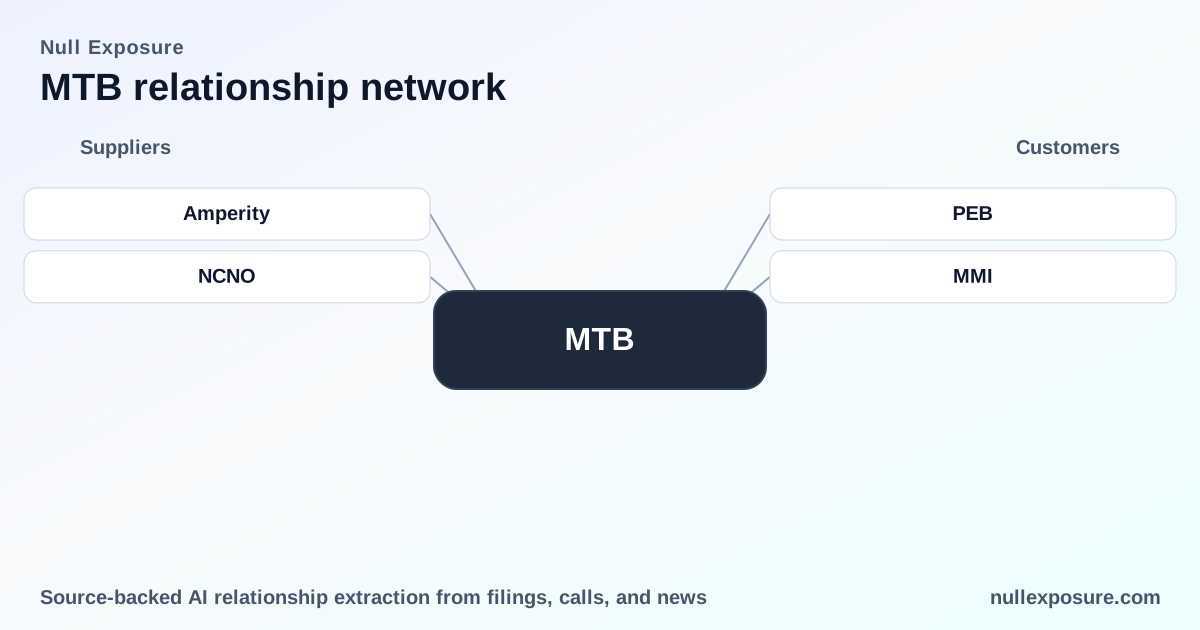
M&T Bank (MTB) — Customer Relationships and Strategic Counterparty Map
M&T Bank operates as a regional, deposit-funded commercial bank with diversified revenue streams across interest income, fee-based services, and institutional products. The franchise monetizes through traditional retail and commercial lending, core deposits that fund credit portfolios, wealth and institutional services fees, and selective capital markets activity executed via M&T Securities and affiliated subsidiaries. For investors focused on counterparty exposure and customer economics, M&T’s business is characterized by deposit-driven funding, geographic concentration in the Northeast, a broad mix of retail and commercial counterparties, and a service-oriented revenue mix. For a structured view of M&T’s outside relationships and how they affect credit and revenue channels, see https://nullexposure.com/.
How M&T’s operating model shapes counterparty risk
M&T’s customer relationships are not one-size-fits-all; the bank blends retail distribution with institutional services in a way that affects contracting posture, concentration, and criticality.
- Contracting posture and duration: Commercial and retail engagements are typically short-term or annual in nature for many services, while lending and deposit relationships are ongoing — the firm’s filings note that many customer contracts have durations of one year or less, with payments received regularly. This creates a mix of transaction-driven revenue and sticky deposit funding.
- Counterparty mix and concentration: The bank serves individuals, small businesses, mid-market and large enterprises, and governmental entities across its network. No single customer produces more than 10% of consolidated revenues, indicating revenue diversification, but core deposits from a large customer base represent a critical funding source.
- Geographic footprint and implications: M&T’s operations are concentrated in the Northeastern and Mid‑Atlantic U.S., with some activity into adjacent states and Ontario, Canada; this regional concentration creates correlated exposure to local economic cycles.
- Role and maturity: M&T acts as both a seller of financial services and a service provider (trust, agency, commercial finance), and most relationships are currently active, reflecting an operating model oriented to ongoing client service rather than one-off project revenue.
These characteristics produce a bank that is service-centric, deposit-dependent, geographically concentrated but broadly diversified across customer types, and naturally exposed to regional real estate and commercial credit cycles. Explore more relationship signal products at https://nullexposure.com/ if you want organized sourcing and tracking.
Recent relationship signals: what the evidence shows
Below I cover every relationship mentioned in the scraped results. Each entry is a concise plain-English take and a short source note.
RLJ
M&T joined a bank group as a new financing partner for RLJ Lodging Trust’s refinancing activity, indicating participation in syndicated real‑estate lending for hospitality portfolios. Source: CityBiz coverage of RLJ refinancing (March 10, 2026).
MMI (Marcus & Millichap) — earnings call (entry 1)
Marcus & Millichap reported that a $2.3 billion portion of mortgage volume was placed with Fannie Mae and Freddie Mac primarily through a strategic alliance with M&T Bank, showing M&T’s role as a conduit for agency multifamily originations. Source: MMI Q4 2025 earnings call transcript (reported March 2026).
PEB‑P‑E (Pebblebrook preferred) — Yahoo Finance notice
Pebblebrook’s transaction commentary lists M&T Bank as a newly expanded financing partner in a package that included unsecured term loans and revolvers, signalling M&T’s entry into hospitality REIT capital structures. Source: Yahoo Finance press release on Pebblebrook financing (March 10, 2026).
MMI — InsiderMonkey news repost
A separate report of Marcus & Millichap’s remarks repeats that the placement activity included agency financing channeled through M&T, underscoring that the strategic alliance is visible across multiple public disclosures. Source: InsiderMonkey transcript summary (March 2026).
HASI (Hannon Armstrong) — SEC underwriting notice
M&T Securities served as an underwriter (principal amount listed as $10,000,000) on a notes offering, confirming M&T’s institutional securities and underwriting capability through its securities affiliate. Source: SEC prospectus supplement / 424(b)(5) filing (March 2026).
PEB (Pulse2 recap of Pebblebrook)
Pulse2’s coverage restates Pebblebrook’s expansion of its bank group to include M&T Bank, reinforcing that M&T is participating as a direct loan/credit partner in that REIT’s financing package. Source: Pulse2 summary of Pebblebrook financing (March 10, 2026).
Pebblebrook Hotel Trust — duplicated Pulse2 entry
An additional Pulse2 mention repeats the inclusion of M&T as a financing partner for Pebblebrook’s $450 million unsecured term loan and revolver extension, highlighting the same financing role from publisher perspective. Source: Pulse2 (March 10, 2026).
PEB — Yahoo Finance duplicate
Yahoo’s article again notes M&T and Royal Bank of Canada as new financing partners in Pebblebrook’s transaction, confirming multiple outlets reported the same bank group expansion. Source: Yahoo Finance (March 10, 2026).
TRTN‑P‑C (Triton International press coverage)
Triton’s press release described senior notes issued under an indenture with Wilmington Trust acting as trustee; M&T is not the trustee here but the inclusion in the scraped results flags broader market activity in securitizations and trust structures adjacent to M&T’s institutional services. Source: Investing.com summary of Triton notes offering (May 4, 2026).
TRTN‑P‑A (Triton SEC filing reference)
A separate EDGAR filing for Triton references Wilmington Trust as indenture trustee for container finance structures, again showing market context where trustee and underwriting roles are materially documented for capital markets participants. Source: Triton 2022/2023 EDGAR filing (referenced via Investing.com, May 2026).
PEB — Yahoo Finance third listing
This third PEB listing repeats that Pebblebrook welcomed M&T as a financing partner; the repetition across sources signals active origination and syndication participation by M&T in REIT financing during March 2026. Source: Yahoo Finance (March 10, 2026).
BXMT (Blackstone Mortgage Trust)
Blackstone Mortgage Trust disclosed a 2024 agreement with M&T Realty Capital Corporation, a subsidiary of M&T Bank, allowing borrowers access to Fannie Mae and Freddie Mac multifamily agency financing via an Agency Multifamily Lending Partnership — this is tangible evidence of M&T’s specialized real‑estate finance distribution. Source: Blackstone Mortgage Trust 10‑Q commentary reported on MarketScreener (May 2, 2026).
Marcus & Millichap, Inc. — InsiderMonkey duplicate
A duplicate reporting item repeats Marcus & Millichap’s statement that a material portion of agency placements was transacted primarily through its alliance with M&T, reinforcing the bank’s role in agency conduit lending for multifamily. Source: InsiderMonkey / earnings coverage (March 2026).
CLPR (Clipper Realty)
Clipper Realty’s SEC‑filing coverage references Wilmington Trust as trustee for a mortgage trust special servicing notice; M&T is not explicitly named in the excerpt, but the inclusion flags the broader securitization and servicing ecosystem where M&T’s institutional services operate. Source: Investing.com recap of Clipper Realty SEC filing (May 2, 2026).
Investment implications and risk points
- Revenue diversity is real but funding is critical: fee income from underwriting and agency lending partnerships complements net interest income, but core deposits remain the most significant source of funding—a critical dependency for capital and liquidity management.
- Geographic concentration amplifies real estate exposure: the bank’s Northeast/Mid‑Atlantic footprint concentrates credit exposure to local commercial and residential markets, making REIT and regional hospitality financings (as evidenced above) meaningful to underwriting cycles.
- Institutional capabilities extend reach: M&T’s securities and specialty finance subsidiaries enable participation in underwriting and agency lending, increasing high‑margin fee opportunities but also tying the bank to capital markets volatility.
- Client base spreads risk: the lack of any single customer accounting for >10% of revenues points to diversified revenue sources across individuals, small businesses, mid‑market, large enterprises, and governmental clients.
Bottom line
M&T Bank combines a traditional deposit-funded commercial bank model with targeted institutional and real‑estate finance capabilities. The recent relationship signals show active syndication and agency lending partnerships, growing participation in REIT financings and underwriting roles, and a clear emphasis on multifamily agency channels. For investors and operators, the principal watchpoints are deposit stability, regional real estate trends, and capital markets activity executed through M&T’s securities and specialty finance units.
If you want a structured extract of these relationships with source links and change tracking, visit https://nullexposure.com/ for our relationship intelligence offerings.