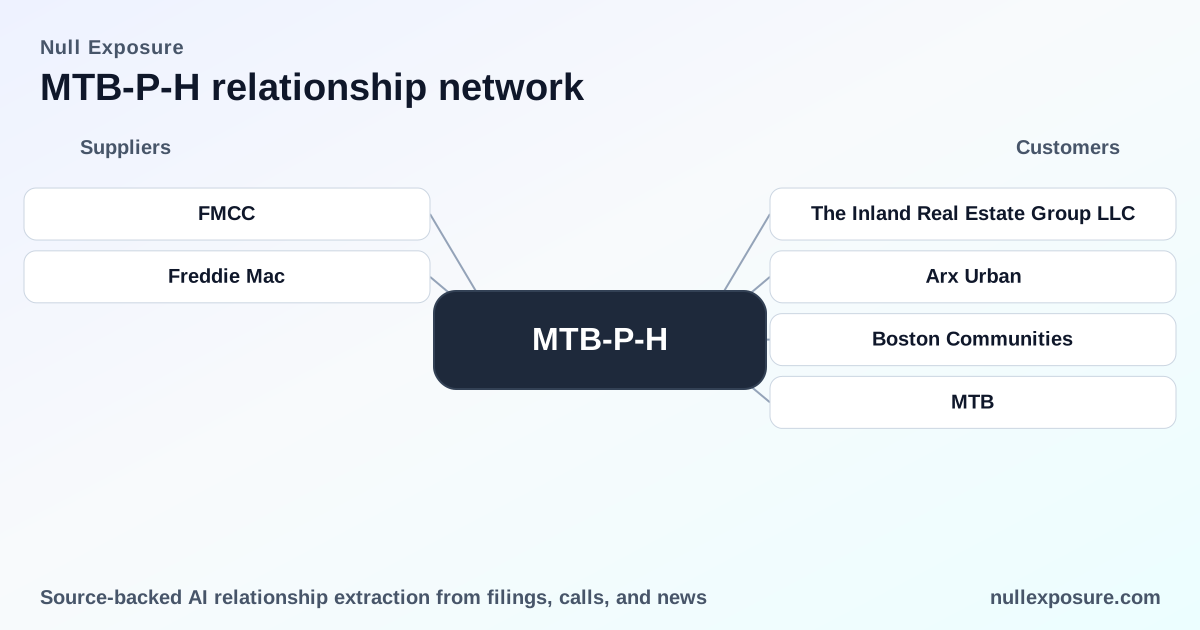
M&T Bank (MTB‑P‑H): Real‑estate lending relationships that drive the balance sheet
M&T Bank operates as a full‑service regional bank and bank holding company that monetizes through net interest income on loans, fee income on originations and servicing, and structured financing through affiliates such as M&T Realty Capital Corporation (M&T RCC). The firm leverages its balance sheet to originate and warehouse commercial real‑estate loans, then channels risk to agency conduits (Freddie Mac/Fannie Mae) or retains performing positions to generate ongoing spread and fee revenue. For investors in MTB‑P‑H, the preferred class exposure is best understood through the stability and credit profile delivered by these lending relationships and the bank’s underwriting franchise. For deeper counterparty mapping and background, see https://nullexposure.com/.
How M&T’s real‑estate posture converts into earnings
M&T’s operating model in commercial real estate is that of a lender and conduit manager: it underwrites projects, supplies balance‑sheet financing through M&T RCC, and participates in agency markets to distribute risk. That structure produces three durable business model characteristics:
- Contracting posture — lender-first: M&T engages as a senior lender and sponsor bank through documented mortgages and agency conduit placements, giving it priority in recovery and documented rights in structured financings.
- Concentration and criticality — regional CRE focus with sponsor relationships: The bank emphasizes middle‑market and sponsor‑backed multifamily and mixed‑income developments, making sponsor relationships and municipal approvals critical to deal flow and credit performance.
- Maturity and distribution — established originations with agency channels: M&T uses Freddie Mac and Fannie Mae conduits to scale and transfer credit risk, which helps preserve capital ratios while preserving fee income streams.
These attributes together drive predictable spread capture but create sensitivity to multifamily underwriting cycles and agency program dynamics.
Customer relationships that matter — who M&T is financing now
Below are the customer relationships surfaced in recent public reporting and what each means for M&T’s lending footprint.
The Inland Real Estate Group LLC
Inland publicly acknowledged that M&T Bank and M&T RCC support Inland’s activities “in multiple capacities,” indicating an ongoing sponsor‑bank relationship that spans acquisition and structured financing solutions. (re‑nj.com, March 2026)
Arx Urban
M&T Realty Capital Corp. is financing a 47‑unit mixed‑income development being developed by Arx Urban (with municipal support), demonstrating M&T’s role in smaller urban mixed‑income projects and its ability to underwrite deals tied to public housing policy. (HousingFinance, March 2026)
Boston Communities
Boston Communities is a co‑developer on the same Boston project financed by M&T RCC, confirming that M&T engages with local developer partnerships for mixed‑income pipelines and works alongside municipal and state housing agencies. (HousingFinance, March 2026)
Gordon Property Group
An affiliate of Gordon Property Group secured a $50 million Freddie Mac‑backed refinance for a Manhattan multifamily asset where M&T RCC supplied the Freddie Mac‑sponsored loan, illustrating M&T’s participation in high‑value Manhattan transactions and its use of agency securities to underwrite and distribute large loans. (Commercial Observer, June 2025)
MTB (as referenced in the press)
Media coverage of the Gordon Property Group transaction names M&T (MTB) directly as the lender via M&T Realty Capital Corporation for the Freddie Mac‑backed financing, underscoring the bank’s branding and direct underwriting role in agency‑sponsored multifamily markets. (Commercial Observer, June 2025)
What these relationships reveal about strategic exposure
These customer ties show two consistent revenue drivers: sponsoring mid‑market mixed‑income projects (Boston) and executing large, agency‑backed multifamily financings (Manhattan). The mix implies:
- Portfolio breadth: exposure to both community/mixed‑income housing and high‑value urban multifamily.
- Agency dependence: frequent use of Freddie Mac and Fannie Mae conduits to syndicate or securitize risk, which supports capital efficiency but links performance to agency program rules and market demand.
- Sponsor concentration: repeated work with established developers such as Inland and Gordon highlights the importance of stable sponsor relationships to recurring deal flow.
These are company‑level operating signals rather than property‑level performance metrics.
Investment implications and key risk factors
Investors should weigh the following, which derive directly from the observed relationships and M&T’s lending posture:
- Credit sensitivity to the multifamily cycle. Large Freddie/Fannie financings reduce immediate balance sheet risk but keep M&T exposed to sponsor performance and loan servicing over time.
- Regulatory and agency program risk. Fee income and capital planning rely on stable agency execution; changes to Freddie Mac/Fannie Mae policies alter economics for originations and securitizations.
- Local policy and social housing dynamics. Mixed‑income municipal projects introduce execution and entitlement risk tied to municipal approvals and subsidy timing.
- Reputation and counterparty concentration. Strong sponsor partnerships are an asset; sponsor credit deterioration would transmit to M&T through repeat‑business pipelines.
Net takeaway: M&T’s commercial real estate franchise generates durable fee and interest income but is intrinsically linked to agency market functioning and sponsor credit health.
What investors should watch next
Active monitoring will reveal whether the bank’s trajectory is steady or at risk:
- Track agency conduit issuance and pricing, which directly affects M&T’s ability to transfer risk and preserve margins.
- Monitor sponsor performance on projects (Inland, Gordon, Arx Urban, Boston Communities) and municipal subsidy timelines for mixed‑income transactions.
- Watch regulatory statements from the bank and agency counterparties for shifts in underwriting standards or capital treatment.
For systematic counterparty intelligence and to contextualize these relationships in the broader loan book, visit https://nullexposure.com/.
Bottom line
M&T’s recent publicized customer relationships illustrate a dual strategy: originate sponsor‑led multifamily financings and execute agency‑backed refinancings for high‑value assets. That approach produces stable spread and fee revenue while embedding sensitivity to agency markets and sponsor credit cycles. For preferred‑stock investors in MTB‑P‑H, these dynamics explain where earnings durability and downside exposure originate — a lending franchise that is disciplined, agency‑integrated, and sponsor‑dependent.