Match Group (MTCH): customer dynamics and the payment timing risk investors should price in
Match Group operates a global portfolio of dating brands that monetize overwhelmingly through short-term recurring subscriptions and occasional à-la-carte purchases sold directly to individual users and through mobile app stores. The business converts high gross margins into strong operating cash flow — trailing twelve‑month revenue was roughly $3.49 billion with EBITDA north of $1.05 billion — but the company’s cash conversion profile is sensitive to payment timing and the mechanics of app‑store settlements. For investors and operators evaluating MTCH customer relationships, the model is subscription-first, consumer-retail distribution, and globally dispersed, and that structure creates both durable unit economics and episodic cash‑flow concentration risks. For more background on enterprise customer signals and competitive positioning, visit https://nullexposure.com/.
How Match actually collects revenue: subscription mechanics that matter
Match’s revenue is predominantly recurring subscription fees paid by individuals, offered in short packages that range from a week to several months. Subscribers pay in advance, predominantly via credit card or mobile app stores, and revenue is recognized straight‑line over the subscription term. The company supplements subscriptions with one‑off purchases for consumable features, but the revenue base is dominated by pre‑paid, short-duration contracts — a commercial posture that amplifies seasonality and cash timing effects even while smoothing recognized revenue.
- Contracting posture: Short-duration subscription contracts (commonly one week to six months) mean frequent renewals and steady gross subscriber churn activity rather than long multi-year locked-in contracts.
- Counterparty profile: End customers are individual consumers, not large enterprise buyers; this yields high volume, low ticket sizes and operational focus on product and app-store distribution.
- Geography and scale: Services are available in over 40 languages, underscoring a global footprint that diversifies revenue by market while increasing operational complexity around payments and local regulations.
Why app-store mechanics are a material operational lever
Match relies materially on app stores as payment conduits and distribution channels; that dependency creates timing and settlement risk that directly impacts free cash flow. The company discloses that purchases are often made through mobile app stores and that subscribers pay in advance; when app‑store settlements shift across reporting periods, Match’s cash flows can swing despite steady underlying subscription revenue.
A mid‑quarter example crystallizes this vulnerability: during the Q4 2025 earnings call, management reported that free cash flow was negatively impacted by the timing of the final Apple payment of the year, which was expected in December but was not received until early January, pushing cash into the next reporting period and compressing FCF for the quarter. This is a concretely observable source of quarter‑to‑quarter FCF volatility tied to app‑store settlement calendars (InsiderMonkey transcript, March 2026).
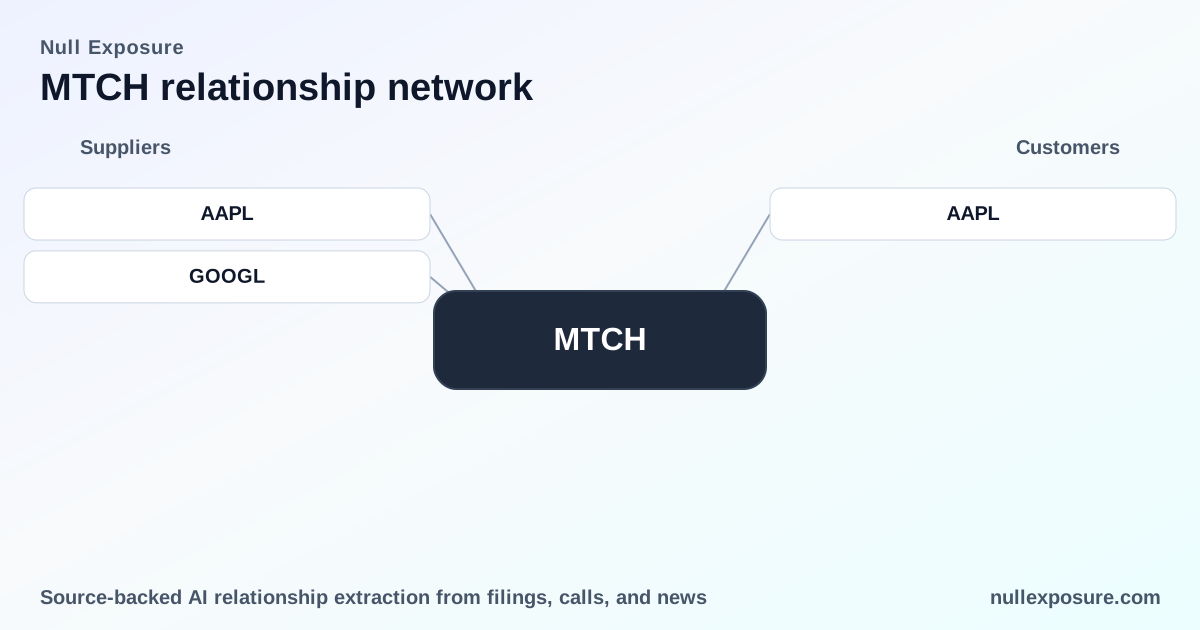
Customer relationship highlights: the Apple / AAPL items in the record
The results include two closely related mentions of Apple; both cite the same operational fact and should be evaluated together.
-
AAPL — management said the timing of Apple’s final payment for the year shifted cash receipts into the next reporting period, reducing reported free cash flow for the quarter. This was disclosed in the Q4 2025 earnings call transcript published in March 2026 on InsiderMonkey.
Source: Q4 2025 earnings call transcript published March 2026 (InsiderMonkey). -
Apple (AAPL) — the company reiterated that a planned December settlement from Apple did not arrive until early January, creating a discrete cash‑timing hit that affected free cash flow for FY2026 reporting. This same disclosure appears in the Q4 2025 earnings call transcript in March 2026.
Source: Q4 2025 earnings call transcript published March 2026 (InsiderMonkey).
Both entries record the identical operational point: app‑store settlement timing, not a change in underlying subscriber economics, drove a short-term FCF variance. Investors should treat these as operational noise for long‑term revenue modeling but as relevant for quarterly treasury forecasting and covenant monitoring.
Operational constraints that shape the business model
Match’s disclosed relationship and contract signals describe a business optimized for consumer subscription sales rather than long-term enterprise procurement. These characteristics inform valuation sensitivity, capital planning, and contract risk:
- Subscription-first, short-term contracts: The product is sold in pre-paid packages commonly between one week and six months; this yields predictable, recurring revenue recognition but increases sensitivity to timing of renewals and settlements.
- Counterparty concentration toward individuals: Revenue is earned directly from millions of consumers rather than a handful of large customers, which lowers counterparty credit risk but increases operational complexity and marketing spend.
- Active relationships and service orientation: Contracts are active and transactional, and the company’s segment focus is services rather than hardware or multi-year software licenses.
- Global footprint with local settlement mechanics: Availability in 40+ languages and sales through local app stores imply settlement cadence differences across regions, and that geographical breadth is a diversification of demand but a source of settlement timing variability.
These are company-level signals drawn from the filing language and are not attributed to any single customer unless explicitly stated.
What investors and operators should do with this information
- For investors: Model a small but material quarterly cash‑flow volatility risk around app‑store settlement calendars — treat app‑store timing as a short-term cash‑timing risk rather than a structural revenue impairment. Monitor quarters where app‑store settlements are likely to slip across fiscal period boundaries and adjust near‑term free‑cash‑flow expectations accordingly.
- For operators/treasury teams: Tighten receivables forecasting around known app‑store and payment‑processor cutoffs, and maintain liquidity buffers that can absorb one‑off timing shifts without affecting operating cadence.
- For strategic managers: Continue to diversify payment channels where feasible and prioritize product stickiness to limit churn-driven top-line sensitivity; the underlying subscription economics remain strong, but timing frictions are real.
Final take
Match Group is a subscription-driven consumer platform with robust margins and recurring revenue, and the recent disclosures underscore a specific operational fast‑ball: app‑store settlement timing can materially move free cash flow without changing user demand. Investors should price in that cash‑timing noise when evaluating quarterly performance and covenant leverage, while operators should strengthen settlement forecasting and liquidity planning. For further customer‑level signals and comparative relationship analytics, visit https://nullexposure.com/.