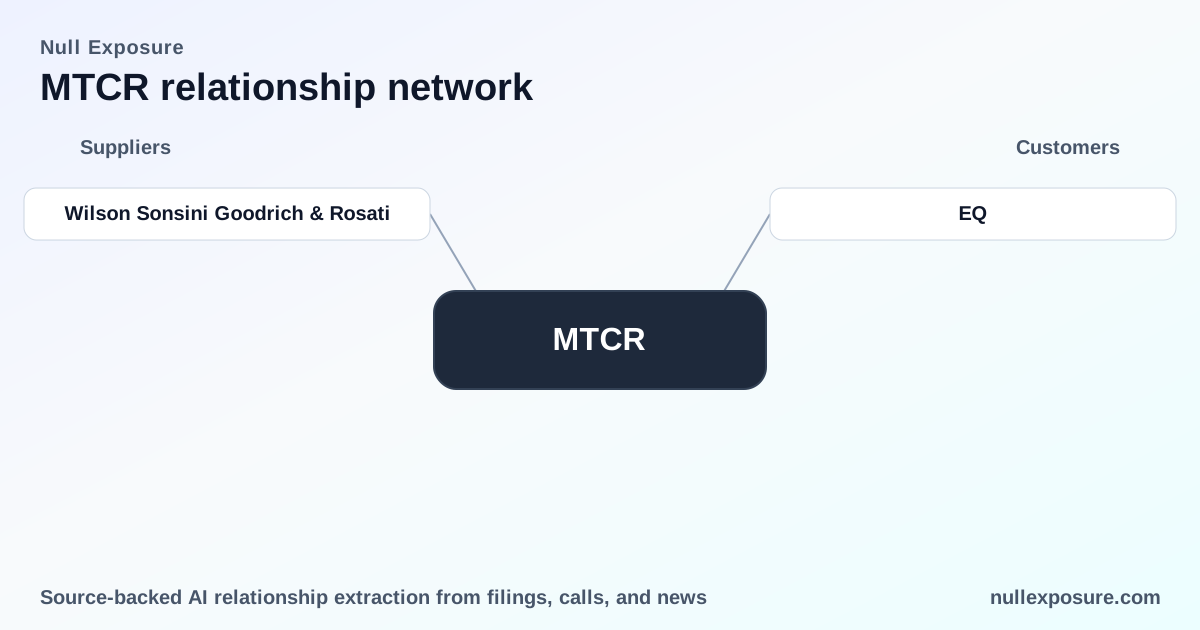
MTCR customer relationships: what the public trail reveals and why it matters for investors
MTCR operates as a therapeutics company that develops clinical-stage assets and realizes value through strategic partnerships, licensing, and corporate transactions; its monetization pathway is therefore transactional and partnership-driven rather than subscription or high-volume enterprise sales. Public signals in the customer scope indicate corporate counterparties and M&A activity as primary drivers of value capture for MTCR. For a concise gateway to the underlying source material and ongoing monitoring, visit https://nullexposure.com/.
The single, clear public signal: a corporate acquisition in the news stream
The most material item in the customer-scope results is a news item reporting that Equillium announced an acquisition of Metacrine in an all‑stock deal. That transaction-level disclosure functions as both a customer/partner signal and a liquidity event: when a peer or buyer is engaged in an all‑stock acquisition, MTCR’s value realization is directly tied to M&A execution rather than to recurring customer contracts or product royalties. According to BioSpace coverage dated March 10, 2026, Equillium disclosed the acquisition of Metacrine in an all-stock transaction (noted in the same article that covered multiple industry M&A moves).
Every relationship captured in the record
Equillium (ticker: EQ) — FY2022 Equillium is cited as the acquirer of Metacrine in an all‑stock deal referenced in industry press, demonstrating a direct corporate transaction between the two firms rather than a traditional supplier–customer sales relationship; the reference is recorded in a BioSpace news item dated March 10, 2026. Source: BioSpace coverage, March 10, 2026 (article on Roche and broader biopharma M&A).
EQ (inferred symbol EQ) — FY2022 The search results also list the shorthand EQ entry that corresponds to Equillium and references the same all‑stock acquisition of Metacrine; the duplicate entry confirms the same single event is the primary public customer/partner signal recorded for MTCR in this scope. Source: BioSpace coverage, March 10, 2026.
How the public relationships inform MTCR’s operating model and business constraints
There are no explicit constraint excerpts returned in the customer-scope results. That absence is itself instructive: public customer disclosures for MTCR are limited and dominated by corporate transaction reporting rather than by recurring contract announcements, regulatory milestones, or multi-year commercial agreements. Company-level signals derived from the customer-scope include:
- Contracting posture — Transactional and deal-centric. Public interactions are recorded as an acquisition event; MTCR’s monetization therefore emphasizes discrete transactions (e.g., M&A, licensing, equity swaps) over long-term commercial contracts.
- Customer concentration — High in public records. The visible universe of counterparties is narrow in the returned results; investors should treat published customer relationships as concentrated and episodic until broader counterparty lists or revenue schedules are disclosed.
- Criticality — Strategic but non-recurring. When counterparties undertake an acquisition, they indicate strategic interest in MTCR’s assets, but that criticality is realized as one-time value transfer rather than predictable revenue streams.
- Maturity of relationships — Early/transactional stage. The nature of the recorded activity (acquisition) signals that public customer relationships are at an execution or exit stage rather than calendarized commercial maturity.
These are company-level signals: no constraint in the provided data explicitly ties a contractual term, revenue guarantee, or exclusivity clause to any named customer.
Investment implications and risk framework
- Valuation sensitivity to M&A outcomes. With public evidence pointing to an acquisition as the key customer/partner interaction, MTCR’s near-term valuation is sensitive to deal structure and equity issuance terms; an all‑stock acquisition transfers equity dilution and integration risk to counterparties.
- Limited visibility into recurring revenue. The absence of announced commercial contracts implies investors should not rely on recurring topline predictability; financial models should emphasize milestone payments, contingent proceeds, and one-time transaction realizations.
- Concentration and counterparty execution risk. A single counterpart in public filings elevates counterparty execution and integration risk; any setback in the acquiror’s strategic plan (financing, regulatory approval, integration) directly affects MTCR’s realized value.
- Governance and post-transaction integration. All‑stock deals change capitalization and governance dynamics; investors and operators must monitor post-close board composition, earn-out provisions (if any), and the blending of R&D strategies.
Key takeaway: MTCR’s public customer footprint is sparse and transaction-focused, so investment theses should be built around deal economics and integration execution rather than recurring revenue multiples.
Practical next steps for investors and operating teams
- Request the full transaction documentation and schedule of consideration for the reported all‑stock acquisition to understand lockups, earn‑outs, and dilution mechanics.
- Prioritize diligence on the acquirer’s balance sheet, equity valuation assumptions, and integration playbook; these factors determine realized proceeds and ongoing upside.
- Track regulatory filings and subsequent investor presentations from the acquirer for disclosure of acquired asset commercialization plans and revenue attribution.
- Maintain a contingency valuation scenario that assumes delayed realization of milestone receipts or incremental restructuring charges.
For a curated, continuously updated view of MTCR’s public counterparties and transaction trail, explore https://nullexposure.com/ — the platform aggregates these relationship signals and contextualizes them for investors and operators.
Bottom line
The customer-scope record for MTCR is dominated by a single, material corporate transaction: Equillium’s acquisition of Metacrine in an all‑stock deal as reported by industry press in March 2026. That transaction transforms MTCR’s public customer profile into a deal-driven monetization model, increasing reliance on M&A execution and counterparty performance rather than on diversified, recurring commercial revenue. Investors should reframe valuation and risk models accordingly and pursue targeted diligence on deal terms and integration milestones.