MTEN (Mingteng International): Customer Relationship Intelligence and What It Means for Investors
Mingteng International operates as a manufacturing and technology integrator in metal fabrication, monetizing primarily through the sale of engineered components and assemblies to industrial customers and through strategic partnerships that expand its addressable market and distribution channels. Revenue is product-driven but strategically augmented by cooperation agreements with industrial customers, which generate mid-single-digit concentration risks while supporting incremental margin expansion. For a concise, data-driven view of customer relationships and commercial posture, visit https://nullexposure.com/.
The headline customer: Suzhou Lvkon Transmission Technology
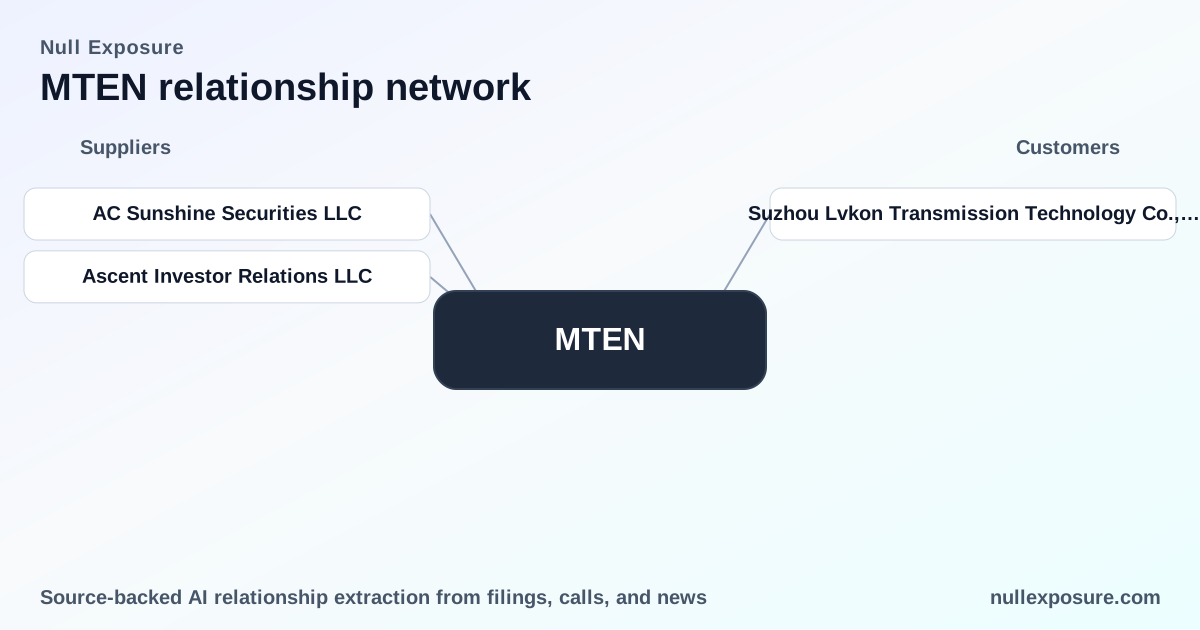
Mingteng’s publicly disclosed commercial relationship with Suzhou Lvkon Transmission Technology Co., Ltd. is the clearest, documented customer linkage in public reporting. Both a GlobeNewswire release in August 2025 and a Yahoo Finance distribution in March 2026 state that Lvkon contributes around 9% of Mingteng International’s total sales, and that a subsidiary of Mingteng entered into a strategic cooperation framework agreement with Lvkon to deepen the partnership. These releases establish Lvkon as a material customer but not a single point of failure for revenue. (GlobeNewswire, Aug 6, 2025; Yahoo Finance, Mar 10, 2026.)
Why the Lvkon relationship matters for revenue concentration and contracting posture
- Concentration: With Lvkon representing roughly 9% of total sales, Mingteng has a material but manageable customer concentration. That level implies the company’s top customers are important to margin stability but that Mingteng is not dependent on a single counterparty for survival.
- Contracting posture: The existence of a strategic cooperation framework agreement signals an intent to formalize supply and collaboration terms beyond ad hoc purchase orders. That suggests multi-quarter to multi-year commercial commitments, which improve revenue visibility relative to spot sales.
- Criticality & maturity: The agreement was executed by a subsidiary, indicating corporate-level governance of partner relationships and a mid-stage commercial maturity—beyond early pilot ties but not necessarily long-term locked-in contracts.
Company-level operational signals investors should weigh
Beyond customer-level details, Mingteng’s financial and ownership profile frames how that customer relationship translates into enterprise value.
- Scale and margin profile: Reported TTM revenue of $11.66 million with gross profit of $2.626 million produces a negative net margin (-15.3%) and negative EPS of -230.2, indicating the company is not yet profitable at the bottom line despite positive gross margins. Operating margin is reported at -6.63%, which points to operating expense pressure versus production economics.
- Valuation context: Enterprise-value multiples are modestly priced relative to earnings: EV/Revenue ~0.493 and EV/EBITDA ~11.71, reflecting low absolute market capitalization (reported $5.58 million market cap) and depressed profitability.
- Share structure and liquidity: Insiders hold 30.681% of shares, while reported institutional ownership is 0.005, indicating high insider concentration and virtually no institutional participation. The reported float is 33,330 shares against 5,028,400 shares outstanding, signaling a very tight public float that can amplify price volatility on limited flows.
- Growth signals: Quarterly revenue growth shows a positive traction (+17% YOY), while quarterly earnings growth is negative (-17.6% YOY), which signals top-line expansion without current operating leverage to convert growth into profit.
Relationship-by-relationship rundown (complete coverage)
- Suzhou Lvkon Transmission Technology Co., Ltd.: Mingteng’s subsidiary executed a strategic cooperation framework agreement with Lvkon, and the partner accounts for ~9% of Mingteng’s total sales, making it a material commercial counterparty with structured ties to the company (GlobeNewswire, Aug 6, 2025; Yahoo Finance, Mar 10, 2026).
This list matches all documented customer relationships in public releases for the scope examined.
What the commercial signals imply for investors
- Revenue stability is supported but not guaranteed. A partner contributing ~9% of sales gives Mingteng measurable revenue support while leaving the company exposed to the rest of its customer base for the majority of revenue.
- Commercial agreements improve visibility. The framework agreement with Lvkon elevates the relationship from transactional to strategic, which reduces short-term volatility in orders and increases the probability of recurring business.
- Profitability and scale remain primary risks. Despite positive revenue growth and gross margins, negative net margins and negative EPS place emphasis on whether margin expansion and operating leverage will follow the top-line momentum.
- Market structure amplifies trading risk. High insider ownership and a tiny public float create elevated liquidity risk and potential for outsized price movements on minimal flow.
Tactical takeaways for investors and operators
- For investors: Prioritize monitoring order cadence from large counterparties (Lvkon and any peers announced later) and look for evidence that cooperation agreements convert into multi-quarter revenue schedules. Given the thin float and insider concentration, size positions cautiously.
- For operators and partners: The strategic agreement structure is a positive signal for suppliers, logistics, and channel partners seeking predictable demand; however, counterparty credit and working capital dynamics should be validated given the company’s negative profitability.
For ongoing, relationship-level intelligence and to track changes in customer concentration and contractual formality, explore our coverage at https://nullexposure.com/.
Final assessment
Mingteng is a small-cap industrial with structured commercial relationships that materially support revenue but do not eliminate operating and liquidity risks. The documented tie to Suzhou Lvkon provides a clear example of the company shifting toward partnership-based sales, which improves revenue predictability; however, profitability, cash flow conversion, and market liquidity remain the key variables that will determine whether these customer relationships translate into durable investor returns.