Materialise (MTLS): Customer Relationships Signal Strategic B2B Placement in Medical and Aerospace Supply Chains
Materialise is a Belgium-headquartered provider of additive manufacturing software and 3D printing services that monetizes through a mix of software licenses, healthcare solutions for hospitals and device makers, and contract manufacturing for industrial clients. Revenue streams combine recurring software and service contracts with high-value, project-based manufacturing work in regulated sectors, giving the company exposure to long sales cycles but high per-contract economics. For a concise company overview and analytical tools, visit https://nullexposure.com/.
How Materialise earns its keep — a brief investor thesis
Materialise sells software (planning, printing workflow, and industrial orchestration) and executes finished-part manufacturing for healthcare and aerospace customers. The business model blends recurring, defensible software revenues with capital-efficient manufacturing services, allowing margins to scale as software adoption and certified manufacturing volumes increase. Recent public filings show trailing revenue of about $268M and positive operating margins, positioning MTLS as a mid‑market specialist rather than a volume commodity printer.
What the customer map reveals about risk and opportunity
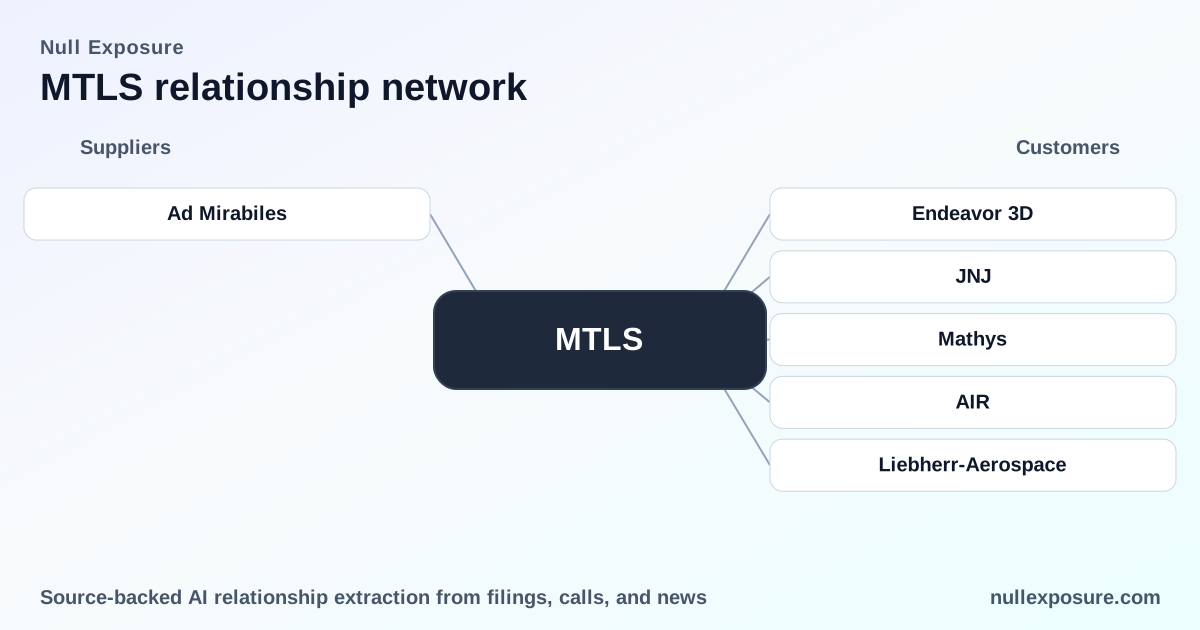
The visible customer relationships span large medical-device conglomerates, family-owned orthopedics firms, aerospace primes, and small-to-mid service bureaus. That mix signals sector diversification across healthcare and aerospace, with a tilt toward mission‑critical, highly regulated work — an attractive profile for investors who value predictable revenue from certified partners rather than one-off hobbyist printing. Contracting posture is oriented toward strategic, multi-year collaborations rather than single-transaction customers, supported by legacy partnerships going back a decade.
Visit https://nullexposure.com/ for deeper vendor and counterparty intelligence on Materialise.
Relationship rundown — what every named counterparty contributes to the story
Below are plain-English takeaways for every relationship referenced in our source set, each with a concise source reference.
-
Johnson & Johnson (JNJ): Materialise has worked with J&J since 2010 to develop personalized craniofacial surgery solutions, reflecting an established, strategic partnership that integrates Materialise’s 3D printing capabilities into J&J’s surgical portfolio (MedDeviceOnline, FY2016 — https://www.meddeviceonline.com/doc/j-j-materialise-partner-on-d-printed-custom-cranio-facial-implants-0001).
-
DePuy Synthes (a Johnson & Johnson business): Materialise teamed with DePuy Synthes to offer patient‑specific titanium craniomaxillofacial implants under the DePuy TRUMATCH portfolio, demonstrating Materialise’s role as a certified supplier into major orthopedics OEM product lines (FierceBiotech, FY2016 — https://www.fiercebiotech.com/medical-devices/materialise-teams-dupuy-synthyes-to-offer-3-d-printed-guides-for-craniomaxillofacia).
-
JNJ (duplicate mention in sources): Reporting reiterates the long-standing relationship and expansion of services with Johnson & Johnson for craniofacial implants and personalized surgical solutions (MedDeviceOnline, FY2016 — https://www.meddeviceonline.com/doc/j-j-materialise-partner-on-d-printed-custom-cranio-facial-implants-0001).
-
Airbus (AIR): Materialise disclosed an award from Airbus’s Defense & Space division to produce environmental control systems for the Eurodrone project, indicating expansion into defense-grade aerospace manufacturing and complex assemblies (Investing.com earnings call transcript, FY2026 — https://m.investing.com/news/transcripts/earnings-call-transcript-materialise-nv-beats-q4-2025-eps-forecast-93CH-4513902?ampMode=1).
-
AIR (duplicate source entry): The same earnings-call reporting from March 2026 reiterates the Airbus Eurodrone production award and reinforces aerospace as a growing vertical for Materialise (InsiderMonkey transcript repost, FY2026 — https://www.insidermonkey.com/blog/materialise-n-v-nasdaqmtls-q4-2025-earnings-call-transcript-1701301/).
-
Endeavor 3D: Endeavor 3D selected Materialise’s CO‑AM software to integrate with its fleet of HP additive manufacturing machines, signaling Materialise’s position as an industrial orchestration and software provider for third‑party print-farm operators (Metal AM, FY2024 — https://www.metal-am.com/endeavor-3d-integrates-materialise-co-am-with-its-fleet-of-hp-additive-manufacturing-machines/).
-
Mathys: Materialise struck a deal with private orthopedics player Mathys to add 3D‑printed surgical shoulder guides to Mathys’s product line, showing traction with smaller, specialized OEMs in orthopedics beyond the largest multinational customers (FierceBiotech, FY2016 — https://www.fiercebiotech.com/medical-devices/materialise-teams-dupuy-synthyes-to-offer-3-d-printed-guides-for-craniomaxillofacia).
-
Liebherr‑Aerospace: Materialise was invited to join the SONRISA funded aviation initiative led by Liebherr‑Aerospace as a key technical enabler, reflecting participation in collaborative, government- or industry-funded aerospace development programs (InsiderMonkey earnings call excerpt, FY2026 — https://www.insidermonkey.com/blog/materialise-n-v-nasdaqmtls-q4-2025-earnings-call-transcript-1701301/).
Company-level operational signals and constraints
Because the source set contains no explicit contractual text excerpts, the following are company-level signals derived from the relationship map and public financials rather than any single contract:
-
Contracting posture — strategic and certified: Multiple long-term ties with J&J (since 2010), and contract awards from Airbus and Liebherr‑led initiatives, indicate Materialise operates as a certified, strategic supplier rather than a spot-market vendor. That posture supports higher switching costs and longer revenue visibility.
-
Customer concentration — diversified by vertical, concentrated by value: The customer roster spans large medical-device conglomerates, family-owned orthopedics firms, aerospace primes, and print-farm operators. Revenue concentration risk exists at the contract level (high-value awards) but the company’s vertical diversification reduces single-sector dependency.
-
Criticality — high in select workflows: Work on patient‑specific implants and defense/aerospace systems is mission‑critical and highly regulated, implying elevated supplier qualification barriers and revenue stickiness for certified parts.
-
Maturity and margin profile: With trailing revenue near $268M and positive operating margin, Materialise is a mid-market vendor that has moved past early commercialization into recurring software and regulated manufacturing services.
Investment implications and risk considerations
-
Upside drivers: Expansion into aerospace defense programs and continued embedding into OEM surgical workflows are high-margin growth levers; CO‑AM adoption by service bureaus can scale software revenue without a proportional rise in capex.
-
Key risks: Regulatory demands and qualification timelines in medical and aerospace slow revenue recognition and concentrate execution risk around a small number of certified programs. Reputation and process control are single points of failure for mission-critical parts.
-
Valuation context: MTLS trades with a modest market cap relative to its revenue base and shows software-driven margin expansion potential; investors should weigh near-term cadence risk from large project deliveries against multi-year contract durability.
Bottom line
Materialise’s customer relationships reflect a business anchored in certified, high‑value B2B partnerships across healthcare and aerospace. For investors focused on specialized industrial software and manufacturing exposure with regulatory moats, MTLS presents a differentiated play. For further counterparty and exposure analysis, explore our platform at https://nullexposure.com/.