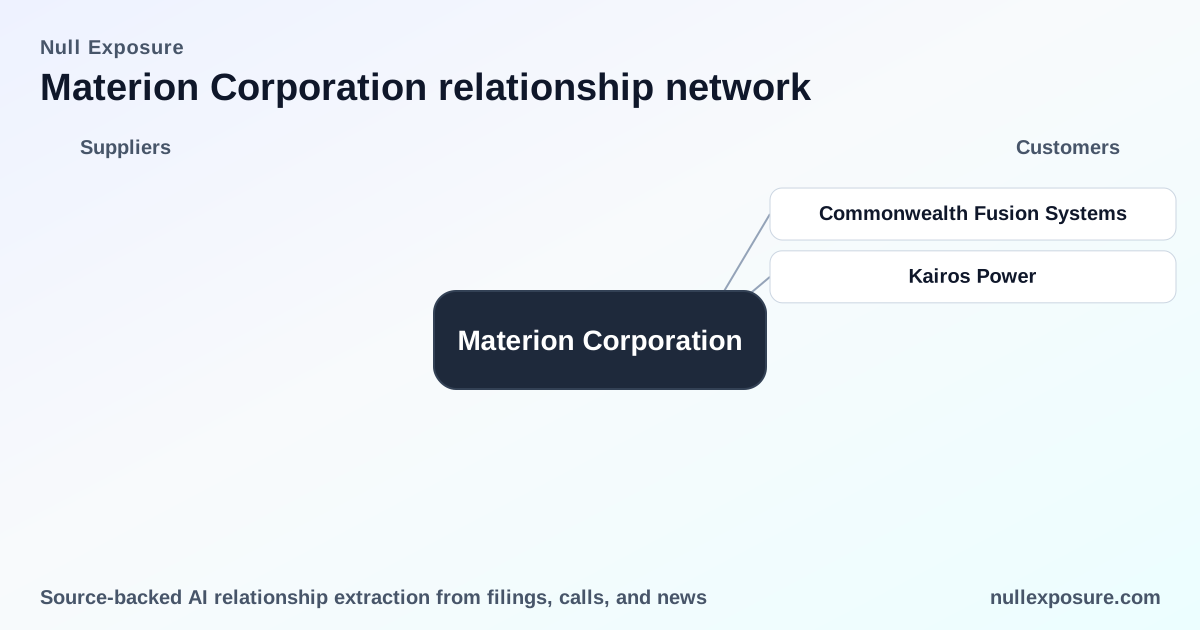
Materion’s customer links: how advanced-materials contracts translate into revenue and optionality
Materion (MTRN) monetizes a portfolio of high-performance metals, specialty alloys and coatings by selling engineered materials and toll-processing services into defense, energy, aerospace and electronics markets. Revenue accrues through direct sales, multiyear supply agreements for critical inputs, and fee-for-service processing, with international distribution augmenting in-house fulfillment. For investors, the core proposition is stable, specialized revenue from high-technical-barrier products combined with upside from strategic wins in emerging energy programs.
Explore more analysis and coverage at https://nullexposure.com/ for a deeper look at customer concentration and contract exposures.
Why customer relationships are the operational lever for Materion
Materion operates as a solutions supplier rather than a commodity metals trader. This business model creates three operational characteristics investors must track:
- Contracting posture: The company sources revenue from a mix of short-term government-style contracts and longer-term supply agreements; government contracts carry termination risk while multiyear commercial agreements create predictable revenue streams.
- Geographic reach and fulfillment: Sales flow from facilities in North America, Asia and Europe, supplemented by company-owned service centers and independent distributors, supporting global customers across semiconductor, defense and energy end markets.
- Role diversity and delivery modes: Materion acts as a seller of products, a distributor through owned and independent channels, and a service provider when customers request toll processing of customer-supplied material.
These characteristics translate into a hybrid revenue profile: defensive baseline demand from established industrial markets plus disproportionate upside tied to a handful of strategic, high-value customers in advanced energy and defense. The company reports that its backlog at the end of 2025 is expected to be filled over the following 18 months, signaling near-term revenue visibility for committed orders.
Customer relationships that matter right now
Below are the customer relationships disclosed in recent earnings commentary. Each relationship is summarized in plain English with the original source noted.
Commonwealth Fusion Systems — supplying beryllium fluoride under a multiyear agreement
Materion announced a supply relationship with Commonwealth Fusion Systems to provide beryllium fluoride used in fusion power plant technology, and later described the arrangement as a multiyear supply agreement for the fusion market. According to Materion’s 2025 Q3 earnings call (reported March 2026), the company committed to supplying beryllium fluoride for CFS’s ARC power plants; the 2025 Q4 earnings call (March 2026) confirmed a multiyear supply agreement. These disclosures indicate a strategically important commercial contract for an emerging energy customer (Materion earnings calls, 2025 Q3 and 2025 Q4, March 2026).
Kairos Power — providing materials to produce FLiBe molten salt coolant
Materion is supplying materials to support Kairos Power’s production of FLiBe, the molten salt coolant central to Kairos’s small modular reactor design. The relationship was described on Materion’s 2025 Q3 earnings call as progressing well and tied to critical reactor performance. This is an active commercial relationship with an advanced-energy customer that relies on Materion’s materials expertise (Materion earnings call, 2025 Q3, March 2026).
How these relationships affect valuation and risk
These disclosed customer links have direct implications for Materion’s revenue profile and risk-adjusted valuation:
- Revenue optionality and premium pricing. Agreements to supply specialty materials for fusion and advanced reactor programs validate Materion’s ability to capture premium margins for materials that require strict quality controls and regulatory compliance. These contracts increase the company’s exposure to high-growth energy markets and support forward revenue visibility, particularly where multiyear terms are in place.
- Concentration of strategic exposure. While the broader customer base spans semiconductor, aerospace and defense, large strategic customers in nascent energy markets can represent disproportionate upside—but they also concentrate execution risk around delivery, qualification, and program timelines.
- Contract risk dynamics. Company disclosures indicate a portion of revenue derives from government-related contracts that are vulnerable to termination for convenience or default, underlining the importance of contract type segmentation in the revenue mix. Investors should treat government contractual exposure as a separate risk bucket from commercial multiyear agreements.
- Global delivery footprint reduces single-region dependency. Sales are executed from facilities in North America, Asia and Europe and through company-owned centers and independent distributors, which mitigates single-market disruption but requires robust supply chain and compliance processes across regions.
Constraints and company-level signals investors should weigh
Materion’s public commentary and filings surface a set of operating constraints and structural signals that apply at the company level:
- Short-term contract exposure: Materion acknowledges revenue tied to defense-related products under government-style contracts that can be terminated, creating revenue volatility in those segments.
- Geographic distribution: The Performance Materials group sells from operations in North America, Asia and Europe and uses a mix of owned service centers and outside distributors, signaling a multi-region fulfillment model.
- Multiple relationship roles: Materion operates as a seller, distributor and toll-processor (service provider) depending on customer preference, giving the company flexibility but also operational complexity.
- Active backlog and near-term fulfillment: The company expects substantially all of its December 31, 2025 backlog to be filled within the next 18 months, which supports near-term revenue visibility but also concentrates delivery risk into that horizon.
These are company-level characteristics rather than attributes tied to any single customer, and they should frame how investors model revenue cadence, margin sensitivity and working-capital needs.
Investment takeaways and next steps
- Growth-plus-quality narrative: Materion combines steady industrial demand with optionality from strategic energy and defense contracts, and recent multiyear agreements demonstrate the firm’s capacity to lock in higher-margin work.
- Execution risk centered on delivery and contract type: The chief near-term risks are fulfilling specialized materials orders on schedule and managing the termination exposure inherent in government-style contracts.
- Catalysts to watch: Milestones from Commonwealth Fusion Systems and Kairos Power—qualification, pilot plant commissioning and order ramp—are direct revenue catalysts for Materion and should be monitored alongside backlog conversion and margin trends.
For a concise, investor-ready dossier on Materion’s customer exposures and contract signals, visit https://nullexposure.com/ and request the company-specific brief.