Matrix Service Co (MTRX): Customer Map and Commercial Implications for Investors
Matrix Service Company provides engineering, fabrication, construction and maintenance services to energy, petrochemical, utilities and industrial clients and monetizes through project contracts (EPC), long‑term service agreements and time‑and‑materials work under Master Service Agreements (MSAs). Revenue is earned project-by-project and through recurring maintenance under MSAs, concentrating cash flow in large, discrete contracts, which creates both upside in execution and volatility in margins and working capital. For a focused view of Matrix’s customer relationships and what they mean for credit and equity investors, read on — or visit https://nullexposure.com/ for further research and signal detail.
How Matrix wins work and how that shapes economics
Matrix’s commercial model is straightforward: bid and deliver large engineering, procurement and construction projects while retaining recurring maintenance and repair work through framework agreements. The company relies on MSAs to convert one‑off project wins into repeatable, time‑and‑materials revenue streams, as disclosed in company filings that describe MSAs and pricing under cost‑plus or time‑and‑materials arrangements.
Operational consequences for investors:
- Contracting posture: Project‑driven with an overlay of framework MSAs that smooth revenue but still expose Matrix to timing and execution risk on large EPC awards.
- Concentration profile: Matrix reported one customer representing 17.4% of consolidated revenue in FY2025 and another contributing 10.5%, signaling meaningful revenue concentration that elevates counterparty and contract renewal risk.
- Criticality and maturity: Most revenue derives from long‑term customer relationships and large infrastructure customers, implying high criticality but negotiated pricing power is limited by competition and contract terms.
- Geographic footprint: Operations span North America and select international markets, with the U.S. driving the bulk of revenue — a company‑level signal that exposure is regionalized but not purely domestic.
Collectively, these characteristics position Matrix as a mid‑cycle industrial contractor: sensitive to capital spending patterns in energy and utilities, dependent on a small number of large counterparties, and dependent on execution discipline to protect margins.
Customer relationships you should know (complete list from public reporting)
Below are every counterparty referenced in the collected coverage, with concise, investor‑oriented takeaways and source references.
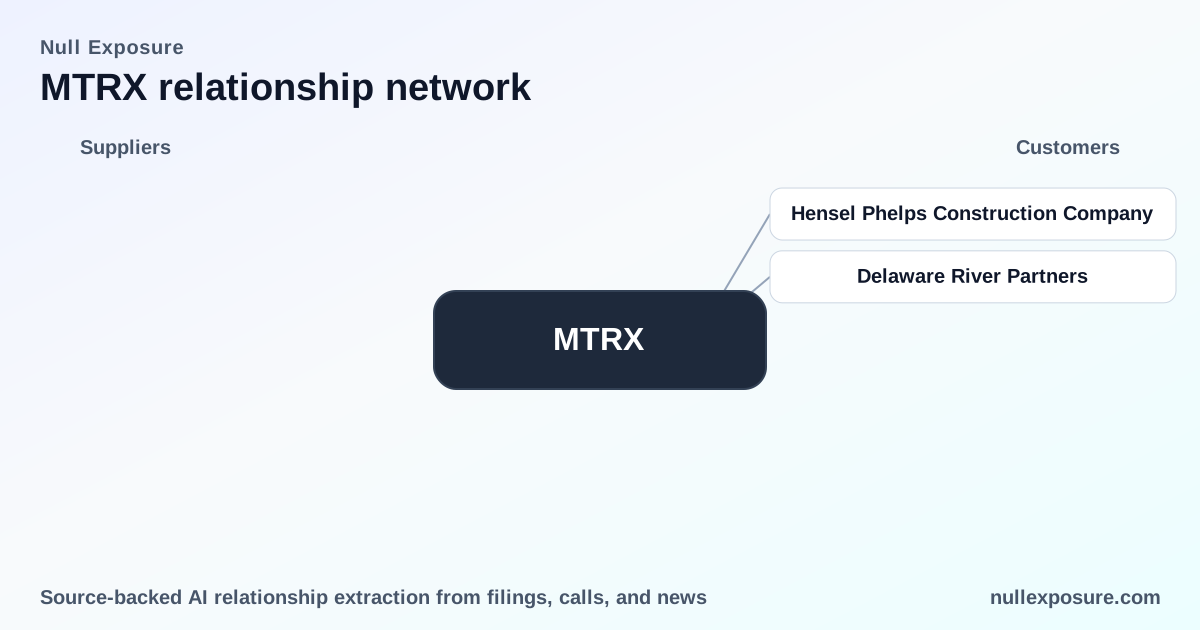
Hensel Phelps Construction Company
Matrix’s subsidiary, Matrix Service Inc., was selected by Hensel Phelps for engineering, procurement and construction (EPC) of three jet‑fuel storage tanks at Houston Hobby Airport — a project win that reflects Matrix’s role as an EPC subcontractor for major construction firms. According to a news release covered on Yahoo Finance (linked March 10, 2026), the award underscores Matrix’s ability to compete for mid‑sized fuel storage projects that fit its fabrication and field services capability. (Source: Yahoo Finance press item, March 10, 2026)
Delaware River Partners
Matrix received multiple awards from Delaware River Partners for work on a 100,000 m3 (≈630,000 barrel) dual‑service full containment storage tank in Gibbstown, New Jersey: one contract covered fabrication and construction for the inner steel tank and later a balance‑of‑plant scope for a full containment project that supports ammonia or LPG storage. These announcements (GlobeNewswire Nov 12, 2024; GlobeNewswire Nov 6, 2025) demonstrate repeat scope expansion on a large terminal project and the capacity to capture adjacent work streams on a single major client project. (Sources: GlobeNewswire Nov 12, 2024 and Nov 6, 2025; MarketScreener summary Nov 2025)
SBH (Sally Beauty Holdings / Beauty Systems Group)
Multiple press items from Sally Beauty and related news outlets list “Matrix” as a consumer/professional haircare brand offered through Beauty Systems Group channels, indicating product distribution of the Matrix haircare line through Sally Beauty’s CosmoProf/Armstrong McCall outlets. These references (PR Newswire, Yahoo Finance, GlobeNewswire, March–May 2026 coverage) are brand‑level retail relationships and do not represent commercial contracting with Matrix Service Company, the EPC and industrial services firm. Investors should note the name overlap but treat these items as unrelated to MTRX’s industrial contracting revenue. (Sources: PR Newswire, Yahoo Finance, GlobeNewswire, March–May 2026)
What these relationships imply for financial risk and upside
- Revenue concentration is real and material. Company disclosures show one customer at 17.4% of revenue and another at 10.5% in FY2025 — a structural risk that can drive volatility in both top line and receivables when large projects end or are delayed.
- Contract mix tempers but does not eliminate project risk. MSAs provide recurring, lower‑margin work and reduce churn, but EPC awards remain the primary driver of earnings volatility and working capital swings.
- Execution on complex storage and terminal projects is a core capability. Wins for large containment tanks and fuel storage indicate competitive positioning in terminal and storage markets, which supports medium‑term revenue visibility if capital spending in those sectors continues.
- Name overlap creates headline risk. The Matrix consumer brand references in retail press introduce potential confusion among general‑market observers; investors must separate brand distribution noise from Matrix Service’s industrial contracting fundamentals.
Investment lens: what to watch next
- Backlog and award cadence: Monitor quarterly disclosures and press releases for new EPC awards and expansions of scope on existing projects; these directly affect backlog and near‑term revenue recognition.
- Concentration shifts: Watch the company’s disclosures for changes in the largest customers and any loss or gain of >10% customers; that will materially affect cash flow predictability.
- MSA utilization: Management commentary on the mix between MSA‑driven service revenue and lump‑sum EPC contracts will indicate margin stability and working capital pressure.
- Execution metrics: Safety, on‑time completion, change order capture and claims resolution headline impacts to margin — investors should parse press releases and 10‑K/10‑Q commentary for these signals.
For a deeper dive into counterparty signals and how they affect valuation and credit dynamics, see our broader research hub at https://nullexposure.com/ — the site aggregates relationship signals and public filings to help investors prioritize operational risk drivers.
Bottom line
Matrix Service is a project‑centric engineering and construction services company that supplements episodic EPC revenue with recurring MSA work. The company’s commercial profile features high‑value, concentrated customers and mature long‑term relationships that confer competitive access to large terminal and storage projects but concentrate execution and counterparty risk. Investors should underwrite both the upside from large scope wins and the earnings volatility that project delivery and customer concentration impose.