MACOM (MTSI) — Customer Relationships, Concentration and What Investors Should Know
MACOM Technology Solutions (MTSI) designs and manufactures analog semiconductor components for optical, wireless and satellite networks and monetizes through direct sales, distributors and channel partners across Industrial & Defense, Data Center and Telecom end markets. Revenue is generated from differentiated RF, microwave and photonics products sold globally via a mix of direct OEM customers, contract manufacturers, resellers and distributors, with a notable proportion of sales routed through distribution partners. For investors, the critical questions are concentration risk, channel dependence and the degree to which customer ties are strategic versus transactional.
Explore deeper vendor and customer signals at https://nullexposure.com/ for more structured intelligence on counterparties.
How MACOM reports customer relationships — high‑level operating signals
MACOM’s public filings and accompanying disclosures deliver a consistent set of operating-model signals that matter for valuation and risk assessment:
- Contracting posture: Sales agreements with sales representatives, resellers and distributors frequently have initial terms of one or more years with automatic renewal options and termination-for-convenience clauses with 30–90 days’ notice, indicating a stable but flexible channel architecture (MACOM 2025 Form 10‑K).
- Geographic footprint and go‑to‑market: MACOM concentrates its direct sales force, applications engineering and channel partners in North America, Asia (notably China/APAC) and Europe, making revenue exposure sensitive to regional demand cycles and geopolitical trade dynamics (MACOM 2025 Form 10‑K).
- Concentration and materiality: No single direct customer accounted for 10% or more of revenue in FY2025; sales to the top 25 direct customers were 45.6% of revenue in FY2025, while distributors accounted for 32.3% of revenue, highlighting meaningful channel concentration even as direct-customer concentration remains diffuse (MACOM 2025 Form 10‑K).
- Role diversity and product segmentation: MACOM acts as manufacturer and seller while also relying on resellers and distributors to reach end markets; its product portfolio is centered on core product lines for I&D, Data Center and Telecom customers, which sustains pricing power but ties the business to cyclical capex in those sectors.
- Relationship maturity and activity: FY2025 revenue growth (+32.6% year-over-year to $967.3 million) signals an active and expanding customer base, not a stagnant roster of one‑off buyers (MACOM 2025 Form 10‑K).
These company-level signals shape how investors should frame customer risk: distributor dependence introduces counterparty concentration, geographic sales mix creates regional exposure, and contract terms support recurring channel access while remaining cancellable on short notice.
Customer snapshots from filings and press — what the record shows
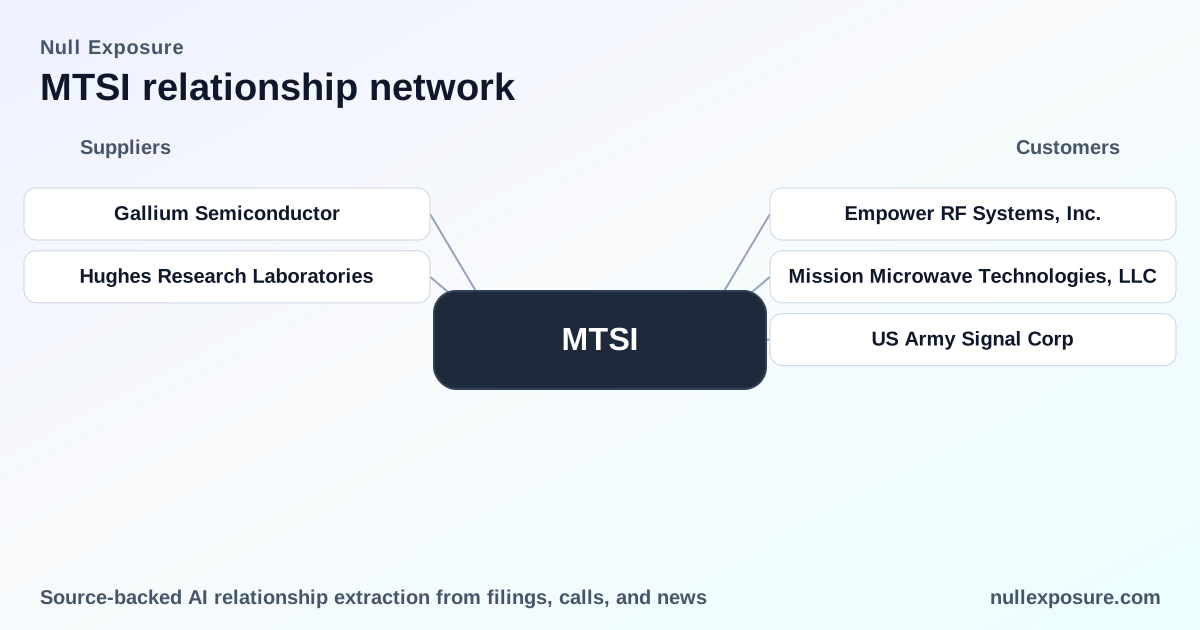
Empower RF Systems, Inc.
MACOM disclosed $0.4 million of commercial product sales to Empower RF Systems, Inc. during fiscal year 2025, and noted Empower is an affiliate of one of MACOM’s directors, which is relevant for governance review and related-party scrutiny. According to MACOM’s FY2025 Form 10‑K filing (filed Oct 3, 2025), this is a small, disclosed transaction that requires monitoring from a conflict-of-interest perspective.
Mission Microwave Technologies, LLC
MACOM reported $0.2 million of commercial product sales to Mission Microwave Technologies during fiscal year 2024, and identified Mission as an affiliate of a former director, Susan Ocampo. The FY2025 Form 10‑K records this historical transaction and provides transparency on director‑affiliated counterparty activity.
US Army Signal Corp (historical supplier relationship)
MACOM’s origins trace to Microwave Associates, which supplied communications equipment to the US Army Signal Corps in the 1950s; modern commentary notes that lineage and historic defense ties inform MACOM’s continuing orientation to Industrial & Defense customers. A March 2026 industry note recapping semiconductor sector highlights referenced this founding relationship and how MACOM’s product mix serves defense communications needs (Finviz, March 10, 2026).
What these relationships collectively imply for investors
The customer disclosures are modest in nominal dollars for the named counterparties, but they reveal broader structural characteristics:
- Immaterial direct-customer line items can mask channel concentration. Although individual direct customers did not exceed 10% of revenue, distributors represent a material share (~32.3% in FY2025), concentrating commercial exposure through a smaller set of intermediaries (MACOM 2025 Form 10‑K).
- Governance and related-party diligence matter. Small-dollar transactions with director-affiliated entities are disclosed; investors should track such entries for frequency and any escalation over time that could signal preferential channeling or procurement patterns (MACOM 2025 Form 10‑K).
- Regional revenue dependence is a strategic risk lever. Sales are concentrated in North America, APAC (including China) and EMEA; investors must account for demand variability and trade-policy risk across these geographies when modeling growth scenarios (MACOM 2025 Form 10‑K).
- Contract flexibility supports responsiveness but reduces guaranteed cash flow. Distributor and reseller agreements often allow relatively short notice termination, so growth is durable but not fully locked down—this affects downside protection in cyclical downturns.
For investors focused on customer credit, supply chain resilience and go‑to‑market durability, these signals should be incorporated into valuation scenarios and downside stress tests. The company’s strong growth trajectory in FY2025 suggests secular demand for its core RF and photonics products, but channel concentration and regional exposure remain the principal counterweights to that momentum.
Explore full counterparty profiles and structured customer intelligence at https://nullexposure.com/ for a concise view of counterparties and disclosure excerpts.
Investment implications and key takeaways
- Growth plus channel risk: MACOM combines robust top‑line growth with meaningful distributor reliance; that mix supports upside while introducing counterparty concentration risk.
- Low single‑customer dependence: The absence of a single customer >10% is positive for concentration risk, but top-25 customers still represent nearly half of revenue, so retention of those accounts is material.
- Operationally active footprint: Geographic diversification and a direct-plus-distributor sales model give MACOM scale, but also expose the company to regional demand shocks and trade-policy disruption.
- Governance items are transparent and small today; monitor for scale: Director-affiliate transactions are modest but disclosed; investors should watch for any increase or pattern that would affect procurement integrity.
Bottom line: MACOM’s customer base and channel structure support persistent revenue growth while creating targeted concentration and geopolitical risks that must be modeled explicitly. Use counterparty-level disclosures and the company-form 10‑K to track any movement in distributor share or related-party activity that would alter risk-adjusted growth assumptions.