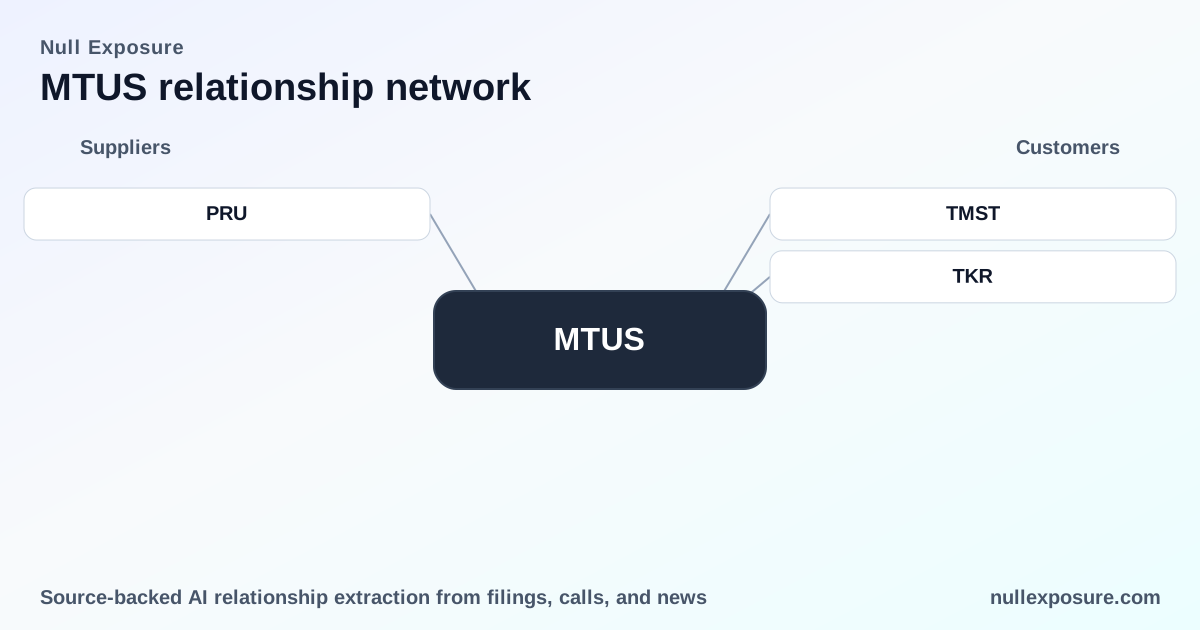
Metallus (MTUS): customer relationships that shape revenue durability
Metallus manufactures alloy, carbon and micro-alloy steel using electric-arc-furnace technology and monetizes through the sale of finished steel products to original equipment manufacturers, distributors and steel service centers across industrial, automotive, aerospace & defense, and energy end markets. Revenue is driven by long-term component contracts and a small number of large customers—one customer accounted for 11.2% of 2024 net sales—while the company retains a primarily U.S. sales footprint with global end-market exposure. For a structured view of Metallus’s customer ties and what they imply for contract stability and concentration, see the notes below and visit the NullExposure homepage for our dataset and tools: https://nullexposure.com/.
Quick business snapshot: how customer relationships translate to cash
Metallus operates as a manufacturer-seller with a mixed distribution posture: most sales go directly to OEMs, while roughly 18% of sales flow through authorized distributors and steel service centers, creating a two-channel revenue profile that balances direct pricing power with reach. The company reports multi-year manufactured components contracts that average roughly five years, lending predictable revenue recognition on key programs. Net sales totaled $1,084.0 million in 2024 with the U.S. comprising the bulk of that revenue, signaling both domestic concentration and the operational advantage of being close to core industrial customers.
What investors should watch in the customer book
- Contracting posture: multi-year, predictable contracts with certain customers encourage visibility but also tie Metallus to program timelines and capital cycles.
- Concentration: the presence of at least one customer >10% of net sales is a material concentration risk that underpins revenue volatility if program demand shifts.
- Channel mix: direct OEM selling provides higher margin leverage; the distributor/service-center channel (≈18% of sales) provides volume and geographic reach.
- Geography and end markets: primarily U.S.-based sales with global end-market exposure; demand is therefore sensitive to domestic industrial cycles but benefits from diversified application demand globally.
If you track counterparty exposure across industrial suppliers, we maintain detailed relationship mappings at NullExposure: https://nullexposure.com/.
Detailed coverage of every customer mention in the record
Below I list every relationship entry captured in the records. Each line is a plain-English summary of the mention and its source.
Ellwood Group — CantonRep article, January 7, 2015 (FY2015)
Metallus’s record set includes a reference to Ellwood Group as a long‑time, valued customer for related steel operations; the citation notes Ellwood’s status in the local industry supply chain. According to a CantonRep piece published January 7, 2015, TimkenSteel acknowledged Ellwood as a longstanding customer in that context.
Source: CantonRep, “PA steel company invests in...”, January 7, 2015.
TMST (TimkenSteel) — same CantonRep article, January 7, 2015 (FY2015)
TimkenSteel issued a statement in the same article referencing Ellwood and customers more broadly, indicating industry relationships and customer continuity among regional steelmakers. The CantonRep article records TimkenSteel publicly identifying Ellwood as a valued customer in FY2015.
Source: CantonRep, January 7, 2015.
Timken Co. — CantonRep article, July 23, 2017 (FY2017)
A later CantonRep article from July 23, 2017 notes that TimkenSteel continued to count Timken Co. among its customers, alongside major bearing manufacturers and automakers, illustrating OEM demand links between steel producers and component manufacturers. The piece frames Timken Co. as a consistent buyer within the industrial supply chain in FY2017.
Source: CantonRep, “Steel proud,” July 23, 2017.
TKR — same CantonRep article, July 23, 2017 (FY2017)
The record repeats the Timken Co. reference under the ticker TKR, again noting Timken’s role as a customer for TimkenSteel and confirming the connection between steel producers and bearing/automotive OEMs in FY2017.
Source: CantonRep, July 23, 2017.
The Timken Company — Leaders Magazine interview, 2014 (FY2022 cited context)
A Leaders Magazine interview documents a historical shift in customer mix at TimkenSteel, noting that by the turn of the century less than 10% of sales were to the Timken bearing business, which signals diversification away from a single affiliate customer. The article contextualizes customer concentration trends and the company’s broader OEM base.
Source: Leaders Magazine, Timken interview feature, 2014.
TKR — same Leaders Magazine piece, 2014 (FY2022 cited context)
This duplicate entry records the same Leaders Magazine content under the TKR ticker, reiterating that sales to the Timken bearing business declined to under 10% historically, demonstrating a long-term move toward a broader customer base.
Source: Leaders Magazine, 2014.
Operating constraints and what they imply for investors
The available constraint evidence provides actionable signals on Metallus’s operating model:
- Long-term contracts are an operational anchor. Contracts for manufactured components frequently extend multiple years and average about five years, giving Metallus forward visibility on a meaningful portion of revenues and reducing short-term cyclical exposure for contract customers.
- Geographic concentration with global end-market reach. Sales are primarily to U.S. customers, but products serve demanding global applications; this creates domestic revenue concentration with demand sensitivity linked to global industrial cycles.
- Dual commercial roles. Metallus is principally a seller/manufacturer to OEMs while also relying on distributors/steel service centers for roughly 18% of net sales, which moderates go-to-market risk but also introduces channel margin dilution.
- Active, diversified customer base but material concentration. The firm reports about 330 customers across several end markets, which suggests diversification, yet one customer exceeded 10% of net sales in 2024 (11.2%), signaling meaningful single-customer exposure that can drive volatility.
- Segment maturity and scale. Operating in basic materials (steel) with EAF technology positions Metallus in an established, capital-intensive industry where margin expansion depends on operational efficiency and program penetration rather than rapid growth.
Investment implications and headline risks
- Stability via contract tenure: The multi‑year contract profile supports revenue predictability for program customers and is a positive signal for cash-flow modeling.
- Concentration risk: The >10% single-customer weight requires active monitoring; loss or reprofile of that relationship would materially impact revenue.
- Cyclicality and geography: U.S.-centric sales expose Metallus to domestic industrial cycles even as product applications are global, creating a balance between local sales advantages and macro sensitivity.
- Channel mix trade-off: The 18% distributor/service-center share provides scale but compresses margins versus direct OEM business.
Investor action: track program renewals and the identity of the >10% customer in quarterly filings, monitor distributor channel margins, and model the company’s cash flow under stress scenarios where that customer’s demand moderates.
Final read
Metallus operates as a manufacturing-first steel supplier with predictable, multi-year contract characteristics and meaningful single-customer concentration—a combination that produces steady visibility but real downside if large program demand declines. For ongoing monitoring and a structured view of counterparty exposure across suppliers and their customers, visit NullExposure: https://nullexposure.com/.