MetaVia (MTVA): Customer Relationships That Drive a Licensing-First Clinical Biotech
MetaVia develops clinical-stage therapeutics and monetizes primarily through licensing agreements, milestone payments and partnership-driven development rather than product sales today; its public disclosures and news flow show active licensing and collaboration activity that will determine near-term cash flow and de-risking events. For investors evaluating MTVA, the company’s revenue pathway is partnership-led: R&D value capture occurs when external parties advance assets into late-stage trials or commercialization under license, triggering payments to MetaVia. For a concise commercial-risk dashboard, visit the NullExposure research portal: https://nullexposure.com/.
How MetaVia operates and why customer/partner links matter
MetaVia positions itself as a biotechnology concern focused on drug candidates (not a digital services firm), and its market capitalization and financials reflect an early-stage, development-heavy business with no recorded revenue TTM and negative earnings. That profile creates a commercial model where partner/licensee relationships are the primary conduit to material revenue—milestones, royalties, and cost-sharing from clinical development programs. Given the absence of recurring product sales, the firm’s contracting posture is inherently licensing-centric and counterparty-dependent.
- Contracting posture: Licensing and collaborative R&D dominate; the company depends on counterparties to execute late-stage development and commercialization.
- Concentration and criticality: A small number of external partners will disproportionately influence cash flow and valuation inflection points.
- Maturity: The business is early-stage with no revenue reported; partner milestones are the main measurable commercial milestones available to investors.
What the public relationship evidence shows
Below I cover every customer/partner relationship surfaced in recent public results. Each entry is a concise plain-English statement about the relationship and its source.
MThera Pharma — license to advance NB-01 (clinical development)
MetaVia (formerly trading under a related corporate identity reported in the press) licensed NB-01, a drug candidate for painful diabetic neuropathy, to MThera Pharma for further research and potential progression to a Phase 3 trial, positioning MThera as a development partner that could trigger future milestone payments to MetaVia. According to an Investing.com report dated May 3, 2026, NeuroBo’s license of NB-01 to MThera Pharma is publicized in the company’s repositioning coverage.
Liberty Global (LBTYA) — historical distribution context involving MTV-branded channels
A historical distribution change documented in coverage from Liberty Global references replacement of legacy channels including MTV and related networks; this item signals legacy carriage and brand-distribution dynamics tied to the MTV name rather than an operating commercial customer for a biotech product. The news item appears in coverage syndicated by NewsIsMyBusiness with first-seen reporting on March 10, 2026, referencing events catalogued to FY2015.
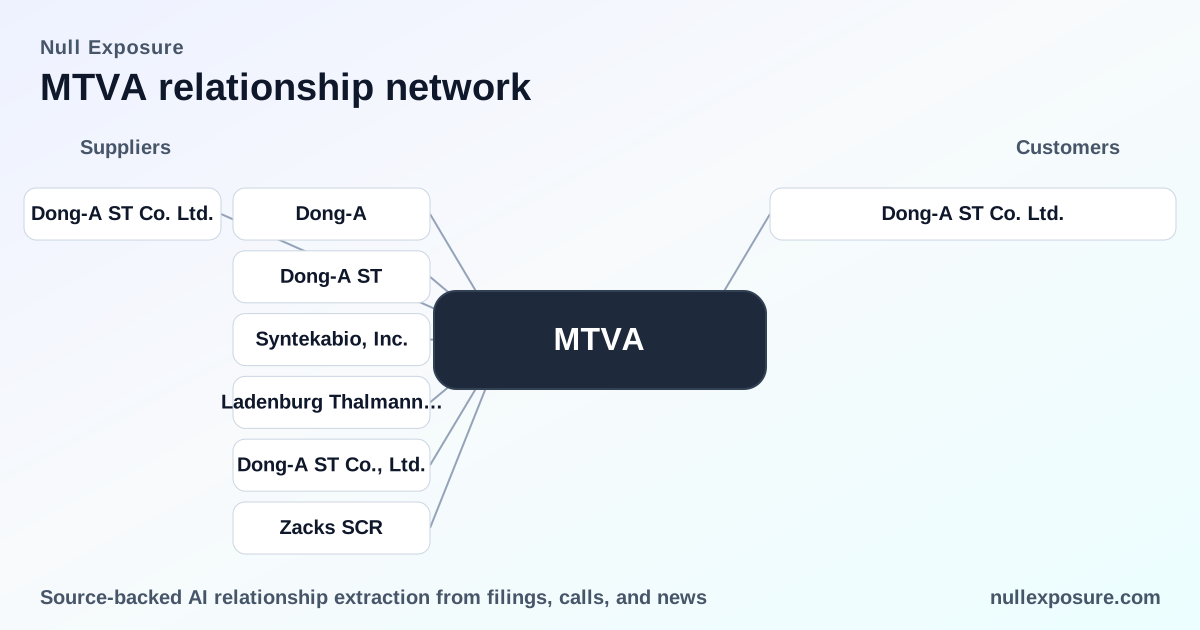
Dong-A ST Co. Ltd. — licensed program with financial implications for MetaVia
MetaVia has an active license agreement with Dong-A ST Co. Ltd. tied to a clinical-stage program (DA-1241), and company communications explicitly link the ability to realize the license benefits to future financial and operating results—making Dong-A ST a strategically material partner for anticipated value capture. This relationship is described in a PR Newswire release covering MetaVia’s presentation of DA-1241 data at the EASL Congress 2025 and noted in reporting on March 10, 2026.
Interpreting these relationships for valuation and operations
These three relationships paint a coherent commercial posture: MetaVia relies on licensing and third-party advancement of its assets. For investors and operators, that has immediate implications:
- Revenue visibility: Because MetaVia reports no revenue TTM, the timing and probability of milestone receipts from licensees such as MThera and Dong-A ST are the primary levers for cash inflow. The MThera license for NB-01 and the Dong-A ST agreement therefore represent the most actionable near-term revenue channels.
- Concentration risk: With a small number of named partners in the public record, success or delays at any single partner could materially change the company’s cash runway and valuation. Concentration of development risk is a principal balance-sheet vulnerability.
- Operational leverage: MetaVia’s operating leverage is high—partner execution (regulatory filings, trial outcomes, commercialization decisions) will convert R&D investment into realized value; the firm’s internal spend supports asset creation but external partners carry many commercialization execution risks.
- Legacy brand signals: The Liberty Global reference is a non-operational, legacy distribution signal tied to the MTV media brand rather than active biotech commercialization, and should be weighted accordingly in commercial models.
Constraints and what’s not shown in public tracking
There are no explicit contractual constraints captured in the available relationship extract for MTVA; this absence itself is a company-level signal. The lack of publicly recorded constraints suggests:
- Limited public granularity on contract terms (timing of milestones, royalty rates, exclusivity windows) in the sources reviewed, which increases reliance on qualitative read-throughs and press releases for modeling.
- Higher information asymmetry around counterparty concentration and the exact financial mechanics of each license, reinforcing the need to monitor partner disclosures and company filings closely.
Because no constraint excerpt explicitly names any of the relationships, these points are presented as company-level operating signals rather than attributes tied to a specific partner.
Key takeaways for investors and operators
- Licensing-first monetization: MetaVia’s path to revenue runs through partner advancement and milestone realization (MThera and Dong-A ST are the primary examples in the public record).
- Event-driven valuation: Clinical progress or licensing payments from partners will produce the material valuation inflections for MTVA.
- Concentration and information risk: Few named partners and no publicly catalogued contract constraints increase outcome volatility; investors should track partner filings and press releases closely.
For a deeper, partner-focused diligence framework and ongoing monitoring, explore NullExposure’s commercial intelligence hub: https://nullexposure.com/.
Bottom line
MetaVia is an early-stage biotech company whose commercial fate is tied to a small set of licensing relationships, notably MThera Pharma for NB-01 and Dong-A ST for DA-1241, with legacy brand references appearing in historical distribution reporting. Investors should underwrite future cash flow as contingent on partner execution and milestone timing, while operators should prioritize transparency in partner agreements to reduce valuation uncertainty.