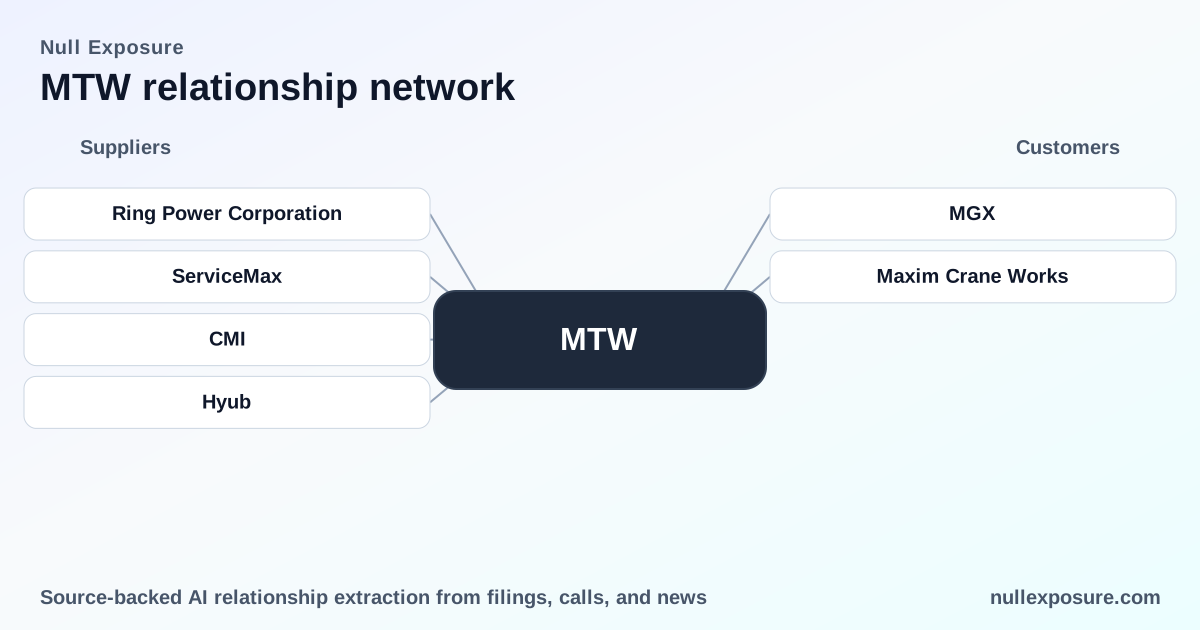
Manitowoc (MTW) — Customer Relationships and Commercial Posture
Manitowoc is an industrial manufacturer that monetizes through new equipment sales, rental fleet operations, aftermarket parts and service, extended warranties, and subscription-based telematics. The company sells mobile hydraulic, lattice-boom, tower and specialty cranes through a global network of dealers and rental companies while also operating direct-service channels and subscription products (Potain Connect and Grove Connect) that convert equipment uptime into recurring revenue. For relationship intelligence and comparative commercial overlays, see NullExposure for deeper client-level signals: https://nullexposure.com/
How Manitowoc converts industrial capital goods into durable revenue
Manitowoc’s business model blends heavy-equipment manufacturing with recurring-service economics. It sells cranes under multiple brands (Grove, Manitowoc, Potain, National Crane, MGX Equipment Services and others) and captures aftermarket economics through repair, remanufacturing, parts sales, rentals and extended warranties. The company explicitly operates subscription telematics (Potain Connect and Grove Connect) that provide real-time service access and remote diagnostics, turning maintenance needs and downtime sensitivity into predictable service revenue. Distribution is largely through independent dealers and rental fleets, supplemented by direct-to-customer activity in select markets.
Key monetization drivers: product margins on new crane sales, recurring service and parts revenue, rental fleet utilization, and growing subscription telematics revenue. For a consolidated view of Manitowoc’s client touchpoints and service footprint, NullExposure maintains an evidence-based relationship index: https://nullexposure.com/
Named customers identified in open reporting
MGX
Manitowoc’s MGX brand figures in recent coverage as part of the company’s dealer and direct-to-customer footprint expansion. A Finviz news summary (Mar 10, 2026) noted that Manitowoc expanded its direct-to-customer footprint and referenced MGX being appointed as a Hiab dealer in the U.S. across 13 states, indicating both channel activity and brand-level dealer positioning. (Finviz, March 10, 2026)
Maxim Crane Works
Maxim Crane Works is documented as a purchaser of Manitowoc product inventory: a ForConstructionPros press release (covering activity from FY2021) reported that Maxim Crane Works purchased 51 Grove cranes, a mix of rough-terrain and all-terrain models, demonstrating Manitowoc’s penetration into large rental and contractor operators. (ForConstructionPros press release, FY2021)
Operating constraints and what they indicate about risk and resilience
Manitowoc’s disclosures and the relationship evidence reveal a set of constraints that define how counterparties interact with the company and how predictable revenue streams are.
-
Contracting posture — hybrid, with long-dated commitments and subscriptions. Company filings disclose buyback commitments that expire at various times through 2032, signaling multi-year contractual obligations on certain inventory or fleet arrangements. Separately, Potain Connect and Grove Connect subscriptions formalize recurring-service contracts that provide steady, serviceable revenue rather than one-off sales.
-
Revenue concentration — broadly diversified. Manitowoc’s financial statements state that no single customer accounted for more than 10% of consolidated net sales for 2024, 2023, or 2022, which positions the company with low counterparty concentration risk among large buyers.
-
Customer types — wide and public-sector inclusive. The company serves dealers, rental companies, contractors and government entities across petrochemical, industrial, commercial construction, power/utilities and infrastructure segments. This mixture gives demand smoothing across private and public capex cycles.
-
Geographic footprint — global but regionally concentrated in NA and EMEA. Sales and service operations are global, with primary service availability in the United States and Europe, and reporting segments that include Americas, EURAF (Europe and Africa) and MEAP (Middle East and Asia Pacific). Revenue disclosures show meaningful North American contribution (United States $1,060.7 million in the disclosed period), with Europe also a material region.
-
Role diversity — manufacturer plus service provider and distributor. Manitowoc is an integrated manufacturer of cranes, uses a global distributor network, and operates a significant service organization (over 460 technicians globally), which collectively produce both product and recurring-service economics.
-
Materiality and spend profile — mid-size contingent liabilities and commitments. The company reported buyback commitments of $29.9 million and loss guarantees with maximum liabilities of $14.3 million as of December 31, 2024, placing these items in a mid-range $10M–$100M spend band that is visible but not balance-sheet dominant.
-
Maturity and criticality — established manufacturing with high aftermarket stickiness. Cranes are capital-intensive assets with high downtime costs; Manitowoc’s aftermarket and subscription services are mission-critical to customers and create durable revenue. The distribution and rental channels indicate an established route-to-market rather than an early-stage rollout.
What investors should focus on now
-
Recurring revenue growth is the strategic lever. Subscription telematics and extended warranties convert equipment fleet into annuity-like revenue; growth in these lines improves revenue visibility and margin stability.
-
Channel mix determines margin volatility. Independent distributors and large rental buyers (exemplified by Maxim Crane Works) drive volume; direct-to-customer and dealer appointments (as with MGX activity) affect margin capture and service penetration.
-
Counterparty risk is limited but regional cycles matter. No single customer concentration reduces idiosyncratic risk, but dependence on construction and industrial capex means regional economic cycles in NA and EMEA will drive near-term topline swings.
-
Balance-sheet exposures are manageable but not trivial. Buyback commitments and guarantees in the tens of millions are material to monitor alongside fleet utilization and working capital dynamics.
Final takeaways for allocators and operators
- Manitowoc operates a diversified commercial model that converts equipment sales into recurring service revenue through telematics, parts, and technicians.
- Customer relationships are broad and immaterial at the single-counterparty level, but relationships with large renters and dealers are important for volume and aftermarket penetration (e.g., Maxim Crane Works’ large purchase and MGX dealer activity).
- Contract architecture is mixed: long-term buyback exposure coexists with subscription contracts that improve revenue predictability. Company filings as of year-end 2024 document commitments and guarantees that investors should monitor.
For subscription-based monitoring of Manitowoc’s customer relationships and rolling evidence updates, visit NullExposure: https://nullexposure.com/