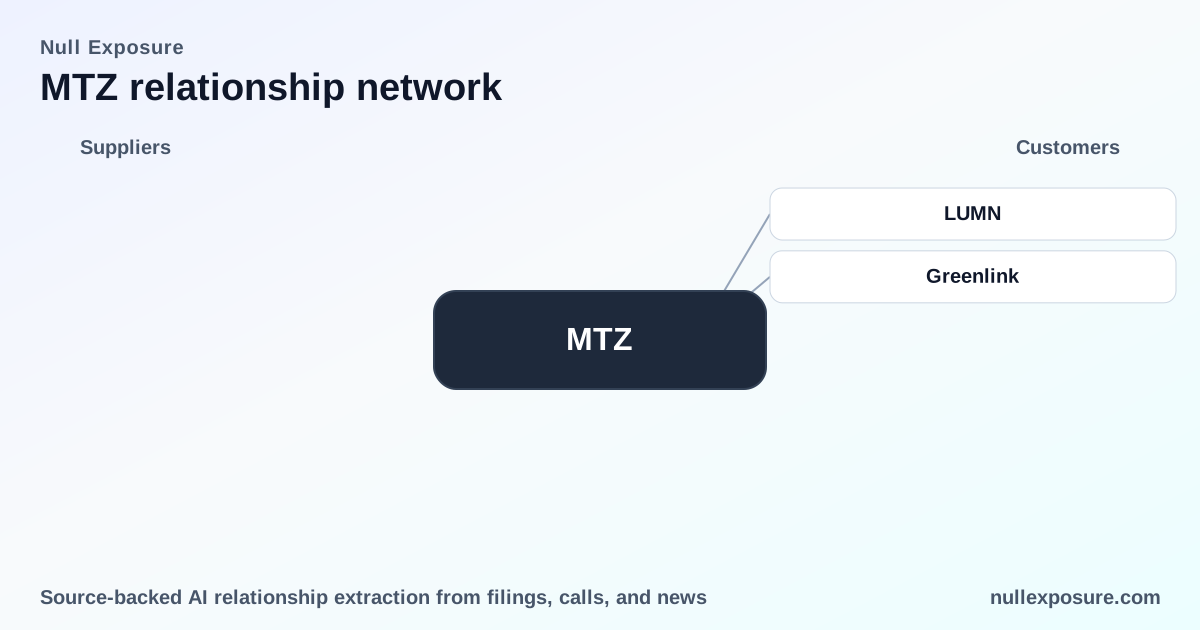
MasTec (MTZ) customer relationships — how two contracts shape revenue visibility and operational risk
MasTec operates as an integrated infrastructure construction firm that monetizes engineering, construction, installation, maintenance, and upgrade services through project contracts and master service agreements across communications, energy, utilities and civil infrastructure in North America. Revenue realization is driven by contract ramps and backlog conversion rather than recurring subscription economics; accordingly, visible near-term growth depends on major contract ramps (for example Lumen) and the restart/progression of large projects (for example Greenlink). Explore additional coverage at https://nullexposure.com/.
How MasTec structures customer exposure — the operating model investors must internalize
MasTec sells project-based services under a mix of contracting arrangements with materially different risk profiles. The company derives a large portion of revenue from master service and other service agreements that provide a menu of services in defined geographies, with pricing that is typically either time-and-materials or fixed-price per unit. Those master agreements accounted for about 41% of consolidated revenue for the year ended December 31, 2024, demonstrating that a substantial share of activity is governed by framework contracts rather than single fixed-price projects.
Key company-level signals:
- Contracting posture: Framework MSAs are core to the model; contracts are often multi-year but many are cancelable or do not require minimum purchases, creating both optionality and revenue volatility.
- Customer mix and concentration: Customers include large communications, utility and power providers; loss or demand reduction from a few major customers would be material to results.
- Geographic concentration: Operations are primarily North American, with virtually all revenue and operations centered in the U.S. and Canada.
- Counterparty mix: Government work represents a measurable share of revenue (roughly low-double-digit percent recently), pairing commercial large-enterprise work with public-sector projects.
- Maturity and role: Relationships are generally longstanding and mature, positioning MasTec as a preferred vendor and principal service provider; the company functions primarily as the seller/service provider though customers retain decision and spend optionality.
- Backlog and visibility: Remaining performance obligations and backlog provide multi-year revenue visibility (company reported $10.0 billion of remaining performance obligations as of December 31, 2024, with about $6.4 billion expected to convert in 2025).
These structural traits create both earnings leverage when large contracts ramp and margin sensitivity when fixed-price work or indemnity exposure increases.
Two customer relationships to watch (and what each means for revenue)
Lumen — a ramping communications contract that drives 2026 visibility
A Tikr blog post on March 10, 2026 highlighted that the Lumen contract begins ramping in 2026, providing visible growth for MasTec. This contract is a material near-term driver given MasTec’s communications installation capabilities and the typical size and cadence of Lumen engagements. (Source: Tikr, March 10, 2026 — “Almost at all-time high: Is MasTec (NYSE: MTZ) stock a good buy right now?”)
Greenlink — restart and backlog support after permitting resolution
MasTec reported that permitting issues on the Greenlink project were resolved sooner than expected, allowing work to restart and supporting future volumes; backlog reached a record $5.6 billion, up 17% year-over-year. Greenlink is cited as an example of how resolving project-level execution constraints translates directly into backlog conversion and revenue recognition. (Source: The Globe and Mail reporting on MasTec earnings call / press release, March 2026)
What the constraints tell investors about durability, concentration and margin risk
MasTec’s corporate disclosures and the constraint evidence together reveal the company’s operating arithmetic and risk levers:
- Framework-heavy but mixed-tenor contracting: With roughly 41% of revenue tied to master service agreements, MasTec benefits from repeatability and lower sales friction, while simultaneously assuming demand optionality because many MSAs do not commit minimum volumes and can be canceled on short or no notice. This creates a dual profile of steadiness in relationships and episodic revenue swings from project ramps.
- Material customer concentration: Company statements emphasize a small number of high-value customers that drive meaningful revenue; the loss of one or more of these customers would be material to financial performance. Concentration increases earnings volatility and elevates the importance of contract renewals and scope expansions.
- North America-centric execution: Operations focused in the U.S. and Canada simplify geopolitical exposure but concentrate regulatory, labor and permitting risk within the same jurisdictions where permitting delays can stop large projects (as Greenlink illustrated).
- Government and large-enterprise counterparty mix: Approximately low-double-digit percent of revenue comes from government entities, complementing commercial large-enterprise work; this mix modifies cash collection and compliance profiles and often lengthens procurement cycles.
- Mature, supplier-role relationships: MasTec positions itself as a preferred, longstanding supplier, which supports repeat wins and improves bid competitiveness; however, the seller/service-provider posture includes indemnity obligations and exposure to claims that can affect margins and working capital.
- Backlog and RPO-driven visibility, but timing-sensitive: The company reported $10.0 billion of remaining performance obligations as of year-end 2024, with a large share expected to convert in 2025 and beyond—this provides revenue runway but requires steady execution and favorable permitting and supply-chain conditions.
These constraints combine into a profile where revenue visibility hinges on a handful of large projects and contract ramps, while profit margins reflect the mix of T&M vs fixed-price work and indemnity/claim outcomes.
Investment implications — what to monitor and why it matters
- Track contract ramps and backlog conversion: The Lumen ramp in 2026 and Greenlink restart materially affect near-term revenue; investors should watch quarterly revenue conversion, segment disclosures and timing updates.
- Monitor contract mix shifts: An increasing proportion of fixed-price work or larger bespoke projects increases margin risk; conversely, higher T&M contracting can protect margins during labor cost inflation.
- Watch customer concentration metrics and MSA renewals: Renewals, expansions or losses among the top customers will determine top-line growth trajectory.
- Permitting, claims and indemnities: Execution delays and indemnity claims have direct margin and cash implications; permits clearing on major projects (as with Greenlink) is a positive leading indicator.
- Geographic and public-sector exposure: North American focus and government business create predictable regulatory and procurement cycles—these help model timelines but require diligence on local execution risk.
For deeper, continuously updated analysis of MasTec’s customer relationships and project-level signals, visit https://nullexposure.com/.
Bottom line
MasTec’s commercial architecture delivers highly visible revenue when large contracts ramp and sustained risk when a limited set of customers or projects drives a disproportionate share of activity. Lumen’s 2026 ramp and Greenlink’s restart are the two near-term relationship events that will define top-line momentum. Investors should maintain discipline around backlog conversion metrics, contract mix evolution, and counterparty concentration to assess the durability of the current growth cycle.