Micron’s Customer Map: Who Buys Its Memory, and Why it Matters to Investors
Thesis: Micron (MU) monetizes by designing, manufacturing, and selling DRAM, NAND, and advanced memory modules to hyperscalers, OEMs, enterprise customers and consumers; its revenue mix is driven by large, concentrated relationships with cloud and AI infrastructure players and complemented by consumer and distribution channels. The company captures value through product specialization (HBM, LPDDR, SSDs), scale in manufacturing, and both short-term transactional sales and negotiated longer-term agreements that periodically reset to market conditions. For a concise signal feed and relationship monitoring, see https://nullexposure.com/.
Why this matters now: AI compute is redefining Micron’s customer dynamics
Micron sits at the center of the AI infrastructure supply chain: hyperscalers and AI chip companies are the primary demand drivers for high-end HBM and specialized DRAM modules, and Micron’s roadmap for HBM3E/HBM4 and SOCAMM2 products directly ties to large design wins. The firm’s fiscal disclosures show material concentration — roughly half of revenue came from the top ten customers over the last three years and one customer represented 17% of revenue in 2025 — which creates both powerful revenue leverage and client-specific execution risk.
If you evaluate exposure to Micron’s customer relationships, focus on the contracting posture (a mix of short-term transactional pricing with periodic long-term frameworks), geographic breadth (large U.S., Taiwan and China exposure), and criticality: memory products are mission-critical inputs for AI platforms and hyperscaler data centers, so design wins and sampling activity translate into outsized revenue implications.
Explore Micron’s relationship signals at https://nullexposure.com/ for ongoing tracking.
Operating model signals: what the company filings say about customers
- Contracting posture: Micron discloses that most customer contracts are short-term at negotiated prices with prompt payment terms, while also entering longer-term agreements that are periodically renegotiated to reflect market conditions. This mix creates revenue flexibility but means pricing and volumes reset with market cycles.
- Counterparty mix and maturity: Customers range from individual consumers (Crucial-branded products) to mid-market OEMs and very large hyperscalers; sales are managed through direct enterprise channels and distributors, indicating broad go-to-market coverage but concentrated enterprise revenue.
- Geography and concentration: Revenue is global with large U.S. receipts (U.S. HQ customers accounted for $24,113 million in 2025) and significant Asia exposure (Taiwan, Mainland China, Japan and other APAC markets); the top-ten concentration and a single 17% customer position are material company-level risks and positives.
- Materiality and spend: Micron reports top-customer concentration and a spend band consistent with $100m+ customers, underscoring that a handful of large customers drive a disproportionate share of revenue.
Relationship log — every result in the source data (short summaries and citations)
-
Nvidia / NVDA — A Finterra piece (markets.financialcontent.com, first seen Mar 10, 2026) reported that Micron may have missed initial lead-supplier status for Nvidia’s next‑gen “Vera Rubin” platform, a development that could hand early share to SK Hynix. Source: https://markets.financialcontent.com/stocks/article/finterra-2026-3-5-the-ai-memory-super-cycle-a-deep-dive-into-micron-technology-mu
-
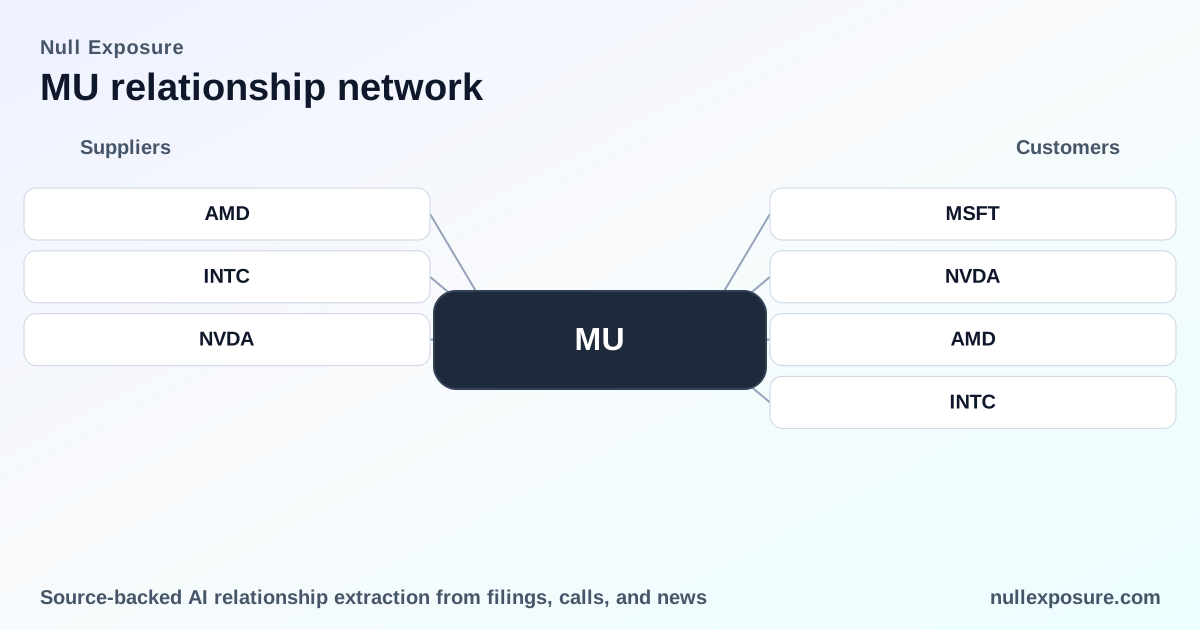
Advanced Micro Devices / AMD — A Globe and Mail press release (Mar 10, 2026) noted Micron is engaged in long-term agreements with NVIDIA, AMD and Intel to capture a larger share of the AI infrastructure market. Source: https://www.theglobeandmail.com/investing/markets/stocks/MU/pressreleases/566847/micron-why-the-recent-pullback-is-an-opportunity/
-
NVDA — Finterra (Mar 9, 2026) reported Micron has begun sampling 16-layer HBM4 for Nvidia’s “Vera Rubin” architecture, indicating early qualification activity. Source: https://markets.financialcontent.com/stocks/article/finterra-2026-3-9-micron-technology-mu-the-american-titan-of-the-ai-memory-revolution
-
Intel / INTC — The Globe and Mail press release (Mar 10, 2026) included Intel among the long-term agreement counterparties that help Micron pursue AI infrastructure demand. Source: https://www.theglobeandmail.com/investing/markets/stocks/MU/pressreleases/566847/micron-why-the-recent-pullback-is-an-opportunity/
-
NVDA — TradingKey (Mar 9, 2026) commented that Micron is well positioned with HBM3E and is preparing to ramp HBM4E into Nvidia’s Vera Rubin platforms in H2 2026. Source: https://www.tradingkey.com/news/stocks/261661844-market-movers-lrcx-20260309
-
NVDA — A second TradingKey entry reiterated Micron’s HBM4E ramp plans toward Nvidia platforms (Mar 9, 2026). Source: https://www.tradingkey.com/news/stocks/261660667-market-movers-intc-20260309
-
NVDA — The Globe and Mail press release (Mar 10, 2026) listed NVIDIA among multiple announced long‑term counterparties for Micron. Source: https://www.theglobeandmail.com/investing/markets/stocks/MU/pressreleases/566847/micron-why-the-recent-pullback-is-an-opportunity/
-
NVidia / NVDA — Finterra (Mar 9, 2026) again noted Micron sampling of 16-layer HBM4 for Nvidia’s architecture, reinforcing sampling signals across reports. Source: https://markets.financialcontent.com/stocks/article/finterra-2026-3-9-micron-technology-mu-the-american-titan-of-the-ai-memory-revolution
-
Microsoft / MSFT — A Zacks summary on TradingView (Mar 10, 2026) noted Micron products enable hyperscalers like Microsoft to accelerate AI workloads and LLM training. Source: https://www.tradingview.com/news/zacks:b51ffb709094b:0-micron-why-the-recent-pullback-is-an-opportunity/
-
MSFT — Duplicate TradingView/Zacks mention reiterating hyperscaler acceleration (Mar 10, 2026). Source: https://www.tradingview.com/news/zacks:b51ffb709094b:0-micron-why-the-recent-pullback-is-an-opportunity/
-
NVDA — TradingKey (Mar 9, 2026) market-movers coverage reiterated Micron’s competitive position with HBM3E and HBM4E ramp plans. Source: https://www.tradingkey.com/news/stocks/261661846-market-movers-cat-20260309
-
NVDA — Finterra (Mar 5, 2026) again flagged reports about Micron’s supplier positioning and potential share shifts with Nvidia platforms. Source: https://markets.financialcontent.com/stocks/article/finterra-2026-3-5-the-ai-memory-super-cycle-a-deep-dive-into-micron-technology-mu
-
Dell / DELL — InvestingNews (Mar 9, 2026) reported Micron presented its first shipment of made‑in‑India memory modules to Dell for laptops manufactured in India. Source: https://investingnews.com/micron-celebrates-opening-of-india-s-first-semiconductor-assembly-and-test-facility/
-
Advanced Micro Devices / AMD — SimplyWallSt (May 3, 2026) noted Micron HBM is designed into a leading AMD AI platform (June 13 reference). Source: https://simplywall.st/stocks/ca/semiconductors/tsx-mu/micron-technology-shares
-
Intel / INTC — A Globe and Mail press release entry duplicated the long‑term agreement mention including Intel (Mar 10, 2026). Source: https://www.theglobeandmail.com/investing/markets/stocks/INTC/pressreleases/566847/micron-why-the-recent-pullback-is-an-opportunity/
-
MRVL (Marvell) — A Globe and Mail item (Mar 10, 2026) referenced collaboration between Marvell and Micron on HBM design and integration to supply custom HBM compute architectures. Source: https://www.theglobeandmail.com/investing/markets/stocks/MRVL/pressreleases/161646/mrvl-declines-8-in-3-months-time-to-hold-or-fold-the-stock/
-
INTC — A Globe and Mail duplicate entry reiterated Intel’s inclusion among counterparties (Mar 10, 2026). Source: https://www.theglobeandmail.com/investing/markets/stocks/MU/pressreleases/566847/micron-why-the-recent-pullback-is-an-opportunity/
-
NVDA — TradingKey (Mar 9, 2026) market-movers feed again recapped HBM3E competitive position and HBM4E ramp context. Source: https://www.tradingkey.com/news/stocks/261661003-market-movers-csco-20260309
-
NVDA — TradingKey (Mar 9, 2026) repeated the ramp/competitive narrative across sector market-movers notes. Source: https://www.tradingkey.com/news/stocks/261661193-market-movers-avgo-20260309
-
NVDA — TradingView/Zacks (Mar 10, 2026) highlighted Micron’s long‑term agreements and relationships with NVIDIA in a broader investment note. Source: https://www.tradingview.com/news/zacks:b51ffb709094b:0-micron-why-the-recent-pullback-is-an-opportunity/
-
Apple / AAPL — Apple’s Q1 2026 earnings call excerpt referenced working with Micron on a new advanced chip packaging and test facility, indicating supply-chain collaboration. Source: aapl-2026q1-earnings-call (first seen Mar 7, 2026)
-
AAPL — Finterra (Mar 3, 2026) reviewed Micron’s corporate milestones including the Elpida acquisition that improved access to Apple’s supply chain. Source: https://markets.financialcontent.com/stocks/article/finterra-2026-3-3-the-memory-supercycle-why-micron-technology-mu-is-the-indispensable-engine-of-the-ai-era
-
Nvidia / NVDA — 247WallStreet (Mar 5, 2026) reported Micron’s 256GB SOCAMM2 LPDRAM module, co‑designed with Nvidia and using one‑third the power of RDIMMs, is shipping — a tangible product win. Source: https://247wallst.com/investing/2026/03/05/micron-stock-price-prediction-where-will-mu-be-in-1-year/
-
Nvidia — Duplicate 247WallStreet mention reiterating SOCAMM2 shipping (Mar 5, 2026). Source: https://247wallst.com/investing/2026/03/05/micron-stock-price-prediction-where-will-mu-be-in-1-year/
-
Intel / INTC — TradingView echoed Globe and Mail’s long‑term agreement references including Intel in Micron’s customer mix (first seen Mar 10, 2026). Source: https://www.tradingview.com/news/zacks:b51ffb709094b:0-micron-why-the-recent-pullback-is-an-opportunity/
-
Microsoft / MSFT — The Globe and Mail press release (Mar 10, 2026) reiterated Microsoft as a hyperscaler beneficiary of Micron’s AI memory solutions. Source: https://www.theglobeandmail.com/investing/markets/stocks/INTC/pressreleases/566847/micron-why-the-recent-pullback-is-an-opportunity/
-
Microsoft — Duplicate Globe and Mail entry restating Microsoft’s role with Micron (Mar 10, 2026). Source: https://www.theglobeandmail.com/investing/markets/stocks/MU/pressreleases/566847/micron-why-the-recent-pullback-is-an-opportunity/
Investment implications: concentration is a feature and a risk
- Revenue upside is tied to a handful of hyperscalers and AI chip partners. Design wins and sampling activity (HBM4, SOCAMM2) are high-conviction leading indicators for future revenue expansion.
- Concentration creates binary outcomes. The 17% single-customer exposure and top-ten concentration mean a major expansion or loss of share with a key partner moves Micron’s financials materially.
- Contracting is fluid. Company disclosures describe short-term, fixed-price sales alongside negotiated long-term frameworks that are periodically reset, which protects Micron against stale pricing but links near-term results to market cycles and demand swings.
Bottom line: Micron’s customer base is strategically well-positioned for AI-driven memory demand, but investors must monitor design-win conversions, supplier status with Nvidia/AMD/Intel, and the company’s execution on HBM4 ramps.
For continuous monitoring and live relationship signals, visit https://nullexposure.com/.