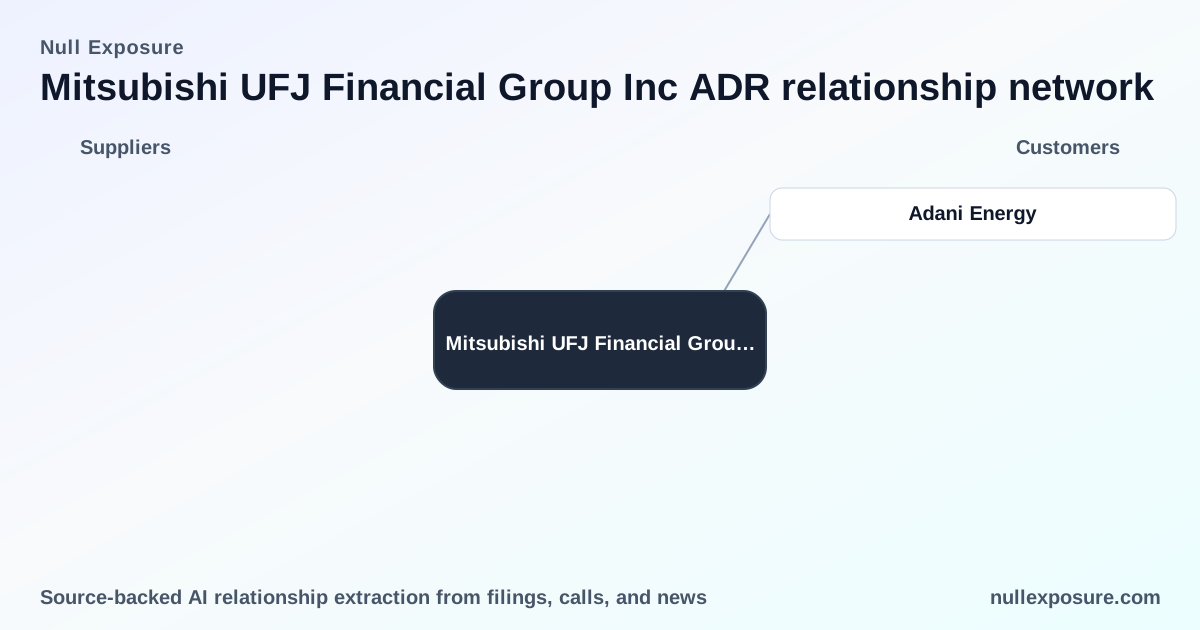
MUFG’s customer footprint: lending, custody and capital markets where the balance sheet counts
Mitsubishi UFJ Financial Group (MUFG) is a global banking holding company that monetizes through a mix of wholesale lending, syndicated and project finance, custody/asset servicing, and investment banking fees. With roughly $5.85 trillion in trailing revenue-equivalent figures reported and a market capitalization near $198 billion, MUFG leverages scale in Asia, the U.S., and Europe to capture fee income on securities and custody work while deploying balance-sheet capital into staged project and corporate financings. For investors, the signal is clear: MUFG generates durable fee streams from custody and capital markets while intermittently using the balance sheet for differentiated, often strategic, credit exposures. Learn more about coverage and signals at https://nullexposure.com/.
Where MUFG shows up and how that translates to revenue
MUFG’s operating posture is a hybrid of client-servicing (custody, securities distribution, co‑managing offerings) and balance-sheet deployment (syndicated loans, project and equipment financing). This results in:
- Contract-oriented relationships: many interactions are governed by multi-year custody or credit agreements that produce recurring fees and optionality to upsell capital markets services.
- Moderate concentration: the portfolio mixes large corporate and project exposures with numerous smaller custody/issuer relationships—concentration risk exists at the project and syndicated loan level rather than being uniform across the book.
- High criticality for counterparties: MUFG’s role as administrative agent, lender of record, or custodian makes it critical to clients’ capital structures and operational plumbing.
- Mature relationship profile: evidence of multi-year facilities, amendments and terminations show long-lived commercial arrangements that generate steady fee and interest income.
These are company-level operational signals; no contractual constraints were provided that change attribution across individual counterparties.
Recent customer relationships observed (concise takeaways)
WTTR (Select Water Solutions)
MUFG Securities Americas is listed on a Form 424B5 placement document with an allocation figure of 259,259, indicating MUFG’s role as a securities distributor or placement agent on the WTTR offering. Source: StreetInsider (Form 424B5), first observed May 4, 2026.
DLX (Deluxe Corporation / Deluxe Receivables LLC)
Deluxe Receivables LLC amended its receivables financing agreement to increase the facility limit to $100 million and extend the termination date, with MUFG Bank, Ltd. participating alongside other lenders. This is a clear example of MUFG’s receivables/asset-backed lending activity. Source: Investing.com press coverage, May 2, 2026.
GUG (Guggenheim Fund custody)
Guggenheim’s fund moved custody/administration away from MUFG Investor Services and BNY Mellon under a new agreement, with no termination fees recorded—an instance where custody relationships produce discrete event risk when mandates change. Source: The Globe and Mail/TipRanks summary, March 9, 2026.
QNST (QuinStreet)
QuinStreet signed a $150 million senior secured revolving credit facility with MUFG Bank as administrative agent, secured by first-priority liens and maturing in January 2031—showing MUFG’s role as lead arranger and administrative agent on corporate credit. Source: QuinStreet company announcement reported March 10, 2026.
FRMI (Fermi Inc. / Project Matador)
MUFG Bank provided a $500 million loan and substantial committed equipment financing to support Fermi’s Project Matador and its broader low‑carbon energy campus, highlighting MUFG’s appetite for large-scale energy and infrastructure financing. Source: company press releases and market summaries (PR Newswire, Finviz), March 2026.
VFS / VFSWW (VinFast)
VinFast executed a US$100 million loan facility with MUFG Bank to support international expansion and green initiatives, reflecting MUFG’s participation in automotive/EV-sector financing and green loan structures. Source: VinFast press release and market notice, reported March 2026.
Adani Energy (India transmission financing)
MUFG is part of a bank syndicate financing Adani Energy’s transmission project in India, increasing MUFG’s visibility in large infrastructure and emerging-markets energy financings. Source: Reuters coverage summarized by Meyka, March 2026.
ORC (Orchid Island Capital)
Orchid Island’s RMBS disclosures list Mitsubishi UFJ Securities (USA), Inc. and MUFG Securities Canada, Ltd. as holders/participants in the portfolio allocations reported in March 2026, underscoring MUFG’s presence in structured credit distribution/placement. Source: Orchid Island Capital investor filing / GlobeNewswire, March 2026.
USB-P-A / USB-P-S (U.S. Bancorp and MUFG Union Bank asset transfers)
U.S. Bancorp’s acquisition activity included buying MUFG Union Bank’s core regional banking franchise and discrete debt servicing and securities custody portfolios from MUFG Union Bank, showing strategic divestitures of regional franchise components. Source: CityBiz (May 4, 2026) and American Banker (March 2026).
WHR (Whirlpool)
MUFG Securities Americas acted as a co‑manager on Whirlpool’s upsized equity/depositary share concurrent offering, illustrating recurring investment‑banking fee opportunities in equity capital markets. Source: Whirlpool press release via PR Newswire, March 10, 2026.
APM (Aptorum Group)
Aptorum’s SEC filing lists MUFG among banks holding cash and restricted cash balances, creating counterparty credit exposure to MUFG on operational cash balances. Source: SEC filing for Aptorum Group (FY2019 disclosure referenced in March 2026 reporting).
LGPS (Logprostyle)
Logprostyle announced a partnership with Mitsubishi UFJ Morgan Stanley Securities to expand market access starting August 2025, highlighting MUFG’s distribution and advisory footprint in corporate growth strategies. Source: TravelandTourWorld coverage, reported May 3, 2026.
Hitachi (decarbonized mobility financing)
MUFG expanded a strategic financing partnership with Hitachi to support decarbonized mobility initiatives, pointing to targeted industry programs aligned with energy transition financing. Source: TradingKey market coverage (March 27, 2026).
What the relationship map implies for investors
- Revenue diversity: MUFG captures fees across custody, distribution and underwriting, and supplements that with interest income from large corporate and project loans. The relationships observed span offerings, syndicated loans, green loans and asset-backed facilities, reinforcing mix-of-fees and balance-sheet income.
- Event risk in custody: Termination of custody mandates (e.g., Guggenheim) creates episodic fee loss; however, many other relationships are credit facilities and project financing with contractual protections.
- Concentration in project financing: Loans for energy campuses and large infrastructure (Fermi, Adani) are sizeable and concentrated exposures that command underwriting premiums but increase credit and execution risk at the portfolio level.
- Maturity and stickiness: Revolving credit facilities, multi-year custody agreements and repeated co-managing roles indicate a mature, sticky client base that supports fee stability.
Near-term watcher list for investment research
- Track cumulative committed exposure to Project Matador and related equipment finance to quantify concentrated credit risk.
- Monitor custody mandate flows and asset servicing wins/losses as a leading indicator of fee momentum.
- Observe syndicated loan secondary performance and covenant enforcement on large green loans.
For a concise dashboard of MUFG customer relationships and event signals, visit https://nullexposure.com/ for structured coverage and alerts.
Bold conclusion: MUFG’s customer footprint combines stable, fee-generating custody and capital-markets roles with episodic, high-ticket balance-sheet placements—an operating model that delivers diversified earnings but requires active credit monitoring on concentrated project financings.