Murphy Oil (MUR): Customer Concentration and Contract Profile — Who Buys Its Production?
Murphy Oil is an upstream oil and gas producer that monetizes through the sale of crude oil, natural gas and NGLs to refiners, integrated majors and midstream counterparties. Revenue is realized under a mix of long‑term, fixed‑price contracts and spot/fixed‑forward arrangements, and the company reports material customer concentration with a handful of large buyers accounting for double‑digit shares of sales in FY2024. For investors and operators, the critical frame is simple: stable production economics for a portion of volumes combined with concentrated counterparty exposure to majors creates both earnings visibility and counterparty risk.
Explore the full relationship view at https://nullexposure.com/ for deeper attribution and filing-level detail.
How Murphy’s business model converts barrels into cash
Murphy operates as a traditional E&P seller: it develops and produces hydrocarbon volumes and sells those volumes to third parties, generating top‑line revenue rather than operating downstream refining or retail networks. The company’s revenue base is therefore driven by three mechanics simultaneously: (1) production volumes, (2) commodity price exposure via spot and fixed contracts, and (3) customer concentration that affects receivables and renegotiation leverage. Murphy’s FY2024 disclosures show material reliance on a few large customers, which amplifies the impact of counterparty behavior on working capital and realized prices.
Key operating implication: the mix of long‑term fixed contracts and spot sales provides partial revenue stability while preserving upside from favorable spot pricing for unhedged volumes.
Corporate constraints that define revenue quality and risk
Murphy’s 10‑K embeds several explicit signals that shape revenue predictability and counterparty dynamics:
-
Contracting posture: mixed long‑term and spot — the company states it has “several long‑term, fixed‑price contracts in Canada” and also uses forward fixed‑price and spot contracts at sales points such as Malin and Dawn. This combination produces partial cash‑flow stability without eliminating market exposure.
-
Geographic footprint: North America‑centric with global operations — Murphy produces primarily in the U.S. and Canada while exploring globally, which means pricing and contract counterparties are concentrated in North America, but operational diversification exists.
-
Material customer concentration — the 10‑K lists customers that represented 10% or more of sales; several counterparties meet this threshold in FY2024. This is a corporate‑level materiality signal: a small set of buyers drives a disproportionate share of revenue.
-
Relationship role and stage: active seller, core product — statements about continuing operations confirm Murphy’s primary revenue source is selling crude, NGLs and natural gas, and these relationships are active and central to core product flows.
Collectively, these constraints indicate a company with moderate counterparty concentration but measurable revenue protection through contracts, which should be incorporated into cash‑flow and counterparty risk models.
If you want the granular filings that support these points, inspect the Murphy 2024 Form 10‑K at https://nullexposure.com/.
Customer roster from the 2024 10‑K — explicit mentions and what they mean
Below are the individual relationship mentions extracted from the FY2024 filing; each entry includes a short plain‑English summary and the filing citation.
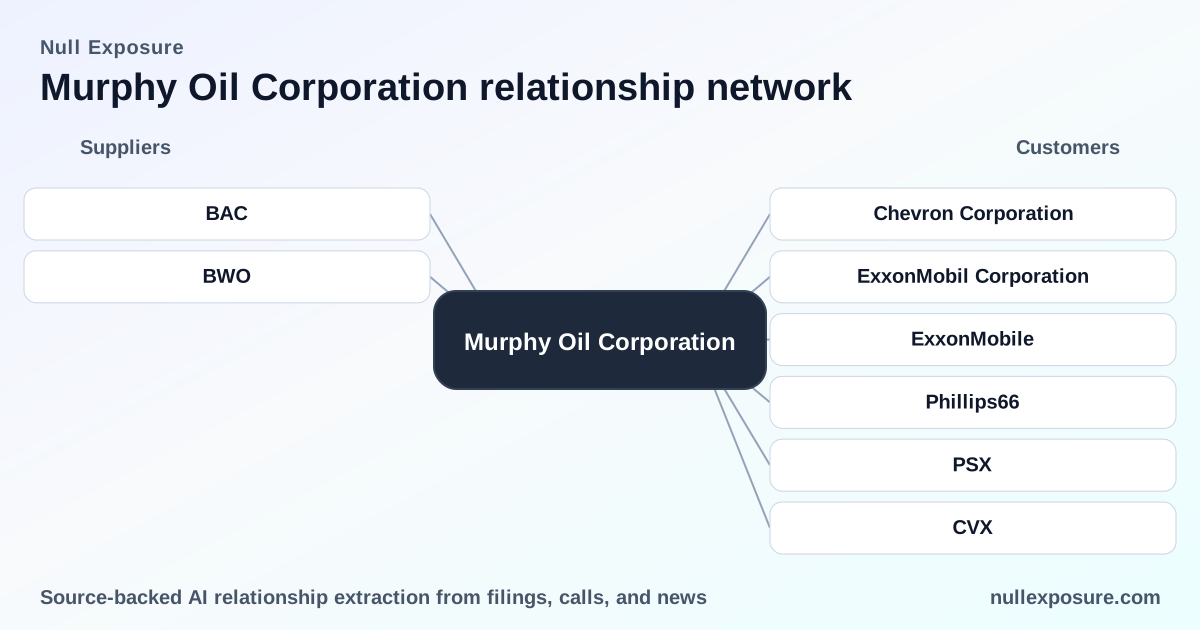
ExxonMobile
Murphy’s 10‑K includes a tagged reference to “ExxonMobile” in its customer concentration section, reflecting the company’s disclosure tagging of a major integrated buyer in FY2024. According to Murphy’s 2024 Form 10‑K, this entity is cited in customer concentration data. (Murphy 2024 Form 10‑K, FY2024)
Chevron Corporation
Chevron accounted for 13% of Murphy’s sales in 2024, making it one of the company’s largest customers and a meaningful source of receivables and negotiated pricing terms. (Murphy 2024 Form 10‑K, “Customers that accounted for 10% or more…”, FY2024)
Phillips66
Phillips 66 was disclosed as representing 10% of sales in 2024, meeting Murphy’s threshold for material customers and indicating reliance on a mid‑to‑large refiner for a notable fraction of volumes. (Murphy 2024 Form 10‑K, FY2024)
ExxonMobil Corporation
ExxonMobil Corporation is reported as representing 20% of Murphy’s sales in 2024, the single largest counterparty disclosed and a primary driver of customer concentration risk for the year. (Murphy 2024 Form 10‑K, “ExxonMobil Corporation 20% …”, FY2024)
PSX (inferred symbol)
The filing shows a line item “Phillips 66 10%” with an inferred symbol PSX; this reiterates Phillips 66’s materiality in the revenue mix and confirms ticker‑level mapping applied in the filing extraction. (Murphy 2024 Form 10‑K, FY2024)
Phillips 66 (alternate naming)
An additional entry lists “Phillips 66” (textual variant), again cited at the 10% sales threshold for FY2024 and reinforcing the company’s repeated disclosure across formats. (Murphy 2024 Form 10‑K, FY2024)
CVX (inferred symbol)
Murphy’s tagging includes an entry tying Chevron to the ticker CVX via a member tag in the filing extraction, consistent with the 13% sales disclosure and confirming symbol mapping in the filing metadata. (Murphy 2024 Form 10‑K, FY2024)
Chevron (alternate tagging)
A second tagging entry for “Chevron” appears in the filing extraction metadata, representing the same material customer relationship described above and underscoring the multiple internal references to Chevron across the 10‑K. (Murphy 2024 Form 10‑K, FY2024)
Collective takeaway: the filing explicitly identifies ExxonMobil (20%), Chevron (13%) and Phillips 66 (10%) as material customers for FY2024; multiple metadata entries and symbol inferences in the filing confirm these are central counterparties in Murphy’s revenue mix.
What investors should value and watch
-
Valuation sensitivity: given these counterparty concentrations, Murphy’s realized price and working capital are sensitive to contract terms and payment performance of a small set of majors and refiners. Model stress tests should include counterparty default or renegotiation scenarios.
-
Hedge and contract coverage: the presence of long‑term fixed‑price contracts in Canada provides a hedge for a portion of volumes, while spot sales at Malin and Dawn preserve upside on favorable market moves. Quantify the share of volumes under fixed contracts when performing cash‑flow forecasts.
-
Operational diversification vs. counterparty concentration: geographic production diversification reduces single‑field risk, but revenue concentration to a few buyers constrains counterparty diversification benefits.
Bold action item: incorporate counterparty concentration sensitivity into both cash‑flow scenarios and receivable stress testing for MUR.
For a detailed, line‑by‑line view of the 10‑K references and metadata mapping that underpin these conclusions, visit https://nullexposure.com/ and review the Murphy customer disclosures.
Conclusion: Murphy’s revenue model is straightforward and transparent — production sold to a small set of large buyers under a mix of contract tenors — which delivers partial earnings stability but requires active monitoring of counterparty exposure and contract roll dynamics when sizing investment risk.