McEwen Mining (MUX) — who buys the metal and what that means for investors
McEwen Mining operates as a producer and seller of gold and silver, monetizing through the sale of refined metal, doré and concentrates from its North and South American operations. The company recognizes revenue at transfer of control and combines spot-market sales with negotiated doré purchase agreements and a long-dated streaming commitment, producing a mix of cash-flow visibility and commodity price exposure that underpins near-term revenue and shapes long-term upside. For a concise view of counterparties and contract posture, visit https://nullexposure.com/.
Customer roster that actually moves the needle
McEwen’s FY2024 disclosures identify a short list of counterparties that together account for material San José sales and ongoing doré arrangements. Each relationship below is pulled from the company’s FY2024 Form 10‑K.
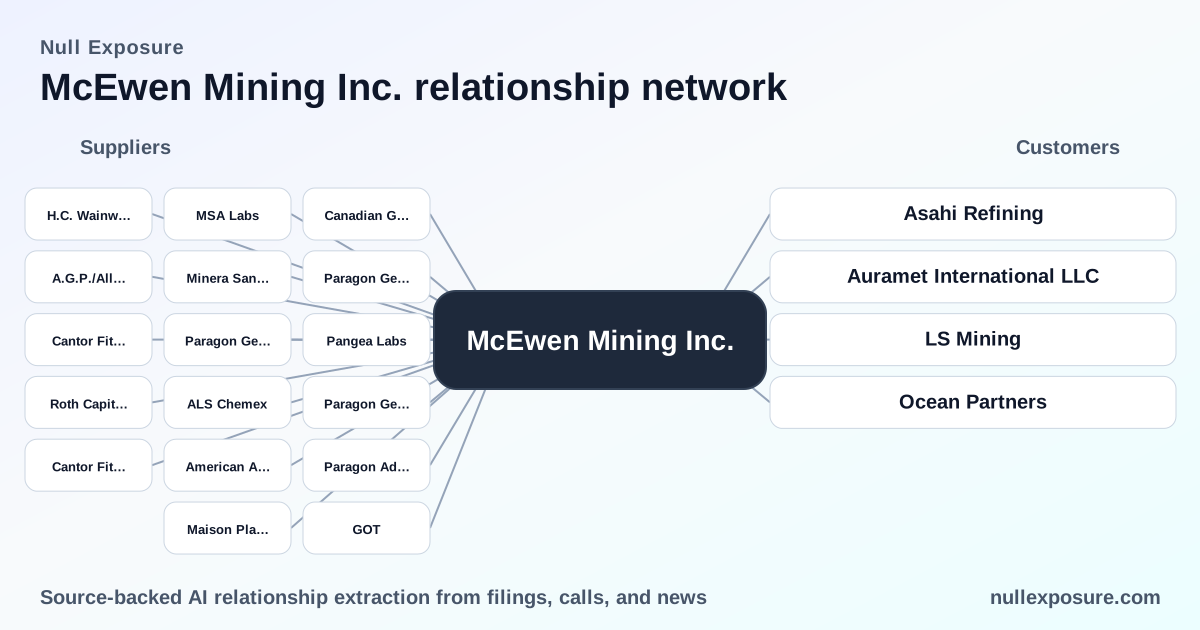
Asahi Refining
McEwen has entered into doré purchase agreements with Asahi Refining, and Asahi accounted for 21% of total sales from the San José mine in 2024, making it the single largest named buyer from that operation. According to McEwen Mining’s 2024 Form 10‑K, Asahi is a principal doré counterparty and a material purchaser for San José (FY2024).
Auramet International LLC
Auramet is named alongside Asahi as a doré purchaser in the company’s disclosure, indicating McEwen sells doré under contract terms that include Auramet as a buyer. The 2024 Form 10‑K lists Auramet International LLC in the company’s doré purchase arrangements (FY2024).
LS Mining
LS Mining, identified as a Korean company, accounted for 18% of San José’s total 2024 sales, representing a significant single-country counterparty concentration for concentrate or metal shipments. McEwen’s FY2024 10‑K reports LS Mining as one of three firms that together made up 57% of San José sales during the year (FY2024).
Ocean Partners
Ocean Partners, a Peruvian company, likewise accounted for 18% of San José’s 2024 sales, forming the third material purchaser alongside Asahi and LS Mining that drove a concentrated revenue pool at San José. This customer relationship is disclosed in McEwen’s 2024 Form 10‑K (FY2024).
What the contract mix and disclosures reveal about the operating model
The company’s disclosures reveal a hybrid monetization strategy: a combination of long-term streaming obligations, spot and doré purchase agreements, and provisionally priced concentrate sales. This mix creates predictable cash flows in places while leaving other production exposed to spot metal prices.
- A long-term streaming contract is in place for certain assets: McEwen is obligated to deliver gold to Sandstorm Gold Ltd. — 8% from Black Fox and 6.3% from Pike River — at the lesser of market price or $561/oz (with up to 2% annual inflation adjustments) through 2090, per the company’s disclosure. This contract locks in a fixed floor price for streamed ounces and runs for decades, limiting upside on the streamed portion while improving long-term cash predictability (FY2024).
- The company sells refined metal and doré under explicit purchase agreements (Asahi, Auramet), and McEwen retains an option to sell on spot, forward or supplier-advance bases, giving the operator flexibility to manage timing and price realization (FY2024).
- Concentrates from San José are provisionally priced, with final pricing adjustments 30–90 days after delivery; this creates short-term pricing and settlement risk and requires working capital management to handle provisional settlements (FY2024).
- McEwen states that gold and silver can be sold through numerous markets worldwide, and thus the company is not economically dependent on a single market geographically — yet the FY2024 sales breakdown shows material counterparty concentration at San José.
These disclosures position McEwen as a seller with operational flexibility but with pockets of concentrated counterparty exposure and a structural price-exposure split between streamed and non-streamed ounces.
Concentration and counterparty dynamics investors must watch
The San José mine’s sales composition is a key risk and reality: 57% of San José’s 2024 sales were to three companies — Asahi (21%), LS Mining (18%), and Ocean Partners (18%) — which concentrates credit and logistics exposure even as the firm sells metal across global markets. According to the 2024 Form 10‑K, this three-party concentration dominated San José receipts for the year (FY2024).
- Counterparty concentration elevates operational and collection risk if any single buyer or national regulatory environment disrupts deliveries.
- Geographic spread of buyers (Japan/Asahi, Korea/LS Mining, Peru/Ocean Partners) reduces single-country regulatory risk but preserves counterparty credit and commodity settlement risk tied to each purchaser’s market position and payment terms.
Contract maturity, renewal signals and short-term posture
McEwen demonstrated near-term stability actions: the company extended a precious metals purchase agreement for one year subsequent to December 31, 2024, signaling active renewal management of near-term doré or metal sale arrangements (FY2024). The company’s mix of spot, forward options and supplier advance choices provides tactical levers to optimize pricing and liquidity.
- Long-dated streaming agreements (Sandstorm) deliver multi-decade cash certainty on a portion of production; investors should view that as a structural constraint on upside earnings from streamed ounces but as de‑risking for base cash flow.
- Spot and provisionally priced sales create earnings volatility and working capital swings but allow the company to capture commodity price gains on non-streamed production.
Investment implications and risk checklist
- Revenue drivers are concentrated by counterparty at San José, elevating short-term counterparty and settlement risk despite the company’s broader market reach (FY2024).
- Streaming obligations materially cap upside on the streamed assets but reduce volatility of cash flows for those ounces through 2090 (Sandstorm contract terms disclosed in FY2024).
- Mixed contract types (spot, doré agreements, provisional pricing) require active commercial management; this benefits operators who can time sales but penalizes those unable to manage provisional settlements and credit exposures.
- Recent agreement renewals indicate management is actively maintaining buyer relationships and near-term liquidity paths (extension disclosed post‑year end FY2024).
Bottom line and where to go next
McEwen Mining’s customer profile is straightforward: a handful of named buyers — Asahi, Auramet, LS Mining and Ocean Partners — account for a large share of San José sales, while the company’s corporate posture mixes long-term streaming commitments with spot and doré sale flexibility. That structure delivers a combination of cash-flow certainty for streamed ounces and commodity upside for non-streamed production, at the cost of concentration risk and provisional-pricing exposure.
For investors evaluating counterparty and contract risk, the 2024 Form 10‑K provides the primary evidence cited above; for a focused counterparty intelligence brief and ongoing tracking of McEwen’s buyer landscape visit https://nullexposure.com/.
Sources: McEwen Mining 2024 Form 10‑K (FY2024) — doré purchase agreements, San José sales breakdown, streaming contract terms and subsequent agreement extension.