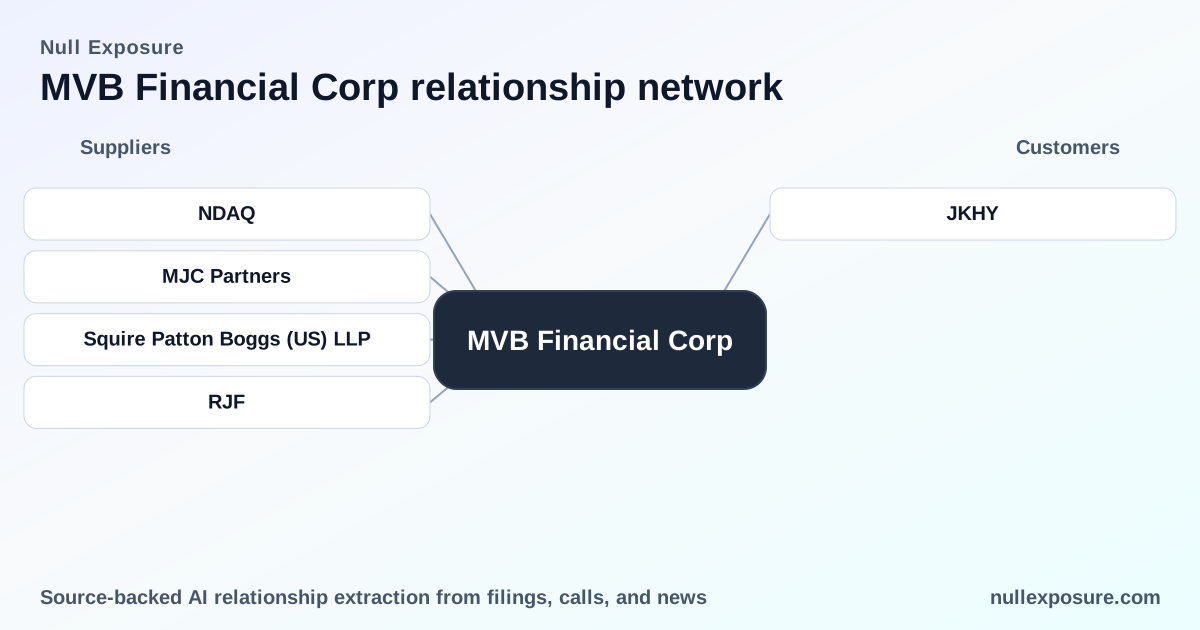
MVB Financial Corp: Fintech-focused regional bank with asset-light fintech relationships
MVB Financial Corp operates as a regional bank that monetizes through traditional deposit and lending margins while intentionally building an embedded fintech services business—providing payment processing, card services, fraud tools and SaaS-style software to fintech customers. Its strategy combines core commercial and retail banking with higher-growth fintech servicing, producing a mix of recurring fee income (interchange and subscription-like hosting fees) and transactional revenue tied to payment volumes.
If you want a concise provider-level briefing on MVB’s customer relationships and strategic posture, review this page and follow up at https://nullexposure.com/ for ongoing deal-level monitoring.
How MVB makes money and why the customer roster matters
MVB’s financials show a traditional banking core (deposits, loans, margins) and an adjacent fintech services franchise that scales through client payment volume and hosted software. The fintech arm drives disproportionate deposit growth and recurring revenue: interchange and card fees are recognized on a transactional basis, while Victor Technologies historically generated SaaS-style hosting fees recognized over contract life. This hybrid model creates a revenue mix that is sensitive to transaction volumes and client concentration, but also offers higher-margin, non-interest income when fintech clients scale.
- Contracting posture: Company-level signals show a mix of short-term transition agreements and multi-year service commitments—MVB executes both 60-day transition/employee-lease arrangements and multi-year support contracts.
- Revenue profile: Transactional (usage-based) interchange income and subscription-style software hosting fees coexist.
- Concentration and criticality: The gaming/online wagering initiative has material impact on deposits, creating concentration risk. Geographic footprint remains regionally focused for traditional banking while fintech clients are national.
- Maturity: The core bank is mature; the fintech stack is a growing business line with a pipeline of enterprise clients and periodic asset sales (e.g., Victor Technologies) that demonstrate product-market value.
If you want an investor-ready dashboard of MVB customer exposures and exits, visit https://nullexposure.com/ to see how these relationships evolve.
Relationship roll call — what each counterparty means for MVBF
Jack Henry & Associates (JKHY)
MVB sold substantially all assets and operations of Victor Technologies to Jack Henry & Associates, closing the deal effective September 30, 2025; the transaction converted an owned fintech asset into cash and reduced operational exposure while validating Victor’s technology to a major core vendor. According to CityBiz (March 10, 2026), MVB announced the definitive agreement and closing of the Victor Technologies sale to Jack Henry. Banking Dive later noted that the third‑quarter sale materially improved MVB’s 2025 financials by offsetting what otherwise could have been a loss (Banking Dive, May 3, 2026).
DraftKings (DKNG)
MVB’s fintech platform processed large payment volumes and listed DraftKings among 40+ clients driving growth, highlighting commercial-scale payments flows that underpin interchange revenue and client stickiness. TradingView coverage of investor slides (May 3, 2026) cited DraftKings as a named client in a $48 billion payment volume context.
FanDuel
FanDuel is another major gambling/wagering client cited on MVB’s fintech pipeline and payment-volume slide—an indicator that gaming payments are a meaningful revenue and deposit driver for the bank. TradingView’s May 3, 2026 recap of MVB investor slides lists FanDuel alongside DraftKings in the fintech client roster.
Virtual Investor Conferences
MVB’s management (CEO Larry Mazza and CFO Mike Sumbs) presented at the Banking Virtual Investor Conference on March 26, 2026, positioning the company to institutional investors and underscoring management’s public messaging around fintech growth and asset scale. GlobeNewswire (March 19, 2026) announced MVB’s participation and presentation at the conference.
Raymond James Bank (RJF)
MVB entered into a $20 million senior revolving line of credit with Raymond James Bank (CI), strengthening short-term liquidity and indicating a finite reliance on external bank credit lines for corporate financing. MarketScreener reported on the line of credit agreement (Feb. 26 / reported in May 2026 coverage) as part of MVB’s financing activity.
What these relationships collectively reveal about risk and scalability
- Commercial validation and exit optionality: The sale of Victor Technologies to Jack Henry demonstrates that MVB can build fintech IP that is acquirable by strategic buyers, creating a de-risking path and episodic balance-sheet gains (CityBiz; Banking Dive).
- High-volume, customer-concentrated payments exposure: Named clients like DraftKings and FanDuel drive meaningful payment volumes; the bank’s interchange and deposit flows are therefore sensitive to a handful of large fintech counterparties. Management itself flags gaming-related deposit concentration as material.
- Mix of contract types supports recurring income: Evidence shows both usage-based transaction revenue (interchange recognized per transaction) and subscription/hosting revenue (software-as-a-service income recognized over contract life), giving MVB a blended recurring/variable revenue stream.
- Operational transition capability: Short-term employee-lease and conversion agreements imply MVB can shepherd asset divestitures and client transitions with temporary support services, reducing customer disruption risk during M&A activity.
- Liquidity and banking relationships: The $20 million revolver with Raymond James is a pragmatic backup facility rather than a structural funding shift; it signals access to institutional credit lines when needed.
Investment implications and what to watch next
- Monitor fintech client concentration metrics (deposit share, payment volume by client) because the earnings multiple for MVB increasingly reflects fintech traction and concentration risk.
- Track additional monetization events—future asset sales or carve-outs similar to Victor Technologies will materially affect quarterly results and capital. The Jack Henry sale is a precedent for strategic exits.
- Evaluate contract mix and renewal cadence for hosted software and minimum-interchange commitments to assess predictability of non-interest income. Company disclosures indicate minimum commitment fees and multi-year support contracts coexist with transaction-based fees.
- Watch liquidity facilities and capital use—the Raymond James line shows short-term flexibility; persistent draws or repeated facility changes would suggest funding stress.
Bottom line
MVB is not a pure-play regional lender; it is a hybrid bank-builder that leverages payment processing and hosted fintech services to diversify revenue and accelerate deposit growth. The sale of Victor Technologies to Jack Henry crystallizes value from MVB’s fintech investments, while the inclusion of high-volume gaming clients like DraftKings and FanDuel amplifies both upside and concentration risk. Investors should weigh recurring interchange and SaaS-style revenues against client concentration and the episodic nature of asset monetizations.
For an investor-facing tracker of MVB’s evolving counterparties and strategic disposals, visit https://nullexposure.com/ to see how these relationships shift across filings and press coverage.