MicroVision (MVIS): Customer Relationships and Commercial Posture — a focused investor brief
MicroVision develops lidar sensors, perception software and licenses IP for automotive safety, industrial automation and defense applications. The company monetizes through hardware sales (MOVIA lidar products), software licenses and royalties, and fixed‑fee development services, with revenue currently concentrated in a handful of OEM customers and short‑duration contract liabilities. For investors, the critical questions are customer concentration, the firmness of OEM design‑wins, and the commercial model that will scale revenue beyond the current low‑single‑digit millions. For direct access to ongoing relationship tracking and source references, see NullExposure’s coverage at https://nullexposure.com/.
How MicroVision sells: contracting posture and commercial constraints
MicroVision’s revenue profile is a hybrid of hardware, software licensing, and development services, which produces a mixed contracting posture. Public disclosures and the evidence set a clear operating model:
- Concentration is high and material — MicroVision reported that in 2024 a leading agricultural equipment manufacturer represented roughly 60% of revenue, a major global trucking OEM 13%, and an automotive supplier 10%, signaling single‑customer sensitivity and earnings volatility. (Company filing, FY2024).
- Contract maturity is short — the company expects to recognize the remaining contract liabilities (approximately $0.3m) over the next 12 months, indicating a short‑term revenue recognition horizon rather than long multi‑year annuities. (Company filing, FY2024).
- Contract types include licensing and royalties — MicroVision derives license and royalty revenue from its IP; historically, royalty income was significant from a Microsoft arrangement tied to a display component. That historical royalty stream is not expected to continue. (Company filing notes on license and royalty revenue, FY2022–FY2023).
- Revenue buckets are fragmented by segment — product revenue is primarily lidar hardware, while development contracts are fixed‑fee and software contributes through license/royalty recognition. This positions the firm as both a seller of integrated sensor systems and a licensor of perception IP. (Company disclosures).
- Geographic reach is global with notable revenue touchpoints in North America and EMEA, supporting a go‑to‑market targeted at OEMs across regions. (Revenue by geography, FY2024).
These company‑level constraints create a commercial profile where small changes in OEM demand produce outsized swings in reported revenue, and where scaling requires either broadening the OEM base or converting short‑term wins into recurring license streams.
Relationship roundup — each mention in the public record
Below I list every relationship referenced in the available results, with a plain‑English summary and the source cited in line.
Volvo Cars
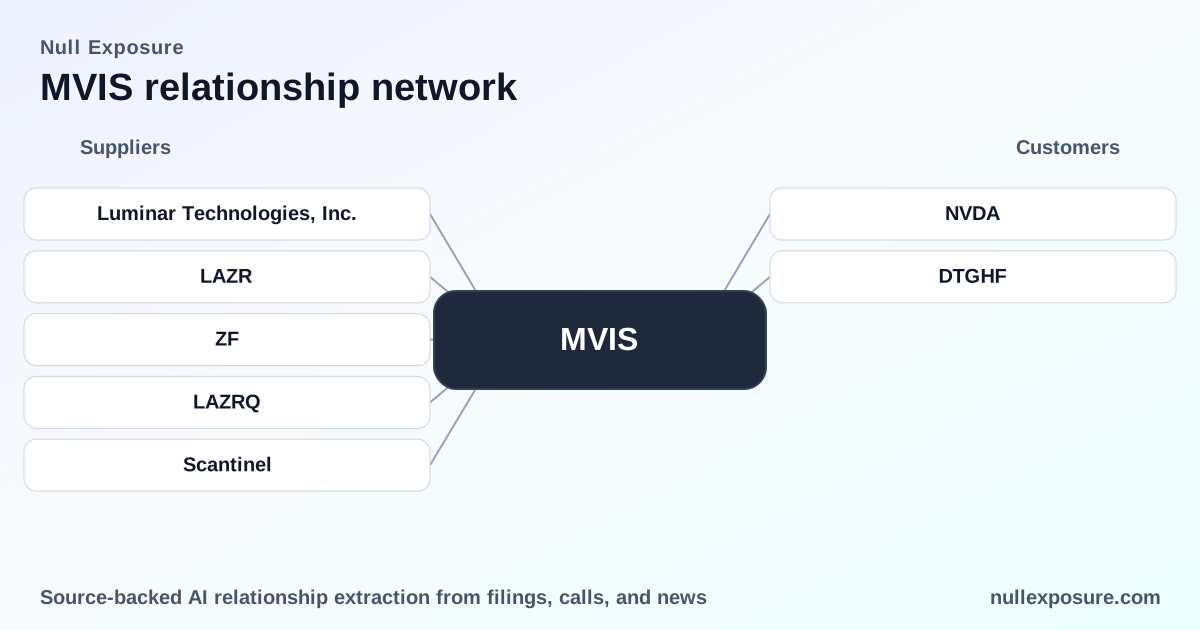
MicroVision acquired assets of the failed lidar supplier Luminar and plans to revive the Luminar relationship with Volvo, indicating an intent to inherit Luminar’s OEM contacts and programs with Volvo Cars. This acquisition is positioned as a strategic step to reengage a high‑profile automotive OEM. (WardsAuto, reporting on the Luminar asset sale, Feb 2026).
A separate investor Q&A also listed Volvo among brands tied to Luminar customer relationships being discussed on MicroVision’s earnings call. (Earnings transcript coverage, The Globe and Mail / Motley Fool summary, Q4 2025 / FY2026).
NVIDIA (NVDA)
MicroVision has progressed integration activity by incorporating MOVIA lidar into NVIDIA DRIVE platforms, aligning MicroVision perception hardware and software with NVIDIA’s automotive compute stack to support perception‑enhanced solutions. This positions MicroVision to participate in NVIDIA’s ecosystem as a sensor/perception partner for advanced driver assistance and autonomy. (TS2.Tech note summarizing Q3 2025 developments and integration activity, reported Mar 2026).
Daimler Truck (DTGHF)
The company disclosed reduced RFQ volumes for MOVIA L to industrial customers and Daimler Truck, highlighting a near‑term decline in demand from this major trucking OEM and signaling caution around funnel activity. This change was noted alongside channel and customer shifts that impacted FY2025/FY2026 revenue patterns. (TradingView summary of MicroVision filings and channel/customer commentary, Q4 2025 / FY2026).
Nissan (NSANY)
Investors asked MicroVision about the status of Luminar’s customer relationships, including Nissan; the exchange in the earnings transcript suggests Nissan remains part of the set of marquee OEMs linked to Luminar programs that MicroVision now controls or is evaluating for future deliveries. The company has not, in the public record here, confirmed production shipments to Nissan. (Earnings call coverage, The Globe and Mail / Motley Fool, Q4 2025 / FY2026).
Caterpillar (CAT)
Caterpillar was mentioned alongside Volvo and Nissan as a Luminar customer in investor Q&A, implying MicroVision now holds the rights or responsibilities to the Luminar programs that included Caterpillar for autonomous or ADAS use cases; the public commentary centers on program status rather than confirmed deliveries. (Earnings call coverage, The Globe and Mail / Motley Fool, Q4 2025 / FY2026).
Notes on duplicated entries and coverage: some sources referenced the same underlying interaction more than once (for example, NVIDIA/NVDA and DTGHF entries appear in source feeds that duplicated mentions). I have consolidated commentary by company while preserving direct source attribution for each mention.
Investment implications and risk checklist
- Revenue sensitivity is acute. With a single agricultural OEM driving 60% of revenue in FY2024, any contraction or non‑renewal materially affects cash flow and runway. (Company FY2024 disclosure).
- Commercial model is mixed and early. MicroVision sells hardware while pursuing software licensing; historically meaningful royalty income (e.g., Microsoft) is not repeatable on the current roadmap, so predictable recurring revenue remains limited. (Company filings on license and royalty revenue, FY2022–FY2023).
- OEM design‑win upside is the core growth vector. The Luminar asset purchase and explicit plans to reengage Volvo, Nissan and Caterpillar represent the quickest path to scale but require converting program relationships into production shipments and predictable orders. (WardsAuto; earnings call commentary, FY2025/FY2026).
- Channel and RFQ variability matters. Reduced RFQ activity with Daimler Truck and industrial customers is an early warning on funnel strength and order timing risk. (TradingView coverage of filings, FY2026).
- Geographic diversification helps but is incomplete. Financial detail shows revenue across North America and EMEA, yet concentration by customer persists, limiting the protective effect of geography. (Revenue by region, FY2024).
Final takeaway and next steps
MicroVision’s commercial position combines promising tech‑stack alignment (e.g., NVIDIA DRIVE integration) and accretive asset purchases (Luminar assets tied to Volvo/Nissan/Caterpillar) with a fragile revenue base anchored to a few large OEM customers and short‑term contracts. For investors, the key monitorables are: conversion of Luminar relationships into confirmed production contracts, RFQ funnel trends with Daimler Truck and other industrial customers, and movement from one‑off hardware sales to durable licensing or recurring services. For ongoing source‑level monitoring and relationship intelligence, visit NullExposure’s coverage at https://nullexposure.com/.
Bold claim: MVIS is an OEM‑centric small cap where program execution — not technology promise alone — will determine valuation re‑rating.