Microvast (MVSTW): Customer relationships that drive battery revenue and risk
Microvast designs, manufactures and sells lithium‑ion battery cells, modules and full systems to commercial electric vehicle (EV) manufacturers and utility‑scale energy storage customers. The company monetizes through product sales, long‑term supply and framework agreements, and sales‑type leasing arrangements that generate upfront revenue and trailing interest income, with a concentrated customer base and a material order backlog that underpins near‑term revenue visibility. For investors and operators evaluating Microvast’s customer footprint, the mix of global OEM partnerships, government counterparty exposure, and long‑dated commercial arrangements shapes both upside from electrification adoption and downside from concentration and execution risk. For a consolidated view of Microvast relationships and constraints, visit https://nullexposure.com/.
Two customer relationships to watch
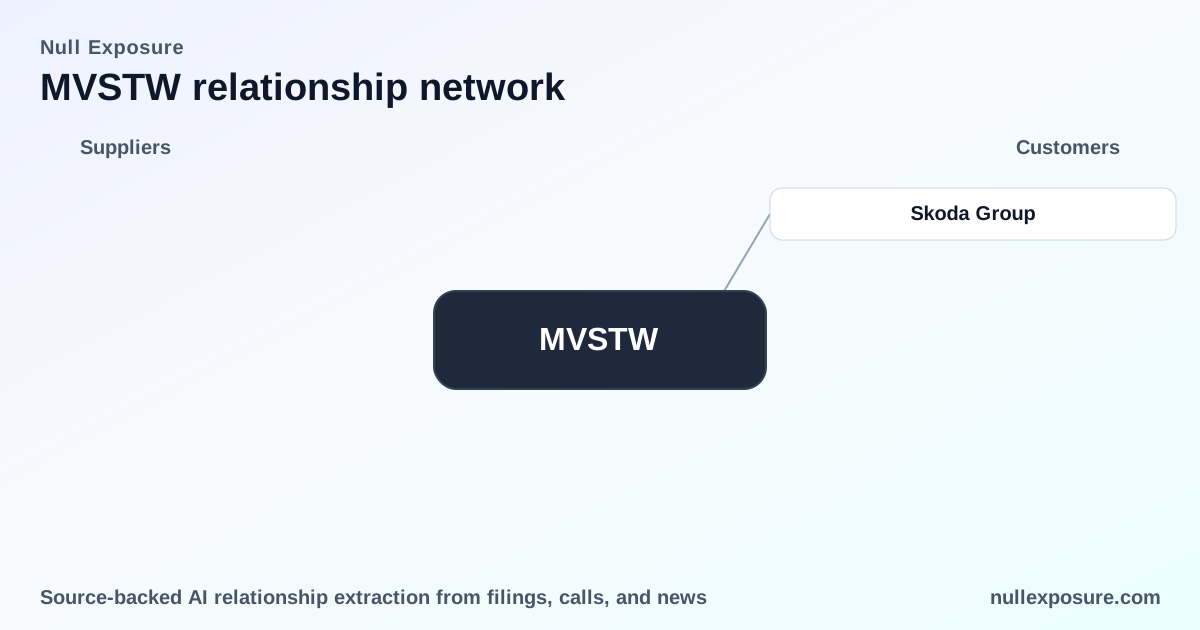
Skoda Group — validation in rail and public transport
Microvast disclosed an established partnership with Skoda Group during its 2025 Q3 earnings call, positioning the company’s battery technology for extreme‑duty and high‑safety rail applications. This is a direct product endorsement from a leading European rail and public transport manufacturer and signals Microvast’s push into heavy‑duty, safety‑critical segments. According to Microvast’s 2025 Q3 earnings call (mentioned in documentation first seen March 8, 2026), the Skoda relationship validates the technology in rail use cases.
Iveco Group — expanded long‑standing commercial tie
Market coverage noted that Microvast and Iveco Group expanded a long‑standing partnership as reported March 19, 2026; the relationship supports Microvast’s position in commercial vehicles across Europe and beyond. The expansion with Iveco, a recognized large OEM in commercial vehicles, reinforces Microvast’s role as a strategic battery supplier to major fleet OEMs (news report via TipRanks/CNBC, March 19, 2026).
What the customer map reveals about Microvast’s operating model
Microvast’s customer profile is not a collection of one‑off buyers: it is structured around repeatable, long‑horizon commercial relationships that generate both product revenue and financing income. Company disclosures and recent filings surface a consistent set of operating characteristics:
- Contracting posture — long‑term and framework agreements. Microvast routinely executes long‑term supply or framework agreements in the commercial vehicle market, often without minimum purchase obligations; the firm also records sales under sales‑type leases and recognizes related interest income over time (company filings and disclosures).
- Revenue concentration — materially concentrated book of business. In 2024 the top five customers accounted for 60% of revenue, and a single customer represented 39% of net revenues, placing concentration risk squarely in focus for investors (FY2024 filing).
- Counterparty mix — large enterprises and government channels. The company engages with leading global OEMs and, in China especially, state‑owned end users, which elevates both strategic scale and regulatory considerations such as FCPA exposure (company statements).
- Geographic footprint — true global distribution with EMEA, APAC and North America exposure. Microvast reports installed systems and sales across Asia‑Pacific, Europe and North America, supporting diversified end markets while retaining historical revenue weight in APAC (company disclosures).
- Relationship stage and criticality — active backlog with short‑to‑medium term delivery. The company reported an order backlog of $401.3 million as of December 31, 2024, with the majority expected to be fulfilled in 2025 and 2026, delivering near‑term revenue conversion (FY2024 filing).
- Business segment and role — seller and manufacturer of core battery hardware. Microvast’s revenue mix centers on battery sales, modules and ESS hardware, sold through a direct sales force across its regional footprint (company overview).
These signals combine to define Microvast as a manufacturer with product‑centric revenue, executed through contractual partnerships that are long in tenor but can lack strict minimum‑take protections, creating both visibility (backlog) and demand volatility (framework agreements).
For a structured investor feed on customer relationships and contract signals, see https://nullexposure.com/.
Investment implications for operators and investors
The customer architecture provides clear tradeoffs:
- Revenue visibility vs concentration risk. The $401.3M backlog and long‑term supply agreements produce near‑term revenue visibility; however, the fact that one customer comprised 39% of 2024 revenues means a single counterparty’s renegotiation or deferral materially impacts top‑line performance.
- Commercial durability with execution sensitivity. Long‑term OEM partnerships, such as those with Iveco and Skoda, establish durable demand but require ramped manufacturing capacity and strict quality controls — execution slippage would translate quickly into missed deliveries and reputational exposure.
- Regulatory and counterparty complexity. Substantial interactions with state‑owned enterprises in China create compliance pressures (FCPA considerations) and procurement idiosyncrasies that influence contract structure and payment terms.
- Balance sheet and financing nuance. The use of sales‑type leases generates upfront recognition and ongoing interest income, which supports margins but increases receivables/lessor accounting complexity and credit exposure.
- Geographic diversification as a partial hedge. Presence across EMEA, APAC and North America spreads demand risk and provides multiple growth vectors, yet historical concentration in APAC means execution in other regions remains critical to de‑risk overall revenue.
Investors and operators should treat these as active governance points: monitor revenue concentration metrics, backlog conversion cadence, and disclosure around lease receivables and OEM program ramps.
Relationship summaries — concise investor notes
- Skoda Group: Microvast confirmed a partnership in its 2025 Q3 earnings call positioning its batteries for extreme‑duty rail and high‑safety public transport applications, a strategic validation for heavy‑duty use cases (2025 Q3 earnings call; reported March 8, 2026).
- Iveco Group: Media coverage noted an expansion of a long‑standing relationship between Microvast and Iveco on March 19, 2026, reinforcing Microvast’s foothold with a major European commercial vehicle OEM (TipRanks/CNBC coverage, March 19, 2026).
Final takeaways for investors and managers
Microvast’s customer relationships are a core value driver: long‑term OEM partnerships and a sizeable backlog underpin near‑term revenue, while concentration and execution risk remain the principal downside. Operators must convert framework agreements into firm orders and manage lease receivables closely; investors should watch customer revenue shares, backlog fulfillment and regional ramp performance as the primary indicators of operational health. For an investor‑grade overview of Microvast’s partner ecosystem and to track evolving customer signals, visit https://nullexposure.com/.