Marwynn Holdings (MWYN) — Customer Relationships, Concentration Risk, and Operational Implications
Marwynn Holdings operates as a holding company that monetizes through two principal activities: (1) a food & beverage supply-chain and brand-management business that sources and distributes premium Asian food products to U.S. retailers, and (2) a retail/distribution channel for indoor home‑improvement products complemented by consulting and logistics services. Revenue is earned from product sales, distribution margins and short‑term services/consulting contracts; recent filings show product sales and distribution remain the core monetization engine (FY2025 10‑K). For a compact supplier‑and‑channel view, see NullExposure’s coverage here: https://nullexposure.com/.
Key takeaway: the company's revenue mix and customer profile create both retail-scale upside and concentrated counterparty risk that has materially shifted year‑to‑year.
What matters to an investor: concentration, contracts, and channel strategy
Marwynn’s operating model combines merchanting (buying and reselling inventory) with short‑term service contracts (logistics, consulting). Revenue recognition and operating cadence are short‑term — engagements and fulfillment cycles typically range from a few months up to a year and revenue is recognized over those service periods, per the company’s disclosures (FY2025 10‑K). That posture drives working‑capital intensity and exposes the business to rapid shifts in retailer ordering patterns.
Geography and channel are concentrated in the United States: all assets and a substantial portion of revenue are U.S.‑based and the company focuses on mainstream supermarkets, ethnic grocery chains and foodservice distributors (FY2025 10‑K). Customer counterparty types span two practical classes: individuals (homeowners, designers, dealers) in the home‑improvement line; and very large retailers (Costco and other marketplaces) in the food/distribution line, which results in a mixed risk profile—broad retail reach but periodic concentration by specific large buyers.
For a deeper site overview, visit: https://nullexposure.com/.
How partner relationships are moving the needle
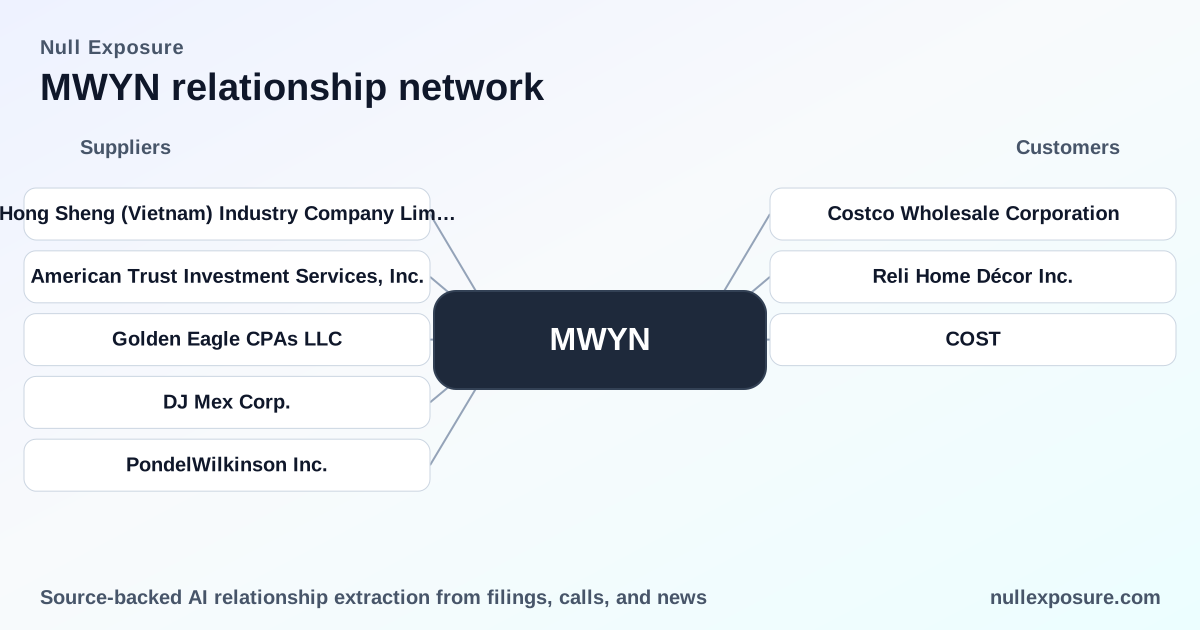
Below are concise, plain‑English summaries of every customer or counterparty relationship identified in public results, with source context.
Costco Wholesale Corporation (Costco)
Costco has been a material retail customer historically: Costco accounted for approximately 19% of Marwynn’s sales in the year ended April 30, 2024 and roughly 39% in the year ended April 30, 2023; the FY2025 10‑K states that decreased sales were driven by reduced purchase orders from Costco, notably for the White Rabbit ice cream product (Marwynn FY2025 10‑K, filed April 30, 2025). Trading commentary in FY2026 reiterates ongoing collaboration with Costco to launch tariff‑resilient SKUs and broaden distribution (TradingView news, FY2026).
Reli Home Décor, Inc. (Reli Home Décor)
Marwynn completed the sale of its wholly owned subsidiary Grand Forest Cabinetry to Reli Home Décor for $550,000 in cash, a transaction announced and covered across multiple business news outlets in early‑to‑mid 2026; the sale removes a legacy home‑improvement subsidiary from Marwynn’s portfolio and crystallizes a small cash inflow (Investing.com and MarketScreener news, March–May 2026; WoodworkingNetwork report, March 2026).
NexaCore Technologies
Marwynn has positioned recovered materials from planned battery‑recycling activities as potential input to NexaCore Technologies, an AI‑focused subsidiary, indicating intra‑company supply opportunities where recycled inputs could support hardware requirements for NexaCore’s operations (Investing.com report on Marwynn’s battery‑recycling plan, FY2026).
Relationship-by-relationship brief (1–2 sentence snapshots)
-
Costco — As a historically large retail customer, Costco drove a material portion of sales in FY2023–FY2024 and a subsequent decline in orders caused a notable drop in revenue; Marwynn is actively working with Costco on new product introductions to reduce tariff sensitivity (Marwynn FY2025 10‑K; TradingView, FY2026).
-
Reli Home Décor, Inc. — Reli acquired Grand Forest Cabinetry from Marwynn for $550,000 in cash, closing in early 2026; this divestiture reduces Marwynn’s direct exposure to the indoor cabinetry retail segment and provides a modest cash inflow (Investing.com, MarketScreener, WoodworkingNetwork, March–May 2026).
-
NexaCore Technologies — Marwynn signaled that recovered materials from planned battery‑recycling operations could support NexaCore’s hardware needs, linking circular‑economy initiatives to the company’s AI hardware ambitions (Investing.com, FY2026).
Operational constraints and business model signals investors should weight
-
Contracting posture: short‑term. Marwynn recognizes revenue over short service periods that typically span months up to one year, which produces rapid revenue visibility but increases sensitivity to order volatility (company disclosures).
-
Counterparty mix: dual‑track. The company serves individual consumers and small dealers in home improvement while also acting as an authorized vendor to very large retailers (Costco, Walmart Marketplace, UNFI) for food and beverage distribution, creating a blended risk/reward profile.
-
Geographic concentration: U.S.‑centric. All assets and a significant portion of revenue are U.S.‑based, which simplifies market exposure but concentrates regulatory, tariff and demand risk geographically.
-
Materiality dynamics: shifting concentration. Historical filings show large single‑buyer concentration in FY2023–FY2024, but the FY2025 disclosure also indicates a year in which no single customer exceeded 10% of sales—evidence of meaningful revenue diversification or order reallocation; investors must treat concentration as a dynamic metric rather than a fixed attribute.
-
Roles and economics: merchant + services. Marwynn operates as a seller/distributor for packaged products and as a service provider for logistics and consulting, which means margins and working‑capital profiles vary by segment and SKU.
-
Maturity and criticality. The business is commercially mature enough to land large retail accounts, yet still fragile on concentration and EBITDA performance (negative EBITDA reported in FY2025), marking it as an operationally important yet financially immature growth story.
Investment implications and risk framing
-
Positive: existing retail relationships (Costco and other marketplaces) provide distribution scale that a pure‑play small supplier would lack; the divestiture of Grand Forest Cabinetry clarifies focus on higher‑turnover food and distribution activities.
-
Negative: customer concentration volatility—large swings in a single buyer’s orders materially affect revenue—and negative profitability metrics in FY2025 increase the risk that demand shocks translate quickly into cash strain.
-
Catalysts to watch: stabilization or growth in orders from Costco and other large retailers; successful redeployment of proceeds from the Reli sale; commercial progress on the battery‑recycling initiative that supports NexaCore’s hardware needs.
For ongoing tracking of Marwynn’s partner and customer exposures, NullExposure keeps updated relationship maps and filing captures at https://nullexposure.com/.
Final bottom line: Marwynn combines valuable retail access with tangible concentration and margin risks; investors should monitor order trajectories from major retailers and the company’s execution on diversification and cash preservation.