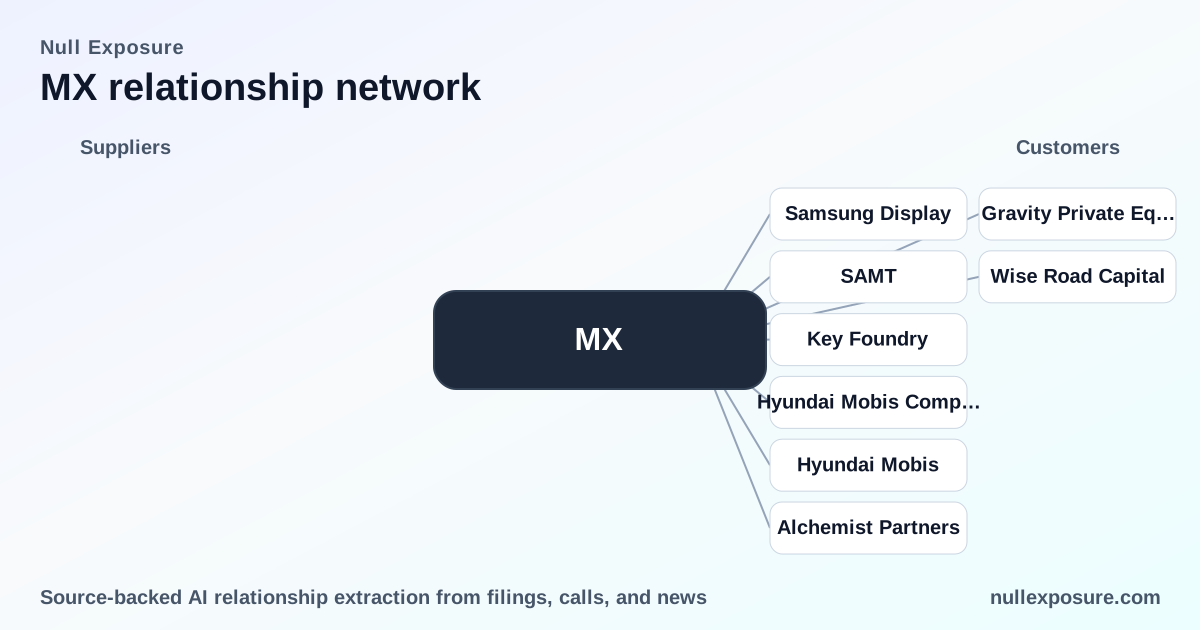
MagnaChip (MX) — Customer relationships that shape revenue and strategic direction
Thesis: MagnaChip designs and manufactures analog and mixed-signal semiconductors and monetizes through direct sales and a network of distributors to large OEMs and contract manufacturers, with product revenue concentrated in a small number of large APAC customers and a strategic pivot from foundry services toward proprietary power and automotive technologies. For investors evaluating MX’s customer book, the combination of high customer concentration, APAC geographic concentration, and short-term commercial commitments defines both upside from product wins and downside from order volatility.
Want regular updates on corporate customer footprints? Visit https://nullexposure.com/ for more coverage.
What the business model looks like in plain terms
MagnaChip operates as a product-centric semiconductor vendor: it sells hardware (MOSFETs, IGBTs, mixed-signal devices) to OEMs and through authorized distributors, while previously operating a foundry that it has substantially wound down. The company generates almost all revenue from standard products and reports that its top ten customers represented 74.1% of standard-product net sales in FY2024, a structural concentration that amplifies customer-specific risk and negotiating leverage. According to the FY2024 10‑K, the company also reports that its sales are predominantly billed to Asia-Pacific jurisdictions, with Korea and the rest of APAC accounting for the vast majority of product revenues.
Key operating constraints that shape customer risk and leverage
- Contracting posture — short-term: The company states it generally does not obtain firm, long-term purchase commitments from customers, which implies sales are largely spot or short-term order driven and revenue can be lumpy.
- Customer type — large enterprises: MagnaChip sells to leading consumer-electronics OEMs and contract manufacturers, positioning MX as a supplier to large enterprise buyers who drive scale economics and command commercial terms.
- Geographic concentration — APAC-heavy: FY2024 billing shows $128.0M to Asia Pacific (ex-Korea) and $86.0M to Korea versus only $2.1M billed in the U.S., underlining significant revenue concentration in Greater China and Korea.
- Materiality — top customers matter: The top-ten concentration (74.1% in FY2024) makes individual account performance materially determinative of near-term revenue.
- Channel mix — direct + distributors: Products move through a direct sales force and a global network of authorized agents and distributors, which helps reach diverse end markets but introduces dilution of direct customer control.
- Business stage — winding down legacy foundry: The company is in the process of winding down Transitional Fab 3 Foundry Services, which represented a shrinking share of total revenues (4.6% in 2024 vs. 14.9% in 2023), indicating a maturity shift away from foundry operations toward standard-product sales and licensing.
These constraints together create a commercial profile where product-market execution and a small number of APAC relationships determine financial outcomes. (All signals above are drawn from the company’s FY2024 10‑K disclosures.)
Customer and related-entity snapshots investors should know
Below are concise, source-backed summaries for every relationship captured in the public record.
Samsung Display
Samsung Display accounted for 14.7% of net sales from MagnaChip’s standard products business in FY2024, up from 13.4% in FY2023 — a sizable single-customer exposure within the product book. According to MagnaChip’s FY2024 10‑K, that level of concentration gives Samsung Display meaningful influence over a material portion of MX’s standard-products revenue.
SAMT
SAMT represented 21.4% of standard-product net sales in FY2024, increasing from 16.7% in FY2023, making SAMT the largest single named customer in the FY2024 disclosure; the company’s 10‑K lists SAMT explicitly as a top buyer and quantifies its material share of sales.
Key Foundry
Key Foundry was formed after Magnachip sold a Cheongju foundry business and a 200mm wafer fab in 2020 for approximately $450 million; the transaction separated the foundry assets from MagnaChip’s ongoing standard-products business. Reporting on the divestiture and subsequent formation of Key Foundry is documented in industry press, which traced the buy-out and asset transfer back to MagnaChip’s 2020 actions.
Source: EENewsEurope coverage of the 2020 foundry buy-out and subsequent Key Foundry formation (reporting FY2021 context).
Hyundai Mobis
Magnachip has a multi-year strategic relationship with Hyundai Mobis focused on IGBT technology: the companies finalized a licensing and development agreement to commercialize high-performance IGBTs for automotive applications, building on collaboration that began in 2015. MagnaChip publicly announced the agreement and referenced it in earnings commentary and industry press that described the technology partnership as a targeted play into EV power electronics.
Sources: company earnings transcript reporting (Q3 2025) and subsequent press reports (Investing.com, late 2025–early 2026) documenting the November 2025 technology agreement.
Alchemist Partners
Alchemist Partners led a consortium that acquired the Cheongju-based foundry assets from MagnaChip, forming part of the private-equity group behind Key Foundry’s creation; Korean media reported the transaction and consortium leadership in 2020–2021 coverage.
Source: Korean Economic Daily reporting on the 2020 sale (published FY2021 context).
Gravity Private Equity
Gravity Private Equity was another PE participant in the consortium that purchased Magnachip’s Cheongju foundry facility, and Korean coverage identified Gravity as a co-lead in that acquisition that separated foundry operations from MagnaChip’s listed business.
Source: Korean Economic Daily reporting on the 2020 sale (published FY2021 context).
Wise Road Capital
Wise Road Capital — a China‑based private equity firm — entered a definitive agreement to acquire Magnachip in a take‑private transaction announced in 2018–2020 reporting cycles, an event covered in Korean and international business press and referenced in retrospective coverage of the company’s strategic transitions.
Source: Korean Economic Daily reporting and follow‑on news items that tracked the proposed take‑private progress (FY2021 context).
What the relationship map implies for investors
- Revenue concentration risk is the headline: With SAMT and Samsung Display separately representing double‑digit shares of standard-product sales, single-account performance can swing near‑term top line. The FY2024 10‑K numbers make this explicit.
- Geopolitical and regional exposure matters: The business is heavily APAC‑centric from a billing perspective; investors must factor regional demand cycles and supply‑chain policy into forecasts. The FY2024 geographic break‑down shows APAC dominance.
- Commercial terms favor buyers: The absence of long‑term purchase commitments means MagnaChip’s revenue levers are execution and product differentiation rather than contractual lock‑ins. The company’s 10‑K statement on purchase commitments is clear on this point.
- Strategic pivot to automotive power technologies is a growth lever: The Hyundai Mobis IGBT licensing deal represents a move into automotive power semiconductors where margins and scale potential differ materially from commodity MOSFETs; public disclosures confirm the licensing agreement and multi‑year cooperation.
- Legacy foundry monetization reduces capital intensity but removes a revenue buffer: The sale/wind‑down of Foundry (Fab 3) assets and the transfer to Key Foundry and PE sponsors cleaned up capital structure but also pared recurring foundry revenue — the company’s transitional foundry services contribution has fallen materially year‑over‑year.
Bottom line and investor action
MagnaChip is a highly concentrated APAC‑centric semiconductor supplier with an articulated strategic shift toward power and automotive technologies and reduced foundry exposure. The company’s topline is therefore sensitive to a few large customers, short-term purchase dynamics, and execution on IGBT commercialization with partners like Hyundai Mobis. For deeper due diligence or regular intelligence on counterparties and customer concentrations, visit https://nullexposure.com/ for subscription options and ongoing coverage.
Key considerations for portfolio positioning: weigh concentration risk against the upside of successful automotive power wins; monitor quarterly order trends from named customers and licensing commercialization milestones with Hyundai Mobis as primary value inflection points.