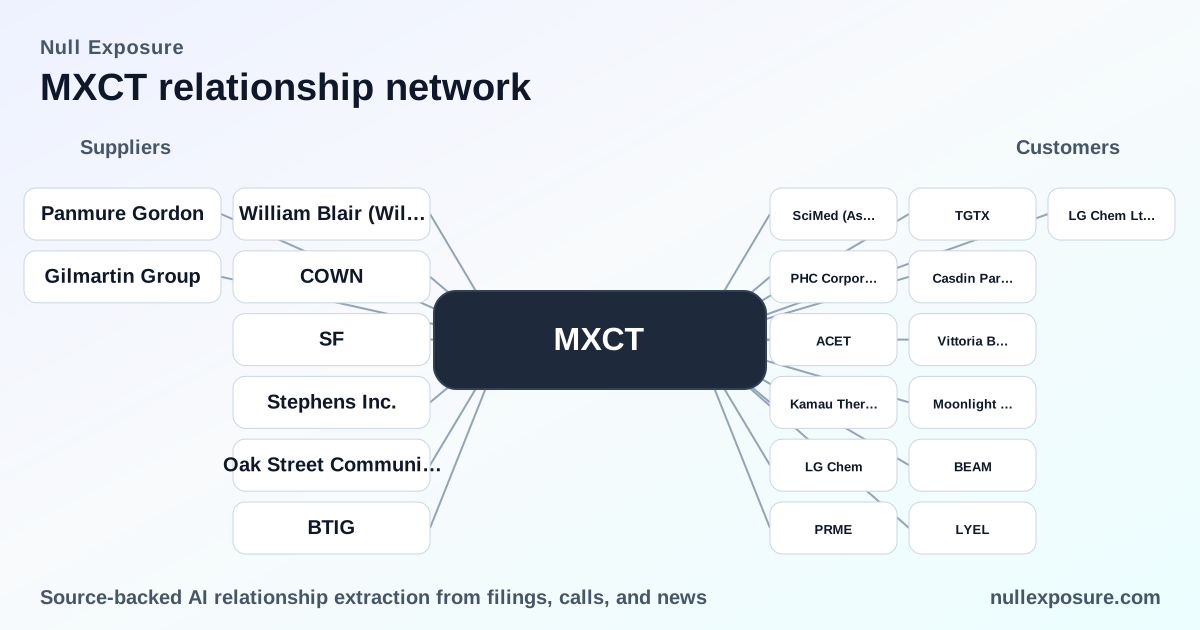
MaxCyte (MXCT): Customer relationships that drive recurring platform economics
MaxCyte operates a platform-led commercial model: it sells and licenses the ExPERT electroporation instruments and captures recurring revenue through consumables, annual clinical licenses and services that support customers’ regulatory filings and manufacturing. Revenue mixes across instrument sales (hardware), license fees (typically in the low-mid six figures per instrument per year), and consumables/services, giving MaxCyte high-margin, repeatable revenue tied to customer clinical progress.
Learn more about how we surface counterparty insights at https://nullexposure.com/.
Market takeaway: MaxCyte’s customer base reads like a who’s who of cell and gene therapy developers, with non-exclusive platform licenses and exclusive regional distribution deals extending both revenue visibility and geographic reach.
H2: What investors need to know about MaxCyte’s customer footprint
MaxCyte’s customer relationships fall into two functional buckets: platform licensees and distribution partners. License arrangements are structured as annual fees per instrument for research, clinical or commercial use; distribution partners extend MaxCyte’s reach into specific territories. The company reports material customer concentration—one customer accounted for 23% of revenue in FY2024—and cites a broad roster that includes top-25 pharma, academia and government research institutions.
H2: Customer relationship snapshots (each entry drawn from public reports)
H3: PHC Corporation (PHCbi) PHC’s biomedical division signed an exclusive distribution agreement to distribute the MaxCyte ExPERT platform in Japan, giving MaxCyte a single-channel partner for a major APAC market. This was reported by Biospectrum Asia on March 10, 2026.
H3: SciMed (Asia) SciMed (Asia), a PHCHD subsidiary in Singapore, executed an exclusive distribution agreement and launched the ExPERT platform locally in June, according to Biospectrum Asia (March 10, 2026).
H3: Adicet Bio, Inc. (ACET) Adicet obtained non-exclusive research, clinical and commercial rights to use MaxCyte’s Flow Electroporation® technology and ExPERT™ platform under a platform license agreement, as reported by SelectScience and Technology Networks (March 2026).
H3: Moonlight Bio MaxCyte signed a strategic platform license with Moonlight Bio to advance T‑cell therapies for solid tumors, an announcement captured in MarketScreener and Finviz reporting on the strategic deal (reported March 2026).
H3: Kamau Therapeutics MaxCyte signed a strategic platform license with Kamau Therapeutics intended to accelerate development of cell therapies for genetic diseases; this relationship was referenced in a News‑Medical roundup of cell‑therapy advances (October 2023 coverage cited in 2026 sources).
H3: LG Chem Ltd. LG Chem secured non‑exclusive clinical and commercial rights to MaxCyte’s Flow Electroporation® technology and ExPERT™ platform to support its allogeneic CAR‑T programs, according to Technology Networks reporting (original release cited in 2022; referenced in later aggregations).
H3: Prime Medicine (PRME) Prime Medicine entered a strategic platform license with MaxCyte to advance gene‑editing therapies; the arrangement was highlighted in News‑Medical’s industry coverage (October 2023 summary referenced in 2026 pulls).
H3: TG Therapeutics (TGTX) TG Therapeutics is listed as using MaxCyte’s Flow Electroporation® and ExPERT™ platform—reported in News‑Medical’s industry survey of recent cell‑therapy advancements (October 2023 summary cited in subsequent reporting).
H3: Vittoria Biotherapeutics Vittoria executed a strategic platform license with MaxCyte to support next‑generation cellular therapies, referenced in News‑Medical’s roundup of 2023–2024 developments and cited in 2026 aggregations.
H3: Casdin Partners Master Fund, L.P. (Casdin) Casdin participated as an investor with indicated interest to purchase shares in MaxCyte’s upsized offering, documented in the company’s PR Newswire release announcing the offering (FY2021 disclosure).
H3: CRISPR Therapeutics (CRSP) CRISPR Therapeutics programs were referenced in MaxCyte’s Q4 2025 earnings commentary—MaxCyte’s platform is used in programs such as zuma cell for B‑cell malignancies—captured in an earnings‑call transcript summary (InsiderMonkey, May 2026).
H3: Beam Therapeutics (BEAM) Academic and industry research reported Beam using ABE8e mRNA delivery via MaxCyte electroporation in ex vivo editing of CD34+ hematopoietic stem cells, as noted in The Scientist’s coverage of gene‑editing clinical advances (October 2023 research cited in 2026 reporting).
H3: Lyell Immunopharma (LYEL) Lyell signed a strategic platform license with MaxCyte, listed among multiple licensees in News‑Medical’s industry summary of recent cell‑therapy partnerships (October 2023 roundup cited in 2026).
H3: WuXi GENE WuXi GENE’s Wu CAR T 007 program was named in MaxCyte’s earnings commentary as a program using MaxCyte technology, as captured in an earnings‑call summary (InsiderMonkey, May 2026).
H3: Imugene (IMU) Imugene was referenced in the Q4 2025 earnings call summary as a user of MaxCyte‑enabled cell programs (InsiderMonkey, May 2026).
H2: How these relationships translate into durable economics
- Licensing is the lever for recurring revenue. Company disclosures and filings describe annual licensing payments—typically about $150k for research licenses and around $250k per instrument per year for clinical/commercial licenses—which creates clear visibility into renewals and upsell as customers progress to clinical or commercial stages.
- Distribution deals extend TAM without direct sales effort. Exclusive regional distributors in APAC (PHCbi/SciMed) accelerate penetration into high-potential markets while minimizing MaxCyte’s local fixed costs.
- Platform breadth reduces single‑customer execution risk but concentration remains. While MaxCyte serves hundreds of biotech and top pharma customers, one customer accounted for 23% of revenue in FY2024, signaling both deep strategic relationships and concentration risk.
H2: Company‑level operating constraints and risk signals
The public record provides direct signals on MaxCyte’s operating posture and business model:
- Contracting posture: MaxCyte relies heavily on licensing (non‑exclusive, annual fee structure) and short‑term license accounting; licensing revenue is recognized ratably over license periods and frequently structured as short‑term leases under ASC 842.
- Counterparty mix and criticality: The customer base includes large biopharma, government and academic institutions, and 29 Special Platform License (SPL) customers with 18 actively in clinical development—indicating the platform is both critical and enterprise‑grade.
- Geography and maturity: The installed base exceeds 760 instruments globally with roughly 33% of revenue from international markets; MaxCyte engages mature clinical customers (one SPL customer is commercial, 18 are in clinical development).
- Concentration and spend bands: One customer drove 23% of revenue (FY2024), and license economics place typical annual instrument payments in the $150k–$250k band, producing material per‑customer revenue when instruments enter clinical/commercial stages.
- Segment mix: Instrument sales and licensing remain core; hardware and consumables accounted for roughly 45% of revenue in recent years, with complementary scientific and regulatory services enhancing stickiness.
H2: Investment implications and final thoughts
MaxCyte’s model is platform-first and recurring-revenue driven, with strategic license deals and distribution agreements amplifying adoption. Key investment considerations are revenue concentration, renewal cadence of high‑value clinical licenses, and the pace at which research partnerships convert to clinical and commercial licenses. For deal flow and customer‑level signals tailored to institutional workflows, visit https://nullexposure.com/.
Bold takeaway: MaxCyte monetizes platform adoption through predictable annual license economics and consumables—customer progression into clinical/commercial stages is the primary catalyst for durable revenue expansion.