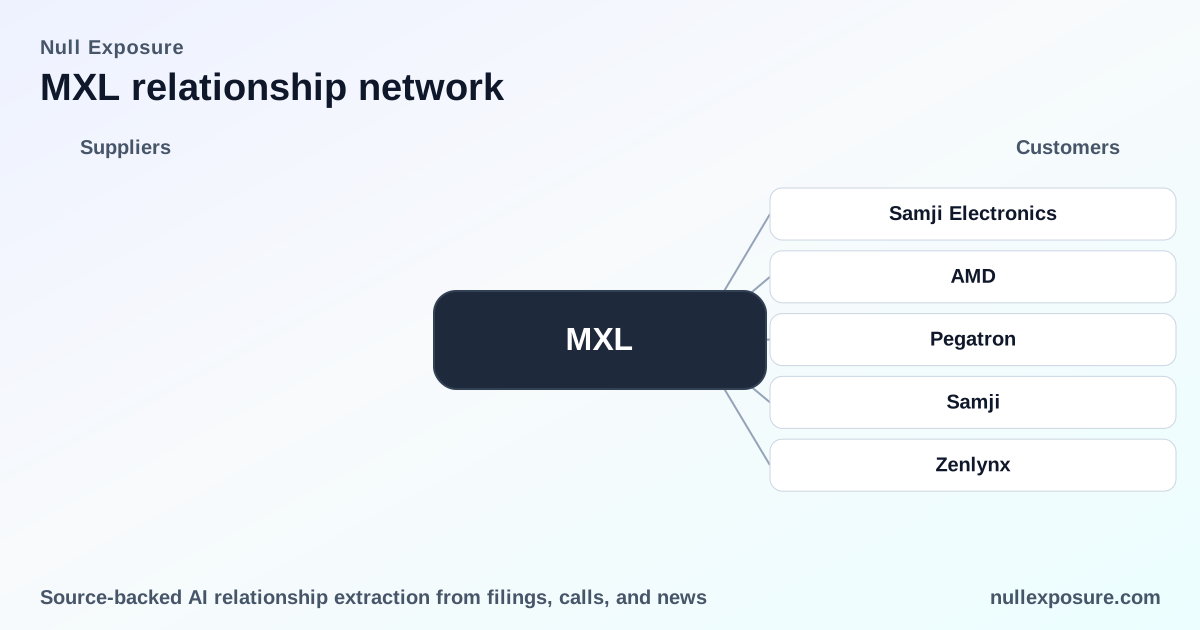
MaxLinear (MXL) — Customer Relationships and Commercial Signals
MaxLinear sells high‑performance analog, RF and mixed‑signal systems‑on‑chip to OEMs, ODMs and distributors, and monetizes through product sales, IP licensing with variable royalties, and short‑term purchase orders supported by rolling production forecasts. The company’s revenue profile is driven by a small number of large customers in Asia buying SoC and RF solutions for broadband, wireless infrastructure and industrial applications, while licensing revenue provides episodic upside tied to downstream product shipments. For a concise view of the coverage and sources behind these customer relationships, see Null Exposure’s company pages: https://nullexposure.com/.
Why these customer ties matter to investors
MaxLinear’s go‑to‑market is built on design wins and repeated product shipments rather than long‑term take‑or‑pay contracts. That structure produces high revenue cyclicality and concentration, but also creates scalable margins when SoCs are adopted at volume. The current public signals show that Sierra radio SoCs and the MxL83234 industrial transceiver are driving fresh design wins with OEMs and distributors across APAC and beyond, a dynamic that underpins the company’s recent revenue acceleration in infrastructure and broadband markets.
Operating model and corporate constraints that shape revenue
MaxLinear operates as a fabless semiconductor design company with a transactional sales posture: customers purchase under purchase orders, not long‑term purchase commitments. Key operating constraints include:
- Short-term contracting posture: MaxLinear does not have long‑term purchase commitments; customers place orders on a purchase‑order basis and the company provides six‑to‑twelve‑month forecasts to foundries and contractors while placing firm supplier orders up to 26 weeks ahead.
- Framework agreements exist but orders are discrete: Some customers transact under master sales agreements that set terms, but revenue is primarily recognized per purchase order.
- IP licensing with variable consideration: Certain IP sales include fixed upfront fees plus usage‑based royalties tied to customer revenue, and the company has recently recognized material variable consideration as those uncertainties resolved.
- Concentration and geography: Ten customers accounted for approximately 65% of revenue in 2025, and Asia accounted for 82% of shipped revenue in 2025, signaling high customer and regional concentration for investors to monitor.
- Market segments and maturity: Revenues are weighted toward broadband (≈44% in 2025), infrastructure (≈32%), and connectivity, with industrial and multi‑market representing the remainder. Design‑win timelines differ by segment — roughly 9–12 months for broadband and 36+ months for infrastructure and industrial — which affects predictability and go‑to‑market cadence.
These constraints produce both upside (large, repeatable OEM wins) and risk (single‑customer dependency and region concentration). For ongoing monitoring and deal‑level context, revisit Null Exposure at https://nullexposure.com/.
Who the customers are and what they bought
Below are the relationships surfaced in public press coverage and earnings commentary; each entry includes a short plain‑English summary and the relevant source.
Samji Electronics — macro O‑RU powered by Sierra
Samji Electronics selected MaxLinear’s Sierra single‑chip radio SoC to power its next‑generation Macro Open RAN Radio Unit (SNOO2‑44N28), highlighting adoption of Sierra in high‑power outdoor cellular radios. Source: MaxLinear press release covered on Yahoo Finance, March 10, 2026.
Pegatron — compact 5G radio enabled by Sierra
Pegatron’s PR2850 radio is enabled by MaxLinear’s Sierra Radio SoC, marketed for an ultra‑compact, low‑power 5G solution that accelerates Open RAN adoption in operator networks. Source: Yahoo Finance Singapore, March 10, 2026.
Zenlynx — indoor enterprise radio using Sierra
Zenlynx leverages the Sierra single‑chip radio platform to deliver indoor radio solutions optimized for enterprise, venue and neutral‑host deployments where scalability and operational efficiency are priorities. Source: Yahoo Finance Singapore, March 10, 2026.
Tokyo Electron Device Limited — MxL83234 for industrial motion control
Tokyo Electron Device Limited positioned MaxLinear’s MxL83234 RS‑485/RS‑422 transceiver as delivering the precision and reliability needed for advanced motor encoder systems in harsh industrial environments. This highlights MaxLinear’s traction in industrial and multi‑market applications beyond telecom. Source: Morningstar (Business Wire), May 3, 2026.
DigiKey — channel showcase and distribution partnership
DigiKey showcased MaxLinear products at APEC and referenced the company while promoting embedded components to its customers, underscoring MaxLinear’s distribution channel presence for broad market reach. Source: FT Markets/BizWire announcement, May 3, 2026.
Advanced Micro Devices (AMD) — sampling of Panther 5 silicon
MaxLinear disclosed that it started sampling Panther 5 to leading customers and partners, including Advanced Micro Devices (AMD), indicating engagement with a major silicon partner on next‑generation products and potential co‑development or ecosystem adoption. Source: Q4 2025 earnings call transcript published on InsiderMonkey, March 2026.
What these relationships collectively disclose
Taken together, the customer touches show a dual commercial strategy: drive design wins for infrastructure and broadband SoCs (Sierra, Panther) with OEMs/ODMs (Samji, Pegatron, Zenlynx) while using distributors (DigiKey) to broaden adoption and industrial partners (Tokyo Electron Device) to diversify end markets. The AMD sampling note signals engagement with a strategic technology partner that can accelerate validation and potential integration in higher‑value platforms.
Investment implications and risk checklist
- Concentration risk: Top customers contributed ~65% of revenue in 2025; investor returns are sensitive to a handful of design wins and repeat orders.
- Regional exposure: Asia exposure at ~82% of shipped revenue in 2025 creates geopolitical and supply‑chain sensitivity that affects near‑term revenue flows.
- Revenue cadence: Short‑term purchase orders paired with 6–12 month foundry forecasts produce volatile quarter‑to‑quarter revenue but allow rapid scaling when design wins convert to production.
- Upside from IP: Licensing with variable, usage‑based royalties offers upside when partners commercialize products at scale; this component has generated material variable consideration in recent reporting.
- Product maturity and timelines: Broadband wins convert faster than infrastructure and industrial opportunities, meaning the revenue mix determines visibility and predictability.
Key takeaway: MaxLinear combines repeatable product revenue from a concentrated customer base with episodic licensing upside; investors should underwrite both the probability of additional design wins and the inherent concentration/geographic risks.
Bottom line
MaxLinear’s recent public disclosures and press coverage document momentum for its Sierra and industrial transceiver products across both OEMs and distributors, and confirm strategic sampling with large partners such as AMD. This revenue mix produces attractive upside when design wins scale, but also concentrates execution risk in a few customers and in APAC shipments — the central tradeoff investors must price into MXL.
For an ongoing feed of customer‑level intelligence and market signals, visit Null Exposure: https://nullexposure.com/.