Myers Industries (MYE): Customer Relationships and What They Mean for Investors
Myers Industries manufactures and sells polymeric products across industrial, agricultural, automotive, commercial and consumer markets, monetizing through direct product sales and distributor channels across two operating segments — Distribution and Material Handling. Revenue is recognized at the transfer of control on short-cycle orders, and the company operates with a modest backlog and broadly diversified customer exposure. For investors focused on customer risk and operational durability, the core thesis is simple: MYE delivers repeatable, low-contractual-risk product revenue with limited counterparty concentration, but limited long-term revenue visibility and exposure to demand cycles and input-cost swings. For a detailed view of relationship signals and primary sources, visit https://nullexposure.com/.
How Myers actually sells and how that shapes customer risk
Myers operates as a seller of finished polymeric goods that are either sold directly to end users or through distributors. Company disclosures state that obligations under customer contracts are typically fulfilled within 90 days and the company generally does not enter into contracts longer than one year, which establishes a clear short-term contracting posture and limited contract tail risk. This operating model produces low counterparty concentration: Myers reports no single customer accounted for more than 10% of net sales in 2024 (and the prior two years), which constrains credit and receivables concentration risk at the corporate level. These observations come directly from Myers’ corporate filings (through 2024) where the company quantifies backlog and customer concentration metrics.
- Short-term contracting reduces lock-in and increases revenue sensitivity to quarterly demand shifts.
- Distribution channel mix broadens market access but increases reliance on distributor inventory cycles and execution.
- Low customer concentration gives investors confidence that revenue shocks from any single buyer are unlikely to be material.
Segments and the commercial logic behind them
Myers runs two commercial engines that drive how customer relationships are structured. The Distribution segment distributes equipment, tools and supplies used for tire servicing and under-vehicle repair and manufactures tire repair and retreading products; the Material Handling segment manufactures durable, reusable plastic products used repeatedly through their service life. The distribution business typically operates with higher transaction volumes and more distributor intermediaries, while material handling sells durable goods with repeat purchase cycles. These segment definitions and roles come from Myers’ segment disclosures in recent company filings.
This split is important for investors: Distribution relationships lean transactional and volume-driven, while Material Handling relationships can generate steadier demand tied to replacement cycles and industrial stocking patterns.
Balance-sheet and order-flow signals investors should track
Company filings show the backlog was approximately $102 million at December 31, 2024 (down from approximately $75 million at December 31, 2023), and lead times are generally less than 90 days — therefore backlog is largely a near-term revenue indicator rather than a multiyear revenue commitment. The filings also state that the company serves customers globally while conducting primary operations in the United States and Canada; this establishes a North American operational base with global sales reach.
- Backlog is near-term by design: the company’s lead times and short contract horizons mean backlog is a rolling indicator, not a durable revenue floor.
- Global sales with North American operations implies exposure to currency and logistics dynamics but operational concentration in NA simplifies supply-chain oversight.
The relationship roster: what the signals show (complete list)
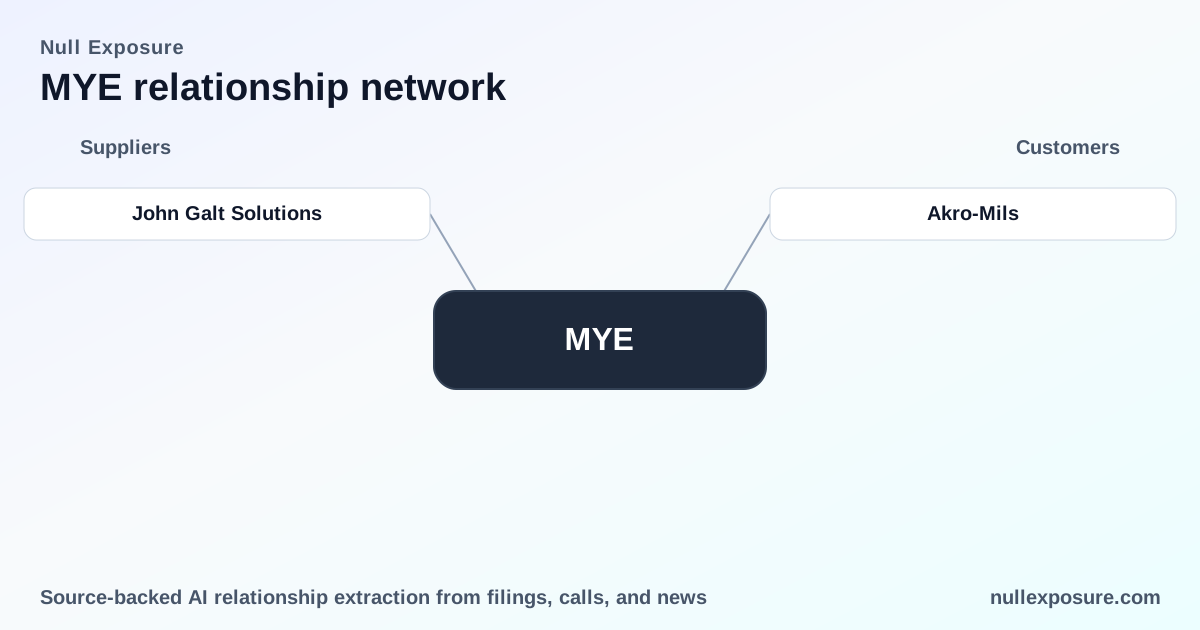
Akro‑Mils
Myers supplies products to larger industrial customers such as Akro‑Mils, indicating that certain product lines are targeted at established industrial distributors and end-users. This was referenced directly on Myers’ Q4 2025 earnings call transcript where management discussed product flows to “larger industrials such as Akro‑Mils.” (Source: InsiderMonkey earnings call transcript, March 2026).
That is the complete set of customer relationships captured in the reviewed material; the public signals emphasize a distributor- and industrial-customer mix rather than a small number of concentrated, named enterprise customers.
Constraints and company-level signals that shape commercial reality
The public constraint evidence provides a set of company-level characteristics investors should internalize:
- Contracting posture: short-term — obligations usually satisfied within 90 days and contracts rarely extend beyond a year. This generates high revenue churn and limited forward revenue visibility (company filings, 2024).
- Geographic footprint: global sales with North American operations — the company serves customers around the world but conducts primary operations in the U.S. and Canada (company filings).
- Customer concentration: immaterial at present — no customer exceeded 10% of net sales in 2022–2024, limiting single-counterparty risk (company filings).
- Relationship role: seller — Myers sells directly and through distributors, recognizing revenue at point of transfer of control (company filings).
- Relationship stage: active with near-term backlog — backlog was ~$102 million at year-end 2024, expected to be delivered within three months given lead times (company filings).
- Segment split: Distribution and Material Handling — two distinct commercial models with divergent margin and exposure profiles (company filings).
These constraints together paint a business model that is operationally flexible but revenue-wise short on long-term visibility. Investors should discount durable revenue claims and instead evaluate quarterly order momentum, input-cost management, and distributor inventory dynamics.
What this means for investors and operators
- For investors: the combination of low customer concentration and short contract duration reduces single-buyer default risk but raises sensitivity to macro and sector-specific demand cycles. Prioritize monitoring backlog trends, margin compression from resin or energy price moves, and any shift toward longer-term distribution agreements.
- For operators and procurement: maintain tight control on resin sourcing, lead times and distributor relationships; the company’s model rewards efficient production and responsive logistics because revenue converts quickly once orders are placed.
For a deeper, transaction-level view of Myers’ customer signals and comparable commercial relationships, explore our relationship mapping at https://nullexposure.com/.
Near-term watchlist
- Quarterly backlog trajectory and order lead times.
- Any change in contract terms that increases multi-quarter commitments.
- Material shifts in distributor inventory policies or a named customer crossing the 10% revenue threshold.
- Margin trajectories against resin and energy price moves.
Conclusion: Myers Industries operates a high-turnover, diversified customer model anchored in product sales and distributor channels; investors should value the firm for its operational durability and low concentration risk while pricing in short revenue visibility and exposure to input-cost cycles.