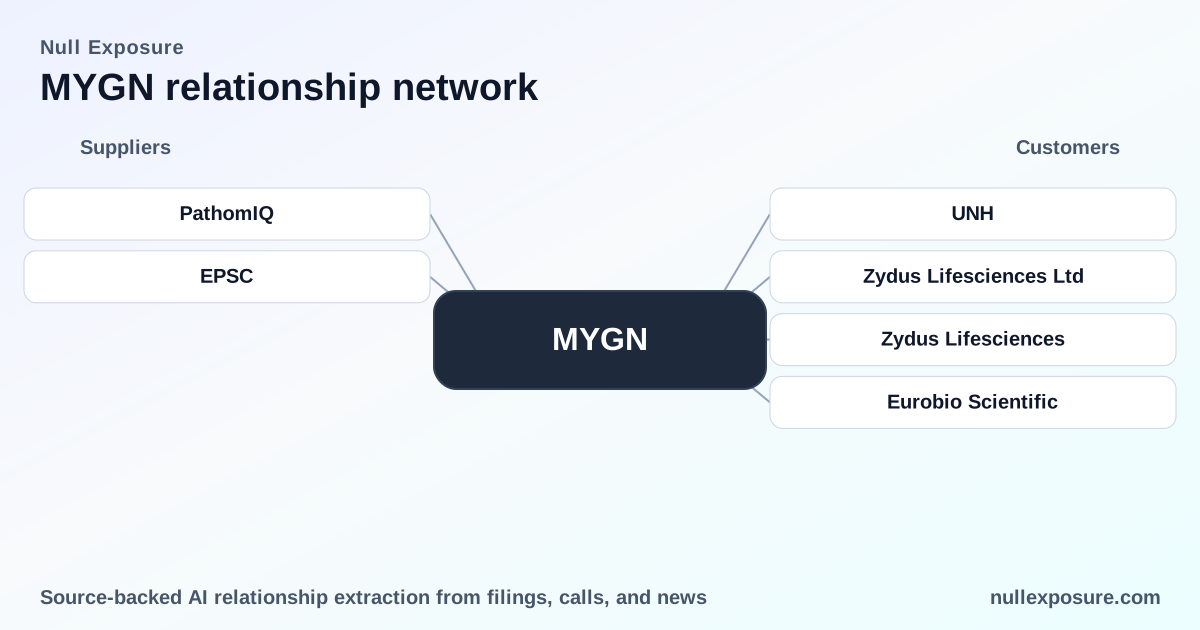
Myriad Genetics (MYGN): Commercial relationships that drive revenue and risk
Myriad Genetics operates a two-sided commercial business: it develops and sells molecular diagnostic tests and related services, and licenses intellectual property and test algorithms to third parties and distributors. The company monetizes through direct test sales to clinicians and health systems, reimbursement from private and public payors, and strategic commercialization agreements and licensing deals that expand geographic reach. Payor coverage decisions and partner commercialization are the principal levers that accelerate or compress near-term revenue.
For a concise tabulation of Myriad-linked relationships and source references, visit the Nillexposure homepage for supporting context: https://nullexposure.com/
Quick read: what matters for investors
- Revenue concentration with private payors is material — over 60% of revenue flows from private third-party payors, making coverage policy changes a core risk to earnings.
- Short-term contracting posture for routine testing revenues implies predictable near-term recognition but also potential volatility if volumes shift.
- Global reach via partners (Japan, India, indirect channels) distributes growth opportunities but keeps Myriad dependent on third-party commercialization execution.
- Intellectual property and licensing provide recurring and strategic value, as seen with algorithm licenses to major sequencing companies.
- Recent asset-level actions (impairment and business sale activity) show portfolio pruning and one-time earnings items that affect comparability.
Customer relationships — source-by-source catalog
Illumina (ILMNV)
Illumina disclosed that its HRD analysis is powered by a Genomic Instability Scoring (GIS) algorithm licensed from Myriad Genetics, reflecting a licensing arrangement that embeds Myriad IP into Illumina’s diagnostic offerings (Illumina press release, 2025).
Zydus Lifesciences Ltd (Economic Times / Pharma)
Zydus signed an exclusive pact to commercialize Myriad’s MyRisk, MyChoice HRD Plus, and Prolaris tests in India, creating a distribution channel to clinicians and healthcare systems across a large emerging market (Pharma Economic Times report, March 2026).
Myriad — Zydus (Finviz coverage)
Market commentary noted a positive share reaction after Myriad announced the exclusive India deal with Zydus, underlining investor sensitivity to international commercialization partnerships (Finviz news summary, March 2026).
UnitedHealthcare (GlobeNewswire — Q4/FY2025 release)
Myriad reported that UnitedHealthcare’s discontinuation of coverage for multi-gene pharmacogenetic testing (including GeneSight) reduced fourth-quarter 2025 revenue, highlighting direct payor policy impact on a named product line (GlobeNewswire press release, February 2026).
UnitedHealthcare (GlobeNewswire — duplicate filing context)
The company reiterated that coverage shifts by UnitedHealthcare materially affected GeneSight-related revenue in the reporting period, a disclosure included in its FY2025 results discussion (GlobeNewswire press release, February 2026).
UnitedHealthcare (InsiderMonkey — earnings call transcript)
Management stated that excluding the UnitedHealthcare GeneSight headwind, underlying business grew roughly 4% year-over-year in Q4 2025, signaling baseline growth in other franchises (Q4 2025 earnings call transcript, reported on InsiderMonkey, March 2026).
UnitedHealthcare (The Globe and Mail / Motley Fool transcript)
Earnings commentary quantified the UnitedHealthcare impact: $8.1 million net headwind on GeneSight in Q4, with underlying revenue growth of 4% when that effect is stripped out (Earnings transcript coverage, March 2026).
UnitedHealthcare (The Globe and Mail — duplicate transcript)
The same transcript coverage repeated the $8.1 million figure and the 4% underlying growth rate, reinforcing the payor-policy sensitivity for the GeneSight product line (Earnings transcript coverage, March 2026).
UnitedHealthcare (InsiderMonkey — duplicate call excerpt)
A second earnings-transcript citation reiterated management’s remark that excluding the UnitedHealthcare decision, the business expanded about 4% versus the prior year quarter (Earnings call transcript, March 2026).
UnitedHealthcare (TradingView / Zacks)
Third-party coverage via Zacks summarized that quarterly revenues in the Mental Health segment were impacted by UnitedHealthcare’s January 2025 coverage policy change, again underscoring product-line vulnerability to payor decisions (TradingView article reprinting Zacks, March 2026).
UnitedHealthcare (TradingView — duplicate)
A duplicate TradingView feed corroborated that the Mental Health revenue was affected by the coverage policy change, highlighting repeated media focus on the same payor event (TradingView / Zacks summary, March 2026).
Eurobio Scientific (GlobeNewswire)
Myriad’s disclosures show a $13.8 million item primarily related to the sale of the EndoPredict business to Eurobio Scientific, alongside a larger $43.0 million impairment for a GeneSight intangible asset, indicating active portfolio reshaping (GlobeNewswire FY2025/2026 results discussion, February 2026).
What the constraints reveal about how Myriad operates
The company’s public disclosures and financial notes paint a clear operational profile:
- Contracting posture: short-term recognition for routine testing. Myriad has elected the ASC 606 practical approach for contracts expected to be recognized within a year, indicating the majority of test revenues come from short-duration performance obligations rather than long multi-year commitments.
- Geographic footprint: North America core with APAC and global indirect channels. The firm sells primarily in the U.S. and Japan, services additional global accounts indirectly, and now uses partners (e.g., Zydus) to enter large APAC markets — a mixed direct/partner model.
- Revenue concentration: materially payor-dependent. Management reports that approximately 63% of revenue derives from private third-party payors, which elevates systemic exposure to coverage policy changes (company-level signal).
- Relationship roles: predominantly a seller of tests and services, but operationally dependent on upstream sample collection. Myriad bills upon completion of testing (seller role) while also depending on reliable receipt of biological material from patients and providers (a buyer-like dependency for inputs).
- Business segments: tests as core products plus services. The company combines core molecular tests with processing and reporting services, creating recurring unit-level economics but limited contract term lock-ins.
- Maturity and portfolio actions: active asset management. The EndoPredict sale and the GeneSight impairment show portfolio pruning and one-time earnings effects, signaling management’s willingness to monetize or write down assets to refocus the business.
Investment implications and recommended next steps
- Payor actions drive near-term earnings volatility. UnitedHealthcare’s decision demonstrates that single payor policy changes can create multi-million-dollar headwinds; investors must model payor sensitivity into near-term forecasts.
- Licensing and distribution partnerships are strategic growth levers. The Illumina algorithm license and the Zydus India commercialization deal are structural positives that extend reach without proportional fixed-cost expansion.
- Watch for further portfolio rationalization. The EndoPredict sale and intangible impairments suggest management will continue to reallocate capital and simplify the portfolio, affecting reported margins and EBITDA comparability.
For a deeper view of Myriad’s customer relationships and to track new partner disclosures as they emerge, consult Nillexposure’s company pages: https://nullexposure.com/
Bold, direct monitoring of payor decisions, partner execution metrics, and one-time portfolio items will be the decisive inputs for modeling MYGN’s recovery and upside.