Playstudios (MYPS) — Customer Relationships and What They Mean for Investors
Playstudios operates and monetizes a portfolio of free-to-play social casino games by selling in-game virtual currency, running in-game advertising, and operating a global loyalty program. Revenue is generated directly from player purchases of virtual currency and from advertising partners that pay to reach engaged users; the company records customers both as individual players (purchasers) and as advertising clients in its accounting. This piece dissects the customer relationships disclosed in Playstudios’ FY2024 filing, explains the operating constraints that drive cashflow timing and concentration risk, and highlights the investor implications.
If you want the company filing and relationship extraction in one place, visit https://nullexposure.com/ for direct access to the underlying filings and signals.
Executive takeaway: condensed investment thesis
- Core monetization is player-driven: Playstudios sells virtual currency inside free games; these purchases are the primary revenue engine.
- Ads and loyalty are strategic diversification: Advertising and the playAWARDS loyalty solution supplement in-app purchases and create cross-sell opportunities.
- Geographic concentration and short payment cycles shape near-term cash flow: North America dominates revenues and counterparty collection terms are defined in the short term (45–60 days).
Collectively, these elements create a predictable revenue mix with exposure to consumer discretionary spending, platform distribution dynamics, and advertiser demand.
What the FY2024 filing reveals about operating constraints and business model
Playstudios’ disclosures frame the company as a software-first, consumer-facing publisher whose financial profile is shaped by several operational constraints:
- Contracting posture — short-term cash conversion. The company discloses payment terms defined as a number of days after month-end, ranging from 45 to 60 days, which signals a compact receivables cycle for commercial customers and defined timing for cash receipts.
- Counterparty profile — individual consumers are the economic customers. The business relies on direct monetization from players; the company reports its titles have been downloaded over 100 million times and had 13.1 million monthly active users for the year ended December 31, 2024, indicating a large, retail-oriented payer base rather than enterprise buyers.
- Geographic concentration — North America dominates revenue. In FY2024 the company disclosed United States $244,184; All other countries $45,245; Total net revenue $289,429, underscoring a heavy North American revenue footprint that concentrates demand and macro sensitivity.
- Role duality — seller to players, buyer to advertisers. Playstudios’ principal role is seller of virtual currency and loyalty services; simultaneously, the company treats advertising service providers as customers in revenue recognition where ad delivery is the single performance obligation. This dual role complicates customer mix analysis but also provides diversification between retail and commercial demand.
- Product maturity and segmentation. The filing defines discrete segments—core product (playGAMES), services (playAWARDS loyalty solutions), and in-game advertising—suggesting an established games business adding higher-margin service lines and advertiser monetization to broaden revenue per user.
Each of these constraints is a company-level signal shaping collection risk, customer concentration, and revenue resilience rather than an attribute of any single counterparty in the filing.
The customer relationships disclosed in the filing
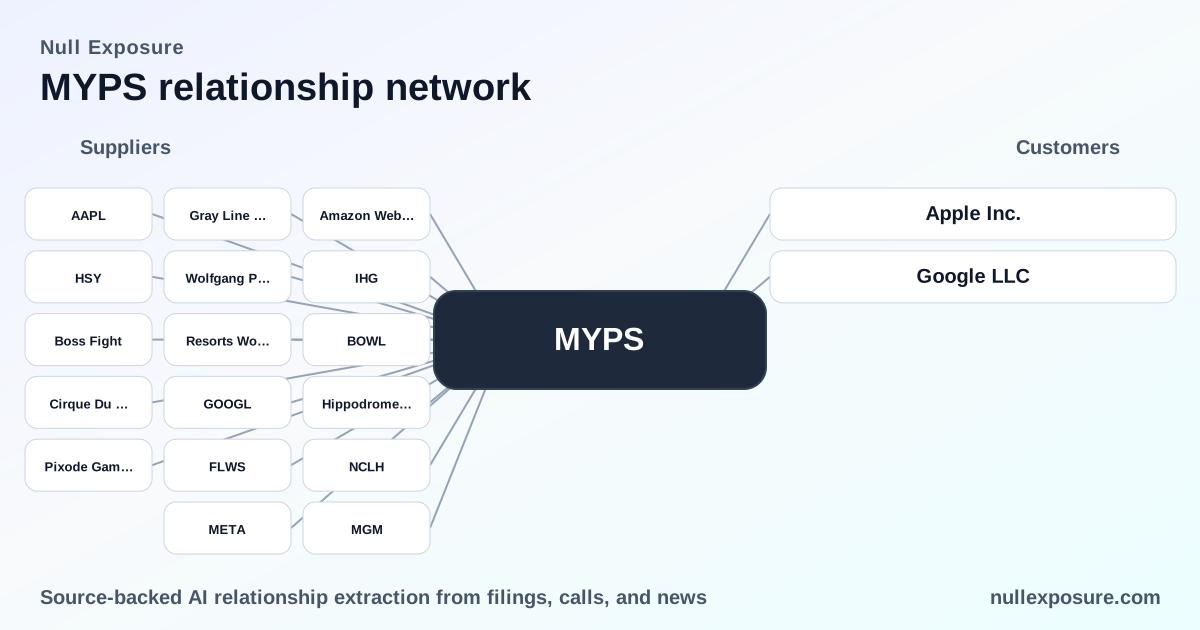
Playstudios’ FY2024 10‑K explicitly references two major platform relationships. Each entry below is summarized in plain English and tied to the public filing.
Apple Inc.
Playstudios lists Apple in its customer concentration risk and accounts receivable disclosures for FY2024, indicating the company recognized Apple as a material commercial counterparty in its revenue and receivable schedules. According to Playstudios’ FY2024 Form 10‑K, Apple is identified in the Customer Concentration Risk and Accounts Receivable sections of the filing for the fiscal year ended December 31, 2024.
Google LLC
Playstudios lists Google LLC in the same Customer Concentration Risk and Accounts Receivable disclosures for FY2024, signaling Google’s role as a major platform or advertising counterparty with receivable exposure reflected in the company’s balance sheet. The company’s FY2024 Form 10‑K shows Google is included in the Customer Concentration Risk and Accounts Receivable schedules for the year ended December 31, 2024.
How these relationships map to commercial risk and opportunity
- Platform and ad-network dependency. Both Apple and Google are traditional distribution and advertising platforms for mobile games; their inclusion in customer concentration notes highlights operational dependence on platform economics, store policies, and ad marketplace dynamics. This dependence is not unusual for mobile-first publishers, but it increases exposure to policy changes or fee adjustments by these large platform holders.
- Receivables and cash timing. The mention of Apple and Google in the accounts receivable context connects directly to the company’s 45–60 day payment term posture, implying that material platform receipts are subject to that concentrated collection window and therefore impact short-term liquidity.
- Commercial advertising demand as a growth lever. The filing’s classification of advertising service providers as customers positions advertisers as a recurring commercial revenue source; inclusion of Google and Apple supports the view that Playstudios monetizes both store distribution and on-platform ad inventories.
Investor implications — risks and upside to price
- Key risks: concentration in North America, dependence on platform partners for distribution and ad monetization, and consumer-spend cyclicality given the heavy reliance on in-app virtual currency sales. These risks translate into earnings sensitivity to macro and platform-level developments.
- Upside drivers: The loyalty program (playAWARDS) and in-game advertising provide high-margin monetization levers that can increase revenue per MAU and diversify revenue away from pure in-app purchases. Tight receivables terms (45–60 days) support predictable short-term cash flows if player and advertiser demand remains stable.
- Operational watch items for analysts: monitor U.S. revenue share relative to other geographies, monthly active user trends, ARPDAU (average revenue per daily active user) metrics disclosed in quarterly updates, and any changes to platform fee structures or ad pricing dynamics.
For direct access to the source filings and relationship signal summaries used here, visit https://nullexposure.com/.
Bottom line
Playstudios’ FY2024 disclosures present a clear commercial profile: a consumer-driven games publisher that monetizes through virtual currency and advertising, with significant North American concentration and tight receivables timing. Apple and Google are documented as material platform/advertising counterparty relationships, and the company’s product segmentation into core games, loyalty services, and ad inventory defines the roadmap for margin expansion. Investors should weigh steady, predictable cash conversion against platform and consumer cyclicality when valuing MYPS.