MYR Group (MYRG): Customer Relationships Drive Recurring Utility Work and Revenue Visibility
MYR Group operates as a networked electrical construction services provider that monetizes through time-and-materials, unit-price projects and multi‑year master service agreements (MSAs) with electric utilities, commercial and industrial customers across the United States and Canada. Its business model delivers recurring, project-based cash flow while preserving pricing flexibility through a mix of short‑duration MSAs and on‑demand service work. For an investor-facing overview of customer exposure and concentration, visit https://nullexposure.com/.
How MYR gets paid and why customers matter
MYR sells on a services-first basis: local operating subsidiaries execute construction, maintenance and upgrade projects under a combination of spot contracts and framework agreements such as MSAs. Work under MSAs is typically billed on a unit‑price or time‑and‑materials basis, which preserves gross margin upside on labor and equipment while providing customers with an established contractor relationship and streamlined procurement. The company reported $2.34 billion of remaining performance obligations at December 31, 2024, which underpins near‑term revenue visibility and backlog-driven capacity planning.
- Contracting posture: Framework MSAs provide predictable work flow for a 1–3 year horizon; spot work captures incremental demand.
- Concentration: The top 10 customers accounted for 37.8% of revenue in 2024, reflecting a material reliance on large utility accounts.
- Geography & counterparty mix: Operations are concentrated in North America and include utilities, governmental entities and commercial/industrial owners.
- Relationship maturity and criticality: Many customer relationships are long‑standing, maintained through partnering and performance metrics, which supports repeat award rates and operational planning.
Customer relationships: the record (all relationships in the dataset)
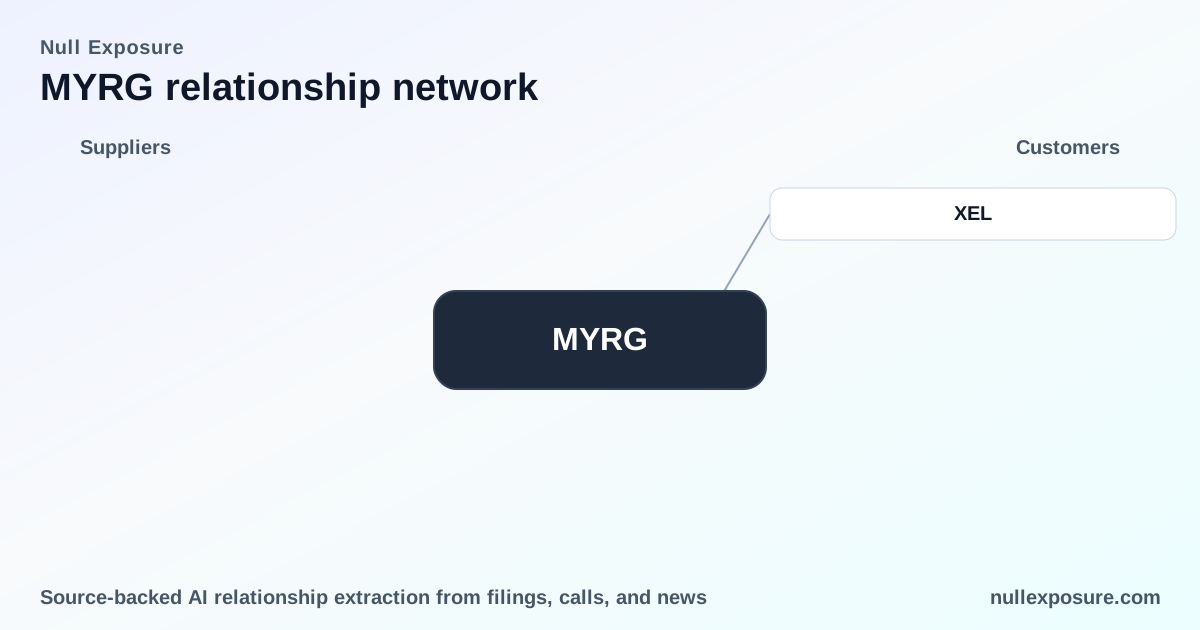
The dataset identifies a single principal customer relationship in public mentions: Xcel Energy (ticker XEL). Below is the plain‑English summary of that relationship and the sources that document it.
Xcel Energy (XEL)
MYR has a material, multi‑year contracting relationship with Xcel Energy that includes a five‑year master service agreement worth approximately $500 million and additional regional MSAs such as a Kentucky agreement referenced in investor communications. According to Sahm Capital reporting in December 2025 and November 2025, MYR announced a new five‑year MSA with Xcel and highlighted MSAs with utilities across the Northeast and Midwest as primary growth drivers. In the Q1 2026 earnings call transcript published on InsiderMonkey (May 3, 2026), company management explicitly referenced the Xcel $500 million 5‑year MSA and a Kentucky MSA as examples of contracted backlog and utility partnerships. (Sources: Sahm Capital, Dec 9, 2025; Sahm Capital, Nov 9, 2025; InsiderMonkey Q1 2026 earnings call transcript, May 3, 2026.)
What these relationships and constraints mean for investors
MYR’s customer base and contractual structure produce a distinctive risk/reward profile: stable, repeatable revenue from utilities combined with exposure to cyclical project demand and commodity/labor cost variability. The company’s operating model characteristics translate into concrete investor considerations:
- Short‑to‑medium contract duration with framework coverage. MSAs are typically one to three years in duration, which creates recurring revenue lanes but requires regular rebidding or renewal to sustain backlog. This contracting posture supports predictable near‑term revenue while keeping the firm agile to capture new electrification work.
- Material customer concentration. With the top 10 customers representing roughly 38% of revenue, single‑account outcomes (renewal, pricing pressure or project deferral) have outsized P&L impact relative to a highly diversified contractor.
- Utilities and governmental counterparties drive credit profile. A significant portion of revenue originates with high‑credit electric utilities and public sector customers, which enhances receivable quality and supports payment predictability versus purely private commercial exposures.
- Mature, partnership‑oriented relationships. Many relationships originated decades ago and are maintained via performance measurement and direct customer engagement, which reduces acquisition cost and increases the share of repeat awards.
- Regional concentration in North America. Operations focused in the US and Canada concentrate regulatory and weather risk but also align the company to major electrification and grid‑modernization spend initiatives.
These operating signals produce both durability and sensitivity: MSAs and repeat utility work create a baseline of durable cash flows and backlog, while concentration and project‑level pricing leave MYR exposed to localized demand shifts and input cost swings.
Strategic and market drivers to watch
Investors should monitor how MYR leverages customer agreements to capture structural demand drivers:
- Electrification and grid modernization. Market commentary in late 2025 highlighted electrification and AI/data center infrastructure as incremental sources of utility and industrial spend for MYR, with MSAs serving as the contracting vehicle for scale deployment (Sahm Capital, Dec 9, 2025).
- Backlog conversion and margin mix. The translation of remaining performance obligations into recognized revenue — and the margin mix between unit‑price MSAs and time‑and‑materials work — will control near‑term operating leverage.
- Contract renewals and new framework wins. Given the short‑to‑medium MSA tenure, consecutive renewals with large utilities such as Xcel will determine revenue stability and growth optionality.
Financial context for customer risk assessment
MYR reported roughly $3.82 billion in trailing‑twelve‑month revenue and EBITDA of approximately $261 million as of the most recent company overview, demonstrating scale in electrical construction but a modest EBITDA margin profile typical of the sector. Top customer concentration and MSA renewal cycles should be evaluated alongside these financials to model durable earnings versus episodic project risk.
Actionable takeaways
- Xcel Energy is a center‑piece utility client for MYR, documented by multiple public disclosures and investor call comments, including a $500 million five‑year MSA. (Sahm Capital; InsiderMonkey Q1 2026 transcript.)
- MYR’s revenue visibility is anchored by MSAs and $2.34 billion of remaining performance obligations, but the company exhibits material top‑customer concentration that increases single‑customer impact on results.
- Electrification and grid modernization are structural growth vectors where MSAs create a low‑friction route to scale work with incumbent utility customers.
For a deeper breakdown of customer exposure and to model counterparty concentration across MYR’s portfolio, see additional resources at https://nullexposure.com/.
Final note for analysts
Incorporate the documented Xcel MSAs and the company‑level constraints above into scenario models for both downside (lost/downsized MSAs) and upside (additional utility framework wins tied to electrification). These relationship characteristics drive both the near‑term revenue cadence and the multi‑year growth runway for MYR.