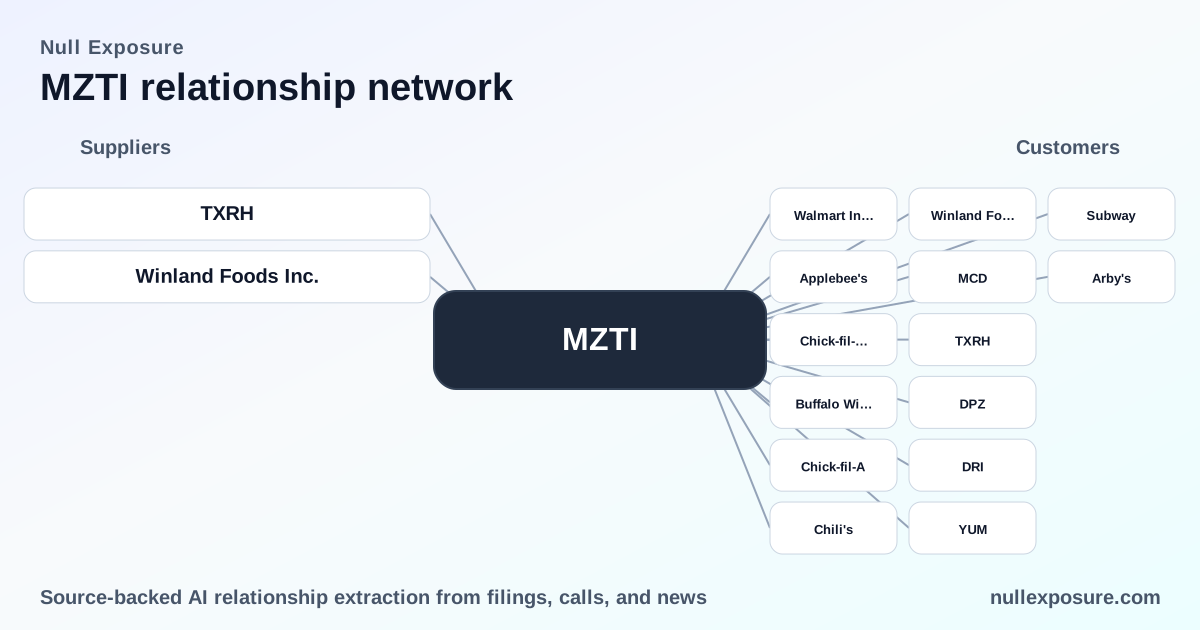
Marzetti (MZTI): Customer map, commercial levers, and concentration risks
The Marzetti Company is a manufacturing-led consumer foods business that monetizes through three primary channels: branded retail sales, licensed retail products tied to national restaurant brands, and private‑label/foodservice manufacturing sold through distributors to chain restaurant accounts. Revenue growth is driven by expansion of licensed SKUs into club and retail channels, recovery in foodservice volumes with large national partners, and targeted M&A that increases manufacturing capacity and short-term supply agreements. For investors evaluating customer-credit or counterparty risk, Walmart and a handful of national chains are strategic revenue anchors, while licensing deals create margin uplift and retail distribution optionality. Learn more about our coverage at https://nullexposure.com/.
How Marzetti actually works — the operating and contracting profile
Marzetti runs a manufacturing and marketing model where the company is simultaneously a seller, manufacturer and licensed-product partner for major foodservice chains. The FY2025 10‑K and subsequent company commentary make several company‑level signals clear:
- Contracting posture: Marzetti executes a mix of long‑standing foodservice supply relationships and explicit licensing agreements; it also operates short‑term manufacturing arrangements following acquisitions (a temporary supply agreement tied to an Atlanta plant acquisition was executed for up to 12 months starting March 2025).
- Customer concentration and materiality: Retail top‑five customers are highly concentrated—accounting for ~62% of the Retail segment in 2025—making large retail relationships material to segment revenue.
- Counterparty type and role: The business sells primarily through distributors and brokers into national chain accounts, while also directly manufacturing licensed and private‑label goods; this positions Marzetti as a critical supplier for partner brands.
- Geography and scale: Over 95% of sales are in the United States, concentrating country‑level operational and demand risk.
- Relationship maturity and stage: Management describes many foodservice relationships as mature and active, and uses licensing to extend those relationships into retail channels.
These characteristics imply high dependence on a small set of national partners, predictable U.S. demand, and episodic capital deployment to scale manufacturing capacity—all factors investors should weigh when modeling revenue volatility or counterparty concentration.
Relationship-by-relationship: who drives revenue and where the leverage sits
Below are concise, source‑linked notes on every partner mentioned in company filings, earnings remarks, and press coverage in the period covered by the dataset.
Chick‑fil‑A
Chick‑fil‑A is identified in the FY2025 10‑K as a national chain whose business “represents a significant portion of our consolidated net sales,” and management has highlighted expanded licensed Chick‑fil‑A sauces into club and retail channels. According to the FY2025 10‑K and FY2026 press commentary, Chick‑fil‑A licensed products are both material and growing in retail distribution (company 10‑K FY2025; press 2026).
Walmart Inc.
Walmart accounted for 19% of consolidated net sales in 2025 (18% in 2024 and 2023), making it the single largest retail customer disclosed. The FY2025 10‑K quantifies Walmart’s share directly, underlining concentrated retail exposure (FY2025 10‑K).
Applebee’s
Applebee’s was referenced on Marzetti’s Q4 FY2025 earnings call as a casual‑dining partner showing operational improvement and contributing to foodservice recovery. Management cited Applebee’s performance as evidence of casual‑dining stabilization (Q4 FY2025 earnings call, Mar 2026).
Buffalo Wild Wings
Marzetti manufactures Buffalo Wild Wings sauces under license; management credited these licensed sauces with adding to growth in licensed items and retail lift. Multiple press pieces and the Q4 earnings call reference Buffalo Wild Wings as a core licensed partner (Q4 FY2025 earnings call; FoodBusinessNews and company press 2026).
Chili’s
Chili’s was mentioned on the Q4 FY2025 earnings call as one of the casual‑dining chains showing improved volume trends, contributing to foodservice normalization. Management grouped Chili’s with peers pointing to menu simplification and operational improvements (Q4 FY2025 earnings call, Mar 2026).
Winland Foods
Winland Foods is the seller of an Atlanta‑based manufacturing facility Marzetti acquired; Marzetti entered a temporary supply agreement (TSA) with Winland to manufacture certain products for up to twelve months commencing March 2025. This reflects a near‑term transitional manufacturing partnership tied to the acquisition (Q4 FY2025 earnings call; related acquisition disclosures).
McDonald’s (MCD)
McDonald’s was discussed on the Q4 FY2025 call as an example in QSR leadership, with management noting the potential for other quick‑service operators to follow McDonald’s moves on snacking options—signaling Marzetti’s view of broader QSR opportunity rather than a direct supply disclosure (Q4 FY2025 earnings call, Mar 2026).
Texas Roadhouse (TXRH)
Texas Roadhouse is a licensed partner for dinner rolls and steak sauces; management identified expanding distribution for Texas Roadhouse dinner rolls as a driver of sales growth. Press releases and the Q4 call reference TXRH as a growing retail licensing relationship (press release March 12, 2026; Q4 FY2025 earnings call).
Domino’s (DPZ)
Domino’s is listed by management as a national account contributing to foodservice recovery in FY2026, with normalized volumes improving after earlier pull‑forward effects. Market commentary in March 2026 highlighted Domino’s as a notable foodservice partner (Finviz/StockStory coverage March 2026; company commentary).
Arby’s
Arby’s sauces are part of Marzetti’s licensed‑product portfolio, cited in trade coverage as an established partnership that supports retail licensing expansion (FoodBusinessNews and company press 2026).
Olive Garden (DRI)
Marzetti holds an exclusive licensing arrangement for Olive Garden dressings, cited across press and investor commentary as a core branded licensing relationship that contributes to retail growth (press coverage March 2026; FY2026 commentary).
Subway
Subway sauces are included among licensed partnerships referenced in Marzetti’s retail expansion narrative and press coverage, supporting the company’s strategy to monetize restaurant brands in grocery channels (press coverage March 2026).
Taco Bell (YUM)
Taco Bell was named by management among national account partners (alongside Domino’s) contributing to foodservice normalization in FY2026 commentary; this illustrates Marzetti’s exposure to major QSR chains even when those relationships are routed through distributors (StockStory/Finviz March 2026).
Implications for investors: levers and risks
- Revenue upside derives from continued expansion of licensed SKUs into retail and club channels, plus normalization of foodservice volumes with national partners. Management cited a recent quarter of record sales and margin gains driven by licensed sauces and frozen bakery items (company reports Q1 FY2026 commentary).
- Concentration risk is real: Walmart’s ~19% share and the top‑five retail customers driving ~62% of Retail sales create single‑counterparty sensitivity that will influence scenario analysis for downside cases.
- Operational constraints: The use of TSAs following acquisitions and the need to serve large distributors position Marzetti as a critical supplier, which is positive for sticky demand but raises execution risk if manufacturing integration or distributor tensions occur.
- Geographic concentration to the U.S. reduces exposure to international upside but limits macro risk to domestic consumer and restaurant cycles.
For a deeper look at Marzetti’s customer relationships and how they map to revenue sensitivity, visit https://nullexposure.com/ for our full coverage and data tools.
Bold takeaway: Marzetti’s revenue profile combines high-margin licensed retail upside with material customer concentration—investors should model both the growth runway of licensed SKUs and the downside risk of large retail and national foodservice partners.