Nakamoto Inc. (NAKA): Customer Relationships and Commercial Operating Signals
Nakamoto Inc. operates a hybrid business that generates operating revenue from direct patient services and retail product sales while also allocating capital into digital asset strategies following a corporate repositioning. The company monetizes through fee-for-service clinical encounters reimbursed by Medicare/Medicaid and commercial insurers, direct-pay patients, retail product sales, and related service affiliate arrangements; more recently management has signaled a shift toward deploying capital into Bitcoin-related investments and advisory relationships. For investors, the critical read is that Nakamoto’s core cash flows remain healthcare-driven and localized, while its balance sheet and capital-allocation posture are evolving into a dual operational/investment profile.
If you want a single place for relationship intelligence, visit https://nullexposure.com/ for detailed coverage.
How Nakamoto actually makes money and why it matters to investors
Nakamoto’s revenues are primarily service-based: patient care services account for the majority of top-line receipts, supplemented by retail product sales and affiliate services. The company recognizes patient revenue at the point services are rendered and retail revenue at transfer of control, establishing a predominantly transactional, spot-based contracting posture for core operations. Financial results show small absolute revenue (Revenue TTM ~$1.82M) against substantial negative gross profit and operating losses, signaling that operational scale and margin recovery are the immediate commercial priorities.
Key operating metrics that contextualize customer risk:
- Revenue concentration by geography: operations are focused in Utah, with no current expansion plan outside the state. This creates both a local-market revenue dependency and a tight regulatory/reimbursement footprint to monitor.
- Payer mix and contracting: the company is contracted with most major insurers in Utah and receives payments from Medicare and Medicaid as well as direct patients, making payer reimbursement variability a central commercial risk.
- Customer type and contract length: services are delivered largely on an interaction-by-interaction basis, with the patient considered the contractual counterparty in most cases and consent forms forming the written contract.
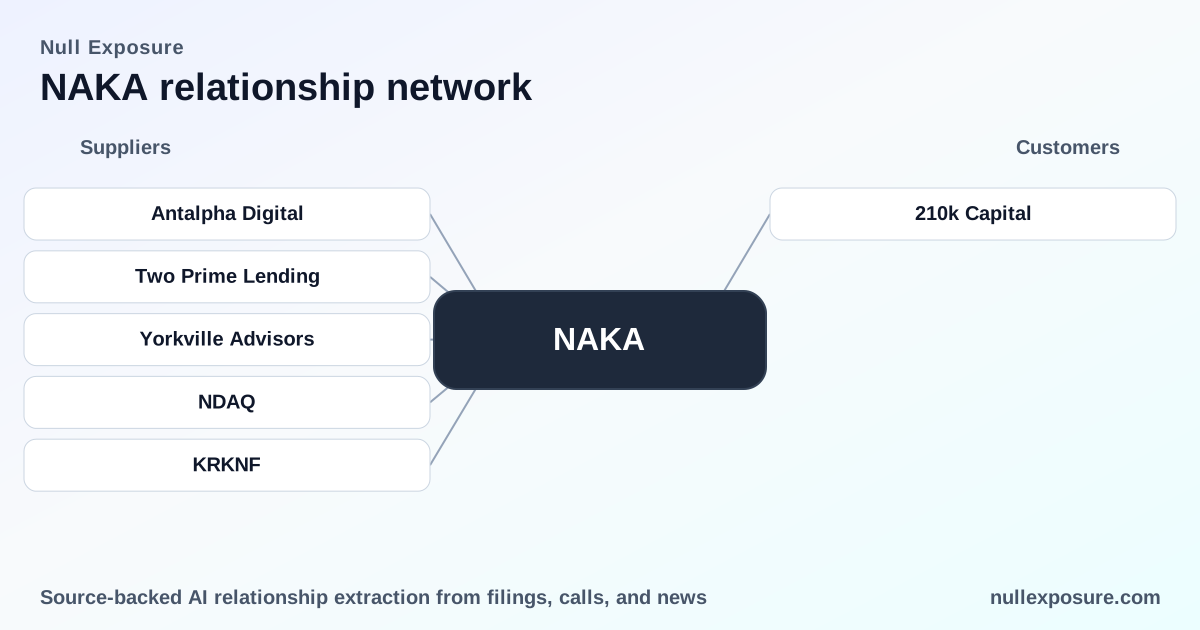
Customer relationship: 210k Capital and the UTXO advisory link
210k Capital — A March 10, 2026 news report noted that UTXO will serve as an adviser to 210k Capital on Bitcoin investments and is expected to help enhance Nakamoto’s capital allocation across public and private markets, which management is leveraging to strengthen the company’s investment portfolio and treasury strategy. This relationship signals a meaningful governance/portfolio-development tie between Nakamoto’s treasury and Bitcoin-focused advisers. (Intellectia news, March 10, 2026.)
What the constraints tell us about the business model and operating posture
The set of extracted constraints forms a compact, investor-relevant picture of how Nakamoto sells, who pays, and where revenue risk concentrates:
- Contracting posture — spot, transaction-based performance: Patient care services are recognized at a point in time when the company can invoice for a billable interaction. This creates a high-volume, low-duration revenue model that depends on steady patient throughput rather than long-term contractual lock-ins.
- Counterparty composition — mixed payers with government exposure: Receivables come from individuals (direct-pay patients), third-party payors (including Medicare and Medicaid), and commercial insurers. Government payor exposure elevates reimbursement and compliance risk but also provides predictable payment channels compared with private self-pay only models.
- Enterprise counterparty scale — major insurers included: The company states contracts with most major insurers in Utah covering over 95% of the insured population, indicating deep local payer penetration and negotiation leverage within that regional market.
- Geographic concentration — single-state operations: Operations are solely in Utah, concentrating regulatory, reimbursement, and demand risk in one jurisdiction; expansion outside the state is not currently targeted.
- Role mix — both seller and service provider: Nakamoto functions as a healthcare service provider and retailer; revenue recognition distinctions (service vs. retail) affect cash timing and margin profiles across segments.
- Relationship maturity and health — active, growing utilization: The company treated 20,636 patient visits in 2024 versus 18,930 in 2023, demonstrating active operations and modest utilization growth at the current scale.
- Segment focus — services-first with ancillary retail: The principal revenue driver is services (medical evaluation and treatment), supported by product retail sales and affiliate agreements; this composition frames capital allocation priorities toward service delivery investments and margin recovery.
These constraints collectively imply a company that is operationally mature on the local-service front but commercially concentrated and sensitive to payer policy and utilization trends. At the same time, the addition of investment advisory relationships around Bitcoin signals a strategic diversification of capital allocation beyond core healthcare operations.
Concentration, criticality and maturity — implications for risk and upside
- Concentration risk is material: single-state operations combined with payer concentration inside Utah make top-line sensitivity to local policy and insurer behaviour a real source of volatility. Investors should model outsized impacts from changes in local reimbursement rates or provider network status.
- Revenue criticality is patient-driven: because revenue is realized per interaction, cash flow stability requires maintaining or growing patient visits; the year-over-year increase in visits is a positive operational signal but not yet indicative of scale or margin recovery.
- Maturity is operational but not profitable: the business shows established workflows and payer contracts but lacks profitability at current scale (negative gross profit and operating margin). This dynamic positions the company as a turnaround or growth-investment case rather than a stable cash generator.
- Capital-allocation shift introduces balance-sheet optionality: the relationship with Bitcoin-focused advisers and reported Bitcoin treasury holdings imply that Nakamoto is deploying its balance sheet as an investment vehicle in addition to running a health services business. This dual posture increases both upside (asset appreciation) and governance, treasury, and volatility risks.
What investors should watch next
- Monitor quarterly disclosures for the scope and governance of any crypto/treasury investments and the formal role of advisers like UTXO/210k Capital in capital-allocation decisions. The March 2026 news item documenting adviser activity is a leading indicator that balance-sheet strategy will be part of the investment thesis.
- Track utilization and payer mix trends from periodic filings: patient visit counts, revenue per visit, and shifts between government and commercial reimbursements will determine near-term cash flow dynamics.
- Watch for geographic expansion or new large enterprise contracting that would reduce Utah concentration risk; absent this, regional shocks remain an outsized hazard.
- Evaluate insider and institutional ownership levels and any related-party transactions as the company blends operating and investment activities; high insider ownership can strengthen strategic continuity but also concentrates control.
Bottom line
Nakamoto is a vertically active healthcare operator monetizing primarily through fee-for-service clinical encounters and retail sales, now layered with an explicit capital-allocation strategy into Bitcoin-related investments. The business is operationally active and payer-integrated within Utah, but concentration and margin deficits require investors to weigh operational execution against balance-sheet-driven upside and treasury volatility. For continued coverage and relationship tracking, visit https://nullexposure.com/ for ongoing updates and source-driven intelligence.