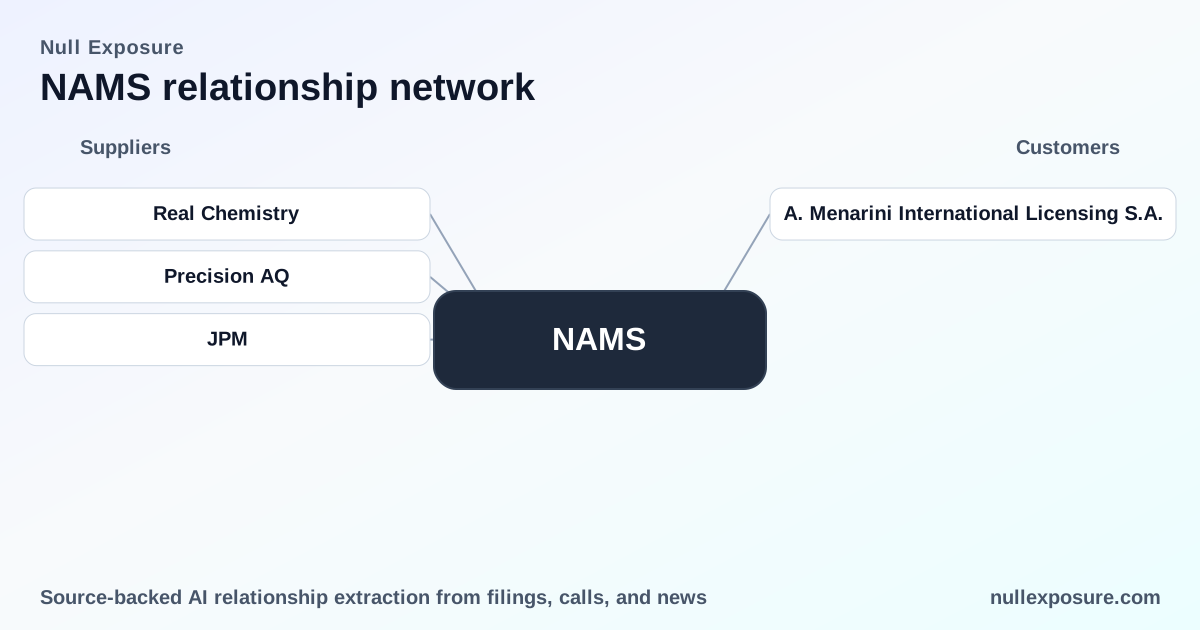
NewAmsterdam Pharma (NAMS): Menarini License Drives Commercial Pathway and Revenue Profile
NewAmsterdam Pharma commercializes its lead asset, obicetrapib, by licensing exclusive European rights to Menarini and monetizes primarily through upfront payments and milestone-driven royalties rather than direct product sales. The company operates as a licensor of intellectual property and regulatory dossiers, concentrating commercial risk and near-term revenue dependence on a single commercialization partner in EMEA. For a concise briefing and ongoing signal tracking, visit https://nullexposure.com/.
Thesis in one paragraph
NewAmsterdam develops cardiometabolic therapeutics and converts R&D value into cash through strategic licensing: it granted Menarini exclusive commercialization rights for obicetrapib in major European markets and recognized a six‑figure upfront payment plus milestone revenues thereafter. The business model is licensing-centric, revenue-concentrated, and outcome‑linked — investors should treat partner execution and regulatory milestones as primary value drivers.
How the Menarini relationship structures near-term economics
The license with Menarini is a classic biotech commercial partnership: NewAmsterdam retains IP and regulatory documentation and Menarini funds post‑approval development, local regulatory interactions, and full commercialization in the Menarini territory. According to company disclosures and press coverage in early 2026, Menarini is responsible for submitting MAAs and for local development and commercialization activities under an exclusive license, and the arrangement generated a non‑refundable upfront payment at contract inception. (GlobeNewswire, March 23, 2026; company filings summarized in January 2026 releases.)
- Revenue profile: NewAmsterdam recorded milestone revenue across FY2022–2025 tied to the Menarini license, and the upfront cash of roughly $120.9 million materially supported the company’s balance sheet and operations at contract inception.
- Commercial scope: The license covers obicetrapib as a monotherapy and as a fixed‑dose combination with ezetimibe across the majority of European countries (the “Menarini Territory”), positioning Menarini as the commercial engine in EMEA.
Operating model constraints and what they reveal for investors
The available constraint signals describe the company-level operating posture rather than speculative projections. These constraints together outline a clear investor map:
- Contracting posture: Licensing is explicit — NewAmsterdam acts as a licensor, transferring commercialization rights rather than building its own European commercial infrastructure. (Contract excerpt dated June 23, 2022.)
- Concentration and materiality: The Menarini License is material to NewAmsterdam’s revenues to date; historical receipts and milestone recognition have been concentrated and geographically narrow. This creates single‑partner concentration risk that investors must track through Menarini’s regulatory and commercial execution.
- Geographic footprint: The commercial rights granted are focused on EMEA, specifically the majority of European countries as defined in the Menarini Territory — this defines NewAmsterdam’s market exposure in the near to medium term.
- Product-level criticality: Obicetrapib is a core product for the licensed activity, positioned both as monotherapy and in combination with ezetimibe, and therefore is central to near-term value realization.
- Capital recognition: The company received a $120.9M non‑refundable upfront at contract inception; this is a company cash‑flow event, not ongoing product revenue, and should be treated as de‑risking but non‑recurring.
- Relationship maturity signals: Public disclosures show milestone revenue recognition in recent fiscal years (FY2022–2025); the company also reports that it performs R&D and had limited direct sales historically, indicating a hybrid posture of active partner commercialization coupled with early‑stage internal development activities.
Relationship-by-relationship notes (every result covered)
A. Menarini International Licensing S.A. — GlobeNewswire / corporate filings (January–March 2026)
- NewAmsterdam states that MAAs (marketing authorization applications) for obicetrapib were submitted by its partner A. Menarini International Licensing S.A., which is charged with regulatory communications and commercialization in Europe under the exclusive Menarini License. (GlobeNewswire, January 9, 2026; company corporate update.)
A. Menarini International Licensing S.A. — Bitget news republication (March 10, 2026)
- A press summary reiterated that Menarini submitted the MAAs on NewAmsterdam’s behalf and will undertake commercialization and additional local development as the exclusive licensee for the Menarini territory. (Bitget news summary, March 10, 2026.)
A. Menarini International Licensing S.A. — Manila Times / GlobeNewswire republish (February 18, 2026)
- Financial reporting and corporate update coverage again confirmed Menarini’s regulatory role and its exclusive commercialization responsibilities as described in the Menarini License. (Manila Times summary of GlobeNewswire filing, February 18, 2026.)
Menarini (independent analysis piece) — Sahm Capital (March 30, 2026)
- Market commentary positioned obicetrapib as a low‑dose oral LDL‑lowering option and highlighted that European commercialization rights are exclusively licensed to Menarini, underscoring the strategic value of the partnership as an investor narrative. (Sahm Capital analysis, March 30, 2026.)
Menarini Group — GlobeNewswire conference disclosures (March 23, 2026)
- NewAmsterdam announced scientific presentations at ACC 2026 and reiterated that commercialization rights for obicetrapib in Europe, including both monotherapy and fixed‑dose combinations with ezetimibe, are exclusively granted to the Menarini Group. (GlobeNewswire, March 23, 2026.)
Menarini Group — GlobeNewswire corporate release (March 23, 2026)
- The company’s conference media materials repeated that Menarini Group holds exclusive commercialization rights in Europe for obicetrapib, reflecting consistent messaging across investor and scientific communications. (GlobeNewswire, March 23, 2026.)
Investment implications — what matters for due diligence
- Partner execution dominates near-term value: With commercialization delegated to Menarini, regulatory approvals, launch timing, pricing, payor access, and local commercial execution in the Menarini Territory will determine revenue delivery and timing.
- Concentration risk is real and measurable: Historical revenue is tied to this single license; investors should treat Menarini’s performance and the contractual mechanics (royalties, milestones, sublicensing rights) as the principal operational risk.
- Non‑recurring cash cushions but does not equal sustainable sales: The $120.9M upfront provided liquidity and validation but is not recurring product revenue; future valuation depends on marketed sales and continued milestone flow.
- EMEA commercialization limits geographic optionality in the near term: U.S. and other markets will require separate strategies or partners to scale global revenues beyond the Menarini Territory.
For investors and operators who need a compact monitoring dashboard and ongoing signal capture on NAMS partner activity, see the platform overview at https://nullexposure.com/.
Bottom line
NewAmsterdam’s model is a focused licensing play: the Menarini license is the single material commercial relationship that converts R&D into cash today, and investor returns depend on regulatory progress and Menarini’s ability to commercialize obicetrapib in Europe. Track Menarini’s regulatory filings, launch planning, and early sales disclosure as the primary catalysts for NAMS equity realization.