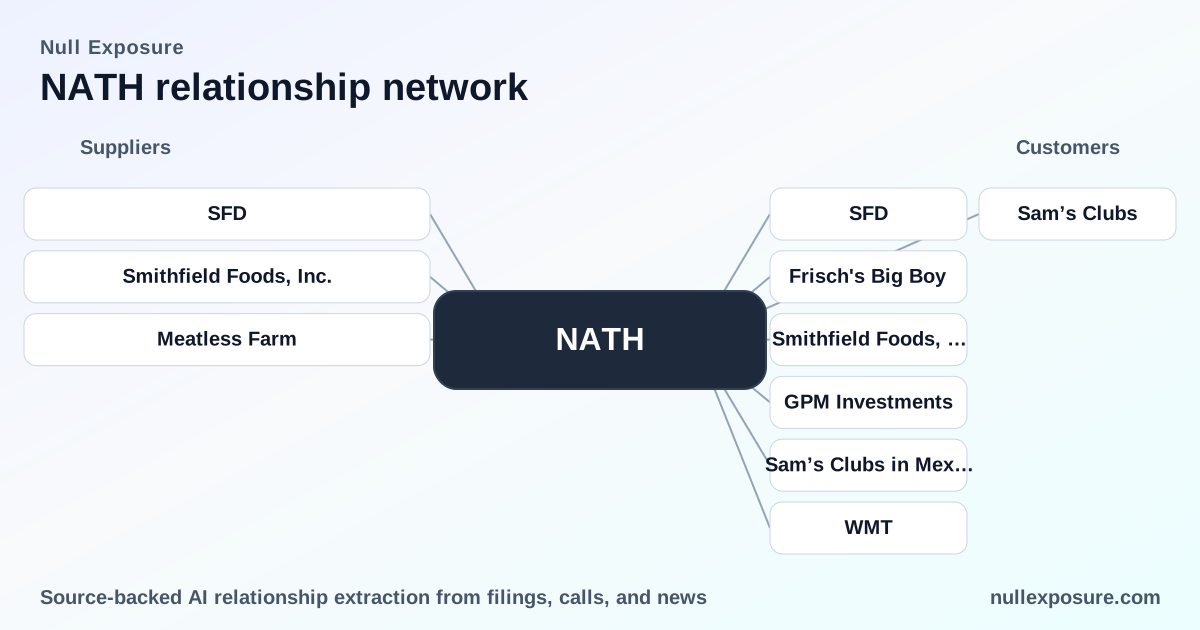
Nathan's Famous (NATH) — Customer Relationships and Commercial Risk Profile
Nathan’s Famous monetizes a heritage consumer food brand through a hybrid business model: franchise-operated restaurants that generate royalties and fees, plus a branded-products licensing program that delivers royalty income from supermarket, club and foodservice channels. The company’s economics therefore depend on two commercial levers—franchise system sales and third-party licensed product volumes—each driven by a small set of large retail and manufacturing partners. For investors assessing exit optionality and downside, the Smithfield license and the concentration of branded-product counterparties are the decisive commercial exposures. For background and client-facing datasets visit https://nullexposure.com/.
Executive takeaway: a brand business with concentrated counterparty exposure
Nathan’s captures cash through franchise fees/royalties and licensing royalties on branded food products; franchising delivers recurring fee revenue while licensing converts manufacturing and distribution partners into de‑facto sales channels. That structure produces high operating leverage to a few large counterparties: the company reports that its five largest branded-product customers accounted for roughly 79% of branded-product program revenues in fiscal 2025, and one customer represented about 20% of total company revenue (fiscal 2025 filing data). Investors should treat Nathan’s as a brand/royalty owner with meaningful concentration and long-term contracting features.
How to read the company-level constraints (what they imply for operations)
- Contracting posture is long-term and structured: the company’s standard franchise agreements carry a 10‑year initial term with a five‑year renewal option and defined royalty and advertising percentages—this is a company that sells predictable, long-dated economic streams to franchisees (company filing).
- Counterparty mix is mixed: individual owners and large enterprises: Nathan’s targets both multi-unit, sophisticated operators and individual franchisees, which produces a portfolio effect—stable large operators offset higher churn risk among single-unit owners (company filing).
- Geographic footprint is North America–centric with pockets of global reach: reported revenues are heavily U.S. weighted (fiscal 2025 data: ~USD 144.3m U.S.; ~USD 3.9m international), but the restaurant system and retail placements extend to multiple foreign markets (company filings).
- High concentration is a material commercial constraint: only a few branded-product customers drive most licensing royalties—this creates clear counterparty risk and buyer power in the retail channel (company filing).
- Role diversity increases optionality, but also dependency: Nathan’s is simultaneously a licensor (collecting royalties), franchisor (collecting fees/royalties) and reseller via company-owned restaurants—this gives the firm multiple revenue vectors but concentrates risk when large licensees control retail supply (company filing).
For a deeper signals overview and tailored exposure reports see https://nullexposure.com/.
Relationship inventory — what every named customer/partner in our coverage means for NATH
-
SFD (ticker SFD) — Multiple news outlets reported Smithfield Foods agreed to acquire Nathan’s for roughly $450 million and has held an exclusive manufacturing and distribution license since 2014 for the U.S., Canada and Sam’s Clubs in Mexico. This long-standing license transforms Smithfield from a supplier into the dominant industrial counterparty for Nathan’s branded products (Food Engineering, GlobeNewswire, Restaurant Business Online, March 2026).
-
Smithfield Foods / Smithfield Foods, Inc. — Smithfield’s exclusive license covers manufacturing, distribution, marketing and retail sale of Nathan’s branded hot dogs and related products; company disclosures and media releases show royalties from Smithfield are a material revenue line and Smithfield was positioned as the acquirer in early 2026 (GlobeNewswire; Franchising.com; AP News, Jan–Mar 2026).
-
Walmart (WMT) — Nathan’s branded retail launches and distribution extend to major mass merchants; press coverage around product introductions cited Walmart as a national retail carrier for new SKUs (Provisioner Online, May 2026). Walmart exposure adds scale to Nathan’s retail royalty pool but also concentrates negotiation power among mass merchandisers.
-
Sam’s Club / Sam’s Clubs — The Smithfield license explicitly covered Sam’s Club locations in Mexico and is referenced repeatedly in acquisition announcements; Sam’s Club placements form part of Nathan’s retail distribution footprint under the Smithfield arrangement (CSP Daily News; Food Navigator USA; AP News, Jan–Mar 2026).
-
Sam’s Clubs in Mexico — News releases describing the Smithfield license call out Sam’s Club locations in Mexico as a defined channel within the exclusive agreement, creating a geographically specific retail relationship that was part of Smithfield’s acquisition rationale (KFGO; Prepared Foods, Jan 2026).
-
Frisch’s Big Boy — Regional restaurant operator Frisch’s Big Boy added Nathan’s Famous hot dogs to menu lineups across its system, expanding the brand’s foodservice presence at franchise-level outlets (WLWT local coverage, March 2026).
-
GPM Investments LLC / GPM Investments — GPM Investments, a large convenience-store operator, began selling Nathan’s hot dogs in 2024; press coverage highlights GPM as a branded-menu partner that scales Nathan’s access to c‑store channels (Provisioner Online; CSP Daily News, 2024–2026).
-
E‑Z Mart — E‑Z Mart stores (a GPM brand network) were named among the select locations rolling out Nathan’s product offers to loyalty program members, evidencing traction in regional convenience banners (Provisioner Online, May 2024).
-
fas mart — fas mart was similarly referenced as an in‑store brand under the GPM umbrella where Nathan’s hot dog units were introduced to loyalty members, underscoring multi‑brand rollouts within single operator groups (Provisioner Online, May 2024).
-
Pride (HPST) — Pride, which operates under the same convenience network family, was listed among banner names where Nathan’s hot dogs were trialed, indicating Nathan’s use of franchisee/operator scale to enter new foodservice micro-channels (Provisioner Online, May 2024).
Key commercial risk and upside vectors
- Concentration risk is the dominant downside: royalty and operating income are highly exposed to a few licensees and large retail partners; Smithfield’s position—historically the exclusive licensee and eventual acquirer—illustrates both the value and the vulnerability of that revenue stream (company filings and press coverage, FY2025–FY2026).
- Long-term contracts reduce revenue volatility but limit optionality: 10‑year franchise agreements and multi-year licensing create predictable cash flows but also lock the company into dependency relationships that large counterparties can exploit (company filing).
- Distribution scale via Walmart/Sam’s Club/GPM increases saleable volume and brand visibility: placements in mass merchants and convenience networks support royalty growth and brand extension, improving top-line leverage when product innovation succeeds (Provisioner Online, 2026).
Final read for investors
Nathan’s is a brand-centric, royalty-first business with clear strengths—stable recurring royalties, long-term franchise structure, and national retail placements—and clear weaknesses: high counterparty concentration and dependence on a dominant licensee. The Smithfield relationship accelerates both valuation upside (strategic buyer interest) and governance questions around independence and negotiating leverage; investors should value the company as a cash‑flowing brand owner with concentrated counterparty exposure and evaluate scenarios that isolate the branded-products royalties in an acquisition context.
For ongoing monitoring of NATH counterparties and to request a bespoke counterparty exposure brief, visit https://nullexposure.com/.