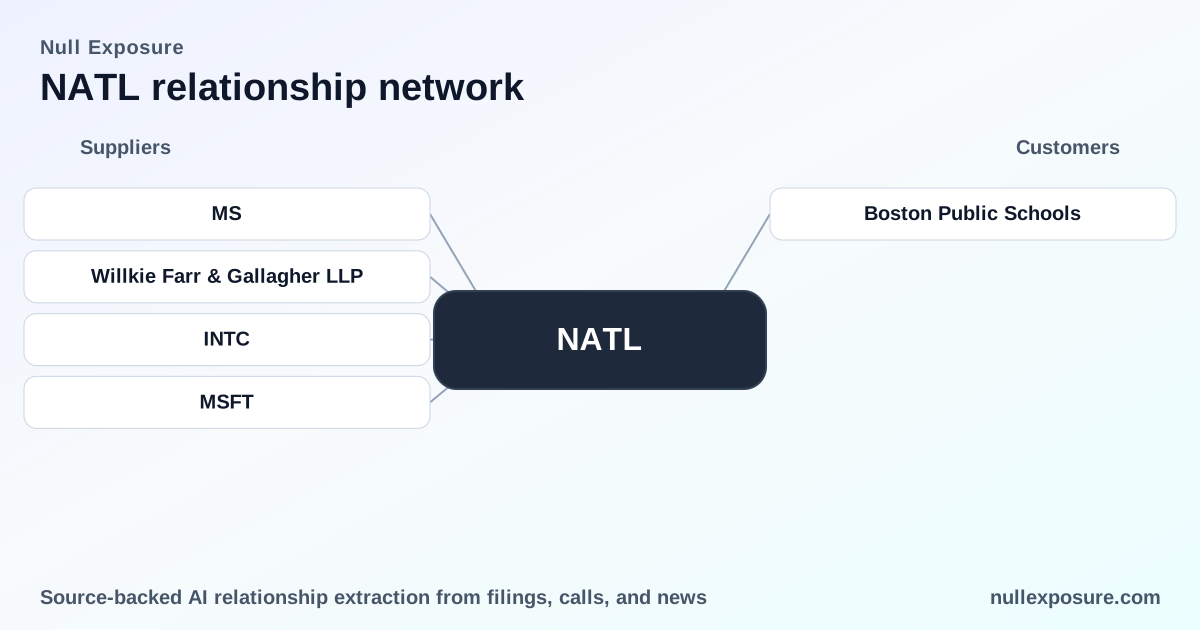
NATL customer map: what management’s disclosures and third‑party mentions tell investors
NCR Atleos Corporation (NATL) monetizes a global self‑service banking franchise by selling and servicing ATM/ITM hardware, licensing and operating software, and running managed services including ATM-as-a-Service and transaction processing. Revenue is mixed across product sales, multi‑year subscriptions and usage fees, producing a recurring base with transactional upside—a profile that supports predictable cash flow while exposing the company to concentrated large‑enterprise exposures and operational execution risk. For a concise, interactive view of these customer relationships, visit https://nullexposure.com/.
Why customer relationships matter for NATL’s valuation
Investors should value NATL as a hybrid equipment and recurring‑services business. The company’s disclosures describe long‑term contracts, subscription and usage pricing, and a mix of licensing and hardware sales. That structure drives predictable recurring revenue while allowing revenue elasticity from transaction volumes and ATM placements; it also creates pockets of counterparty concentration where a single large customer can move margins or working capital. The infrastructure nature of the product—ATMs, ITMs and network services—makes many relationships operationally critical and often long in tenure.
Key operating signals:
- Long‑term contracting and multi‑year subscriptions underpin recurring revenue.
- Pricing mixes include per‑ATM fees, per‑transaction fees, license revenue and one‑time hardware sales.
- Customer base is global (NA, EMEA, APAC) and spans individuals to large enterprises, creating both breadth and concentrated counterparty exposure.
- The business blends hardware maturity with growing software and managed‑services margins, elevating free cash flow potential if scale is maintained.
Detailed relationship snapshots (each relationship from the coverage set)
Below are plain‑English takeaways for every relationship surfaced in available results, with source context and period.
BCO
Management disclosed reciprocal commercial ties with a counterparty referenced as BCO, noting that the firms have been customers and suppliers to each other across geographies. This suggests a bilateral supplier/customer relationship that is operational and likely embedded in managed or equipment channels (Business‑combination communication, StockTitan, March 2026).
Boston Public Schools
Media coverage highlighted an insurance non‑renewal by National Interstate for Boston Public Schools in 2025 after safety concerns; the mention flags a customer insurance decision that affected school district operations. While this item originates from the insurer sector, it is captured in the results and illustrates third‑party service continuity issues that can disrupt public‑sector counterparts (Boston Globe, December 19, 2025).
Mayflower Transit
A 2010 Insurance Journal article records a five‑year agreement under which Vanliner remained an endorsed insurer for UniGroup affiliates including Mayflower Transit, reported in connection with an acquisition and third‑party endorsement arrangements; the mention links to distribution and endorsement channels in the moving/transport sector (Insurance Journal, July 1, 2010).
United Van Lines
The same Insurance Journal note records United Van Lines as part of the UniGroup endorsement arrangement, where an insurer (Vanliner) retained exclusive endorsement rights for affiliated moving and storage agents—another example of company relationships formed through multi‑year channel and endorsement contracts (Insurance Journal, July 1, 2010).
Akron Marathon Charitable Corp.
Local press reported that National Interstate pledged sponsorship support for the Akron Marathon Race Series through 2024, reflecting marketing and community engagement agreements with event organizers and charitable entities—an example of corporate sponsorship relationships and brand investments in community channels (Cleveland.com, January 2022).
CSV
On the company’s 2025 Q3 earnings call, management said it continues to collaborate with sales partners including National Guardian Life Insurance Company and Precoa to leverage technology and increase preneed sales, indicating active channel and partner arrangements to drive product distribution and service integrations (2025 Q3 earnings call, Company filing).
How the constraints map into NATL’s operating model
The disclosures and constraints form a coherent operating posture for NATL:
- Contracting posture: long‑term and subscription‑oriented. Company commentary emphasizes multi‑year contracts and recurring subscription revenue, which aligns NATL with predictable cash flows but also requires sustained service performance to avoid churn.
- Pricing mix: usage‑based and licensing plus hardware sales. NATL combines one‑time product revenue (hardware and licenses) with ongoing per‑ATM and per‑transaction fees and monthly managed‑service charges; this blend provides downside protection from base fees and upside from transaction volume growth.
- Counterparty profile: broad but with large‑enterprise concentration. The customer set ranges from individual retail placements to large institutional clients; management warns that large customer defaults could cause material exposure—this creates a concentration risk that investors must monitor via customer revenue disclosure.
- Geographic footprint: global reach with North America concentration. Revenue splits show heavy North American weighting alongside EMEA and APAC operations, which diversifies market exposure but also concentrates regulatory and operational risk in core markets.
- Role diversity: seller, distributor and service provider. NATL acts as hardware manufacturer, software licensor and managed‑service operator—meaning contractual obligations include indemnities and service SLAs that carry legal and operational risk.
- Segment maturity: hardware is mature; software and services are scaling. Hardware sales remain a core revenue stream, while ATMaaS and recurring software subscriptions are the growth vectors driving margin expansion.
Investment implications and risk checklist
- Revenue quality is improving as subscription and ATMaaS penetration rises; expect recurring cash flow to increase relative to product sales.
- Concentration risk is persistent—large contracts can swing cash flow and working capital. Investors should track the largest customers and contract renewal cadence.
- Operational execution is critical given the managed services footprint; contract performance and uptime directly affect churn and reputational exposure.
- Geographic diversification is a strength but requires vigilance on regional regulation and payment network changes that can alter transaction economics.
For an investor looking at customer‑level signals and counterparty exposure, NATL’s profile is that of a capital‑light software and services engine layered on mature hardware sales—the key value driver is scaling recurring revenue while managing concentrated enterprise relationships.
If you want a consolidated view of NATL’s relationships alongside comparable firms, explore the interactive analyses at https://nullexposure.com/.
Bottom line
NCR Atleos combines durable, contractually rooted recurring revenue with transactional upside from ATM and payments activity. Investors should underwrite NATL as a hybrid hardware‑plus‑services business where subscription growth and managed‑service scale determine margin expansion, while customer concentration and operational delivery remain the principal downside risks.